

Voice over Internet Protocol (VoIP) is a communication technology that transports voice calls and other business communication data via the Internet as opposed to the copper wires of the PSTN. VoIP’s advanced features, high quality audio, and cost savings have made traditional landline telephones nearly obsolete,
Today’s VoIP providers offer far more than just voice calling alone. Functionalities like video conferencing, call routing strategies, interactive voice response, and business process automations have helped make VoIP a 87-billion-dollar industry.[*]
Should you make the switch to VoIP telephony? Discover the top VoIP advantages and disadvantages below.
VoIP Advantages
Here's the list of VoIP advantages:
- Lower Costs
- Portability
- Better Voice Quality
- Advanced Features
- Greater Accessibility
- Increased Security
- Easily Scalable
- Supports Multiple Communication Channels
- Integration Capabilities
- Remote Work Support
- Analytics and Reporting
- Reduced Hardware Requirements
Lower Costs
Significantly lower operating costs is one of the biggest–and the most talked-about–benefits of VoIP.
Legacy phone systems require expensive hardware and equipment, constant maintenance and upgrades, a lengthy setup and installation process, and lots of hidden fees.
Any business switching to VoIP will save 40-90% on monthly communication costs.[*]
How?
First, legacy (PSTN) phone lines cost about $40 per line while one business VoIP line costs about half that.
Additionally, traditional phone systems generally add on per-minute charges for long-distance calls.
With VoIP systems, free unlimited calling in the U.S. and Canada is standard. Further, international calling is often available in bundled pay-as-you-go minutes or unlimited bundled monthly plans. Businesses that make regular international calls will be able to save even more by switching to VoIP.
While traditional phone systems require the end user to pay for costly in-house maintenance, VoIP providers are responsible for upgrading, monitoring, and maintaining the software offsite in the cloud. This means VoIP has little to no maintenance costs–and works with your existing desktop and mobile equipment.
Though some companies choose to purchase VoIP hardware like headsets, IP desk phones, or speakers, all you really need to operate a VoIP phone system is a working Internet connection with sufficient bandwidth, an ethernet cord, and/or a wireless connection.
Finally, traditional PBX phone systems come with very few features, (voicemail, caller ID, call waiting, three-way calling) requiring businesses to purchase separate software to access business texting, web conferencing, and IVR.
On the other hand, business VoIP and UCaaS solutions provide a plethora of advanced communication features at no extra cost.
Portability
Portability is another advantage of VoIP, especially for remote, hybrid, or highly mobile teams.
Because VoIP operates online, users can access their phone systems from anywhere with a working Internet connection–ideal businesses with workers across time zones and locations. VoIP also works with any Internet-enabled desktop or mobile device, offering iOS or Android apps, web browser-based calling, and a softphone interface.
VoIP keeps teams, executives, and customers connected no matter where they are, allowing 24/7 instant access to contacts, files, and features.
Many VoIP providers also include robust team collaboration spaces for video chatting, instant messaging, file sharing and co-editing, and whiteboarding tools for seamless ideation.
Switching to VoIP helps meet the needs of today’s remote, on-the-go workforce–lowering operating costs even further without sacrificing communication.
Better Voice Quality
In the early days of VoIP, landline analog phones still offered a higher call quality and more reliable phone service.
Over the last ten years, however, VoIP call quality has advanced thanks to HD voice, global points of presence, partnerships with tier-1 carriers, and automatic bandwidth adjustment.
Now, VoIP technology delivers more consistent, higher-quality calling than landlines with an SLA-guaranteed uptime of at least 99.9%.
Voice quality and other common VoIP problems are usually due to a poor Internet connection. Issues like broken audio, jitter, and latency are often caused by overloaded bandwidth and can be fixed by an upgrade to higher-speed Internet of at least 5-25 Mbps.
Advanced Features
New, impressive VoIP features designed to streamline workflows and improve the customer experience are always in development –with artificial intelligence (AI) and machine learning taking the lead in recent years.
For example, live call sentiment analysis uses speech recognition and Natural Language Processing (NLP) to scan all inbound and outbound calls for keywords and phrases that indicate a positive, negative, or neutral customer sentiment. Managers can review all call center activities in real-time, assessing call queues, agent efficiency, customer satisfaction rates to further optimize business communication strategies. Business VoIP and CCaaS providers such as Dialpad and Nextiva offer this feature.
Another great example is the Vonage AI Virtual Assistant, which acts as a digital receptionist. The Virtual Assistant can answer all inbound calls, converse with callers using conversational AI, offer relevant solutions, provide menu options, and forward calls–all without involving a live agent.
These are just two examples of many cutting-edge VoIP features designed to make businesses more efficient and productive. Not to mention standard VoIP features that are rarely (if ever) available with landlines such as IVR menus, call routing, call forwarding, video chat, SMS/MMS texting, efax, conference call, and many others. Access to advanced features is not just something nice to have–it’s something customers expect, spurs on business growth, and saves your team time and money.
Greater Accessibility
Because VoIP is wireless and portable, it’s much more accessible than traditional business telephony.
This lets managers expand their hiring pool outside of the business' brick-and-mortar location, and connect with remote employees regardless of location. This level of geographic diversity makes 24/7 customer service and support feasible and affordable–and keeps employees happy. Many VoIP providers also offer live translation features and multi-lingual support so colleagues can communicate across language barriers.
Increased Security
Though VoIP security had a rough beginning, today’s providers offer high-level remote monitoring with real-time security alerts and access control.
VoIP has become just as–if not more– secure than traditional landlines because of security features like:
- Two-Factor Authentication (2FA)
- Spam blocking
- Fraud prevention
- 24/7/265 network monitoring
- HIPAA, GDPR, SOC 3 Type 3, HITECH, PCI compliance
- End-to-end encryption (E2EE)
- Automated data backups
- Meeting waiting rooms, meeting host controls
- Call blocking
- Live security notifications and reporting
Easily Scalable
Traditional PBX phone systems are difficult and expensive to scale. Adding in a new legacy telephone line or office location requires purchasing not only additional lines from your phone network provider, but also new hardware, wiring, and even phone jacks.
VoIP, on the other hand, is known for its quick and easy scalability. Additional lines–and user seats– can be added online instantly by buying only the new phone number–no complex setup or wiring required.
Plus, users can choose from multiple VoIP virtual phone numbers, including local, international, toll-free, and vanity options.
Add-on features like extra storage space, new communication channels, professionally-recorded greetings and more can be added by scaling up to a higher-tiered plan, or purchased individually on an as-needed, a la carte basis.
This level of scalability is especially ideal for newer businesses or teams needing a highly customized business phone system.
Supports Multiple Communication Channels
Though voice communication is still a popular way to communicate with companies, millennials and Gen Z customers are increasingly choosing to communicate with businesses via text, email, live chat, and social media–none of which are supported by traditional telephone systems. Consumers today expect to be able to connect with businesses on at least 3 channels.
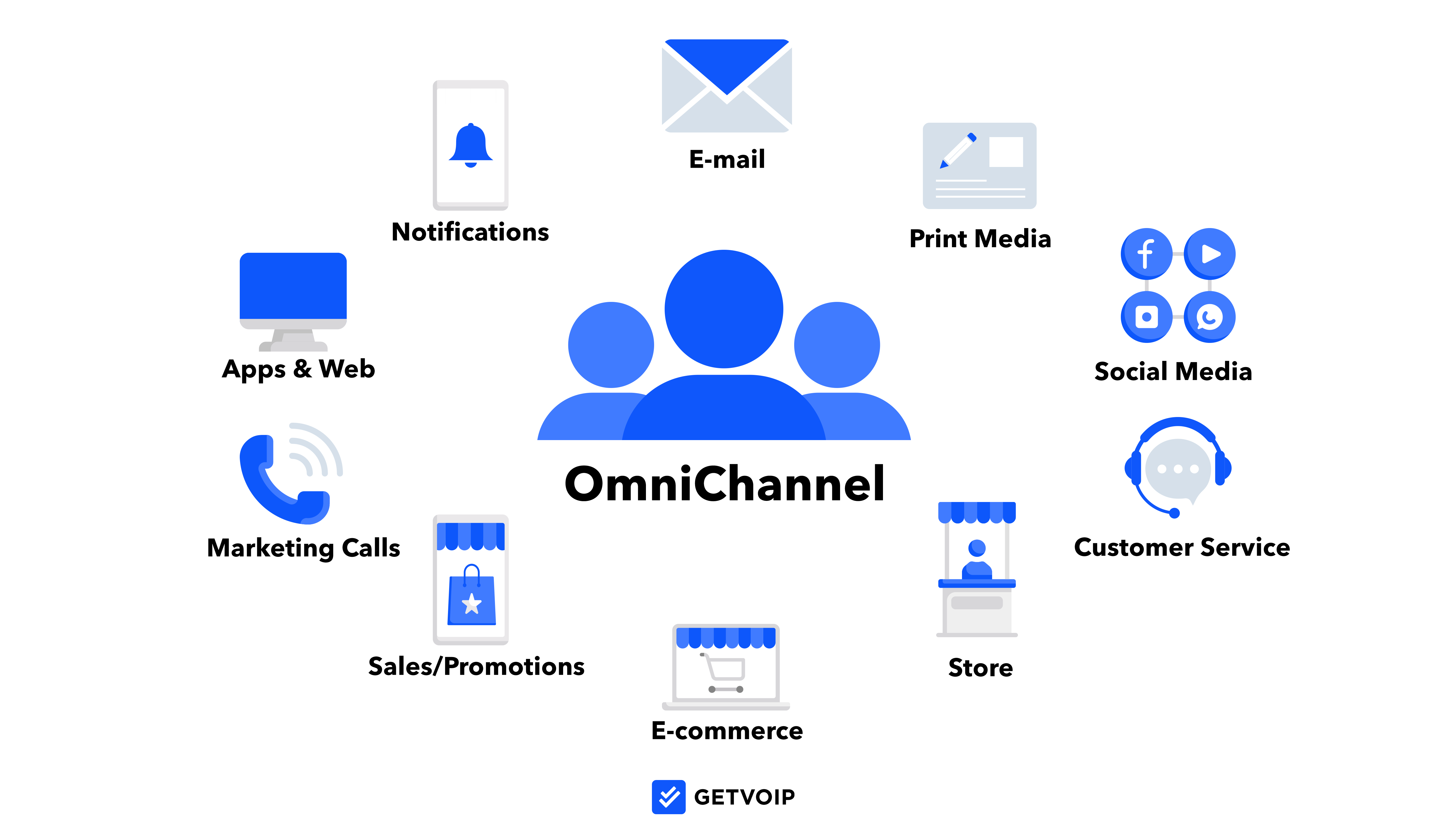
With Business VoIP and omnichannel platforms, users can communicate with customers across multiple channels, switch channels in the middle of a conversation, and access customer information and communication history at any time. This prevents customers from repeating themselves and speeds up resolution rates.
Integration Capabilities
One of the best things about business VoIP systems is that they are completely customizable and can be configured to work with the tools and apps that your company is already using and familiar with. Everything from videoconferencing to marketing apps to artificial intelligence can be integrated with your VoIP phone system.
Customer relationship managers (CRMs) such as Salesforce and Zendesk are probably the most popular VoIP integration. CRM integrations enable agents to view customer history and data in real time and update customer profiles automatically with call notes, tags, and more.
Productivity tools such as Asana and Google calendar can also integrate with VoIP systems in order to automate follow-ups, task creation, scheduling, and more.
Remote Work Support
Although remote work has stabilized since the Covid-19 pandemic high, it remains higher than pre-pandemic levels, with about 22%-23% of the U.S. workforce working at least partially remote in 2025.[*]
VoIP phone systems include many features to make remote work possible and to keep remote workers productive and on the same page with the rest of their team.
Mobile apps allow companies to adopt BYOD policies while employees can work from anywhere in the world, as long as they can access stable internet. Team collaboration tools such as video conferencing, team chat, and whiteboards enable team members to stay in sync even when operating out of different time zones.
Analytics and Reporting
The VoIP industry has seen big advancements in analytics and reporting in recent years thanks to artificial intellingence, machine learning, and natural language processing. The global analytics market is rapidly expanding and is expected to double from 96.6 billion in 2024 to 196.5 billion by 2033.[*]
Real-time analytics and reporting help companies to improve customer service, increase sales, reduce costs, and streamline operations. Here are some important reporting and analytics features to look for in a VoIP provider.
- Historical call logs
- Real-time performance tracking
- Real-time quality of service tracking
- Sentiment analysis
- Call monitoring tools for supervisors such as Whisper, Listen and Barge
- Customizable reporting templates
- Custom alerts and automated report downloading
Reduced Hardware Requirements
Hardware for traditional business phone systems is expensive. The expense includes a large initial investment for equipment as well as yearly costs for maintenance, repair and replacements that are needed. Switching to VoIP can save companies up to 75% or hardware and infrastructure costs.[*]
VoIP can be completely cloud-based with users accessing features via mobile app or softphone or can be combined with VoIP compatible hardware such as desk phones, headsets, and conference phones. VoIP hardware is similarly priced to traditional communication hardware, but often includes more capabilities, such as touchscreens and digital displays with caller ID.
VoIP Disadvantages
Now let's have a look at the disadvantages of VoIP systems:
- Requires Good Internet Connection
- Needs Continuous Power Supply
- Latency and Jitter
- Emergency Calling Limitations
Requires Good Internet Connection
The biggest disadvantage to virtual telephony is that it requires a high-quality VoIP router and a reliable Internet connection. At least 5-25 Mbps is recommended for VoIP calls as well as other features such as video conferencing. Fortunately, the cost of Internet service has been decreasing as broadband connection speeds increase. The initial setup costs for Internet service are also much lower than those of a landline-based PBX system.
Needs Continuous Power Supply
Because VoIP operates via the Internet, an uninterruptible, continuous power supply is required.
While landline phones, which run on copper wires, will remain stable during a power outage or emergency, VoIP phones will not. VoIP users have to choose between having their business completely disrupted until power is restored, or investing in an expensive, somewhat bulky backup power supply.
Latency and Jitter
VoIP works by sending small packets of data across the Internet and then reassembling those packets at their destination/recipient IP address.
Packet loss occurs when these data packets fail to reach their destination, resulting in dropped calls. Jitter occurs when packets do reach their destination, but arrive in the wrong order, resulting in unintelligible calls.
Jitter and packet loss are usually a result of network congestion. Quality of Service (QoS) features to protect packet streams carrying VoIP data.
Latency is a lag in time between when you speak and the person on the other end of the line hears what you say. Latency can usually be fixed by ensuring that devices have the latest updates installed and that the hardware being used (headsets, IP phones, etc.) is recommended and supported by the VoIP provider.
Emergency Calling Limitations
The 911 emergency system was created when landlines were the only option, and the system is built for traditional telephony systems.
Landline phone numbers are associated with a physical address and devices are not portable, so it is easy for emergency services to know the location of a person calling 911 from a landline, even if they are unable to communicate their location.
VoIP service conversely is designed to be mobile and portable, so the caller will not necessarily be located at their “billing address” at the time of an emergency call. When you add in the fact that VoIP is rendered inoperable in a power outage, connecting with services in an emergency becomes complicated. Even with cell phones, emergency services have had to use GPS to locate callers.
Many VoIP companies provide a service called Enhanced 911, or E911, which allows users to provide a physical address to emergency services for every VoIP number.
While this doesn’t solve the problems of multiple/incorrect locations or a loss of power, it’s better than nothing.
Next Generation 911 (NG911) is an IP-based emergency services plan currently being implemented in some parts of the U.S. and Canada. NG911 uses WiFi, bluetooth, and other geographic information systems to locate callers, allowing the public to send in information via voice, text, and video.
How To Minimize VoIP Disadvantages
Although VoIP does have a couple disadvantages compared to landline telephony, there are ways to mitigate them. Here's how to minimize the few VoIP disadvantages.
Solutions for Internet Dependency
VoIP relies on the internet and therefore it is best to have stable high speed internet available. Unstable internet can cause jitter, latency, and even dropped calls, however, there are some workarounds you can employ if you don't have a good internet connection.
If you have decent cellular reception, you can have VoIP calls forwarded to a mobile phone number to get around the internet requirement. You could also use a softphone or VoIP app, which most providers will include for free. If possible, you can also implement network redundancy with a secondary internet source.
Backup Power Options
Aside from stable internet, VoIP also requires a continuous and uninterrupted power supply. Power is needed not only on the user end, but on the provider end as well.
For the provider or manager of your VoIP service, you will want to ensure that their are plenty of failsafes in place such as multiple points of presence (POPs) with automatic failover so that if power is lost in one location, another server can take over and service is not lost.
Regular monitoring, testing, and training procedures should also be in place. On the user end you can take precautions such as installing a generator backup
Reduce Latency and Jitter
A stable internet connection is key for reducing and eliminating latency and jitter on VoIP calls. The easiest way to eliminate latency and jitter is to choose a reliable VoIP service with compliance certifications, data encryption, and multiple global POPs. Other ways to improve your internet connection include:
- Switching from Wi-fi to a wired ethernet connection
- Increasing bandwidth to at least 100 kbps per concurrent call
- Upgrade to a high quality router that is designed for VoIP calls
- Configure QoS settings to prioritize VoIP calls over competing network traffic
- Install a jitter buffer
- Regularly test your connection and internet speed
Who Should (And Shouldn't) Use VoIP?
If you’ve read this far and still aren’t convinced to make the switch, consider that copper wire telephony systems are already being dismantled and will soon become obsolete. There are still some alternatives to VoIP, however, with cellular being the most popular. Additionally, while most UCaaS, video, and messaging platforms do use VoIP, there are some that don't. Digital Enhanced Cordless Telecommunications (DECT) phones, are also an option.
Businesses That Benefit From VoIP
Almost every business will benefit from VoIP because of the cost savings and advanced features, but here are some industries that will do particularly well with VoIP:
- Healthcare industry: Many VoIP platforms are HIPAA/HITECH compliant and offer healthcare friendly tools such as automated appointment reminders and self-serve scheduling
- Customer service teams: Customer service teams can improve in efficiency and overall customer satisfaction with tools like screen pops, sentiment analysis, and call monitoring
- Sales teams: Sales teams can reach more potential customers and make more conversaions with tools like auto dialers, AI-powered lead qualification, gamification, and more
- Education sector: VoIP platforms are used by educators to keep track of grades, allow for students to securely submit assignments, and increase engagement between students with chat rooms and whiteboards
- Marketing teams: VoIP systems can be integrated with nearly any social media platform to combine social media posting with online engagement, social listening, etc.
- Creative teams: VoIP platforms are excellent for collaboration, enabling those in the arts to brainstorm with each other using avatars, whiteboards, drawing tools, file sharing, and more. Clients can be given access to view and approve first drafts
Businesses That Benefit From VoIP Alternatives
- Businesses in areas with unreliable internet: Cellular and DECT based communication does not rely on internet and so these alternatives are ideal for companies without stable internet
- Small scale offices and solopreneurs: If you are frequently away from your desk and heading to locations that may not have internet, DECT offers flexibility and seamless handover between bases to ensure you are always reachable
- Hospitality industry: For businesses that have a large property and employ staff that moves around a lot such as housekeeping, DECT offers extended range and mobility
FAQs
Below, we've answered some questions about VoIP advantages and disadvantages.