
Successful call center management improves the customer experience, boosts employee engagement, and streamlines everyday call center operations.
However, poor call center management causes increased agent turnover, lengthy customer wait times, and higher operating costs.
To be effective, call center managers must balance customer and agent expectations, identify the root causes of consistent problems, and develop creative strategies to optimize workflows. Call center managers must also choose the right technology to help them juggle all these responsibilities.
Use this guide to call center management best practices as your roadmap to success.
- Overview
- Call Center Roles
- Management Responsibilities
- Best Practices
- Dos and Don’ts
- Tools and Technology
- FAQs
What Is Call Center Management?
Call center management is the process of managing day-to-day call center operations, with responsibilities like agent training, performance management, forecasting and scheduling, workflow optimization, and monitoring call center analytics. Effective call center management improves the customer experience, increases agent engagement, lowers operating costs, and leverages the right technology to achieve business goals.
Developing a successful center management strategy is a collaborative effort between customers, agents, managers, supervisors, executives, and company directors.
Call Center Roles and Responsibilities
A well-operated call center has clearly defined roles with corresponding responsibilities and expectations.
The main roles within a call center are:
Call Center Manager
The call center manager is the lead operator (and often, the owner) of the call center. They are responsible for evaluating, defining, and meeting customer needs and expectations.
Call center managers must set agent and supervisor performance standards, explain how these standards will be met, and identify opportunities to increase customer satisfaction rates and sales revenue.
Common call center manager responsibilities include:
- Setting long and short-term call center sales and customer service goals and explaining how these goals are measured
- Creating and updating employee training materials
- Selecting call center and other business communication software (CRM platforms, team collaboration tools, workforce management apps, etc.)
- Hiring call center agents and supervisors
- Reviewing historical and real-time call center analytics and reporting
- Creating, monitoring, and updating call paths/call routing strategies
- Developing HR policies
Key call center manager skills include:
- Superior communication skills
- Ability to cater to multiple agent learning styles
- An understanding of business goals, customer base, and branding
- Task management and delegation
- Flexibility to adjust management strategies/business goals on the fly, according to customer and employee feedback
- Ability to interpret analytics and KPIs and make data-driven decisions
- Empathy and understanding to ensure customers and employees feel recognized and valued
More on call center management responsibilities are discussed in the section below.
Call Center Supervisor
Call center supervisors train, monitor, and assist call center agents with customer interactions.
They are responsible for implementing the strategies developed by the call center manager to ensure expectations are met. Supervisors are in near-constant communication with both agents and managers, and must be able to identify when adjustments to the management strategy need to be made.
Common call center supervisor responsibilities include:
- Employee training and onboarding
- Real-time call center/agent conversion monitoring and in-call coaching
- Administrative task management, including agent scheduling
- Alerting management to ineffective or outdated training materials or strategies
- Reviewing call recording and transcriptions to identify trends
- Evaluating individual agent performance
- Creating call center activity summaries and briefs to share with management
Key call center supervisor skills include:
- Technical understanding of call center software
- Workforce management and scheduling
- Ability to discern which information should be sent to upper management
- Soft skills (communication, active listening, problem-solving, etc.)
- Ability to provide detailed feedback to employees and managers
Call Center Agent
A call center agent is a representative that actually speaks to the caller with the goal of resolving each customer issue as soon as possible.
They are on the front lines, representing the business and carrying out the instructions of call center managers and supervisors.
Common call center agent responsibilities include:
- Providing live customer assistance or technical support
- Making outbound sales or marketing calls
- Confirming, canceling, or rescheduling appointments
- Taking orders or payments over the phone
- Providing order updates/shipping information
- Making account updates
- Collecting customer survey responses and managing customer complaints
- Discerning when to transfer calls or initiate the call center escalation matrix
Key customer service agent skills include:
- Communication, empathy, and problem-solving
- Strong knowledge of product/services
- Ability to prioritize calls and stay calm under pressure
- Conflict management and resolution
- Developing personal relationships with clients to increase sales and customer retention rates
- Organization
- Teamwork and team collaboration
Call Center Management Responsibilities
Call center managers oversee a variety of call center operations and departments. The most important components of call center management are:
Customer Experience
A call center manager’s most important job is to create a unified, intuitive, and positive customer experience. This starts with providing excellent customer service and support. Managers are responsible for optimizing agent-led support and automated customer self-service across voice and digital channels.
Managers use features like Interactive Voice Response (IVR), Intelligent Virtual Agents (IVA), knowledge base management, CRM call pops, and AI Agent Assist to simplify and speed up the support process.
Call monitoring, recording, and transcripts offer managers further insight into the customer experience, helping them identify gaps in agent training and the customer journey.
Hiring the Right Agents
According to recent research, skills-based recruiting culls bad hire rates by a whopping 400% in large enterprises and apparently, highly skilled customer service reps become 27.3 times less likely to ditch their jobs than lower-skilled hires.[*]
You have to scan and find candidates who showcase strong communication skills, problem-solving abilities, and emotional resilience. Genuine customer empathy is a must-have demonstrated skill during your interview process. Behavioral interview questions and role-play scenarios will immediately paint the picture for candidates who can thrive in high-pressure customer service environments.
A structured onboarding program sets new hires up for long-term success. Research shows that 69% of employees are likely to stay for at least 3 years with a company that has a great onboarding process.[*] Beyond basic training, comprehensive onboarding should include:
- Shadowing experienced agents during live calls
- Intentional but gradual increase in call complexity over the first crucial 60 days
- Regular check-ins with managers during the first 90 days
- Clear performance expectations and success metrics from day one
- Mentorship pairing with top-performing agents
Investing time in recruitment and onboarding reduces turnover, improves agent performance, and establishes quality standards from the start. Many management challenges stem from rushing the hiring process or providing inadequate onboarding (these are sticky problems that compound over time and end up costing your money.)
Agent Training and Performance Monitoring
Call center managers are responsible for onboarding and training new agents as well as ongoing performance management.
Managers create training materials, an internal knowledge base, call scripts, and more to improve soft and hard agent skills. Real-time call monitoring and call whisper lets managers guide agents through live customer conversations. Today’s software has more advanced call center coaching capabilities, like custom agent scoresheets with automated post-call scoring and training module assignments. Other platforms include utterance monitoring, agent talk: listen ratios, and AI-powered customer conversation simulators.
Employee engagement is another essential part of the performance monitoring process, given that 31% of call center agents quit because they don’t feel rewarded or recognized for their work.[*]
Features like performance gamification, employee rewards, recognition programs, and live wallboards all increase agent engagement. 78% of employees say gamification makes them more engaged at work[*]
Beyond gamification, there lies a need to foster and grow a true recognition and rewards program that lifts and celebrates all the different types of labor and achievement your staff does. Recent studies show that employees who receive robust and true recognition are 45% less likely to leave you high and dry within the next two years, moreover companies with strong recognition programs see 31% lower voluntary turnover.[*]
Here's some of the ways to show your team you see them:
- Monthly or quarterly performance-driven competitions with coveted prizes (think gift cards, extra PTO, better parking spaces, etc.)
- Public and proud shoutouts during team meetings for agents who destroy predicted targets or get exemplary positive customer feedback
- Tiered reward systems based on points for accomplishments to redeemed for various incentives (like those mentioned earlier)
- On-the-spot recognition or even bonuses for killer customer interactions (like viral public reviews or top marks)
- Career advancement opportunities and promotions for consistently high performers
- Anniversary or milestone celebrations that recognize tenure and loyalty
Employees who are recognized monthly or more report double the engagement and productivity compared to those recognized rarely if not ever.[*] Make recognition timely, personalized, and truly unique to furnish motivation across wide swaths of personality types and career stages. No agent is built the same, but they all want to get some love for the work they do for you.
Workforce Management
Managers must build call center workflows for everyday business processes, identify which tasks can be automated, and continually adjust workforce management strategies to optimize operations.
Common workforce management tasks include forecasting, agent scheduling, adherence monitoring, and PTO management.
Automation is also a part of workforce management. Call center managers are responsible for automating routine processes like pre and post-call work, data entry, support ticketing, performance scoring, agent scheduling, call flow paths, reporting, Quality Assurance, and more.
Business Software
Managers must research the technology and features required to meet business objectives, then choose the best call center software and corresponding hardware.
They may need additional tools like CRM systems, UCaaS platforms, omnichannel contact center solutions, and helpdesk apps. Managers must also evaluate each platform’s available third-party integrations, ensuring compatibility to prevent communication silos.
The manager is also responsible for training employees on how to use the software.
Analytics+Reporting
Call center managers must select the Key Performance Indicators (KPIs) to measure call center performance, set intervals for data collection, and review analytics to identify areas for improvement and trends in agent and customer behavior.
Managers continually monitor historical and live call center analytics, create custom reports, and set real-time KPI alerts for below-standard performance. They also create customer surveys and review feedback, often leveraging AI-powered speech and text analytics for deep insight into customer sentiment and intent.
Administrative Management and Compliance
Call center managers must stay on top of administrative responsibilities and ensure regulatory compliance across all operations.
Compliance is not some rinky-dink checkbox exercise anymore and the clear answer to avoiding all of these costly mistakes eating up your profits and eroding consumer trust is being strategic about it. TCPA class actions are surging 95% year-over-year and data breach costs are climbing up to damages up to $4.88 million on average.[*]
This includes maintaining accurate records, managing agent documentation (performance reviews, coaching logs, attendance records), and ensuring adherence to industry-specific regulations.
Depending on your industry, compliance requirements may include:
- Payment Card Industry Data Security Standard (PCI DSS) for handling credit card information. It is said only 36% of companies are in full compliance[*]
- Health Insurance Portability and Accountability Act (HIPAA) for healthcare-related calls, shocking studies show that up to 70% of businesses aren't HIPAA-compliant yet and 70% of customers aren’t even aware of changes to the rules that could affect them[*]
- Telephone Consumer Protection Act (TCPA) for outbound calling practices. The kicker is that violations can cost up to $1,500 per call[*]
- General Data Protection Regulation (GDPR) or other regional and unique privacy laws for customer data handling
- Call recording consent and data retention policies (these vary from region to region and can lead to big fines too!)
Managers should conduct regular compliance audits, provide ongoing compliance training to agents, and stay updated on regulatory changes that affect call center operations. Administrative systems and processes should be documented, standardized, and regularly reviewed to maintain operational efficiency and minimize risk.
Call Center Management Best Practices
The most effective call center management best practices are:
- Review and Update Employee Training Materials
- Optimize Workforce Management
- Leverage Automation and AI
- Focus on Agent Engagement
- Anticipate Common Call Center Problems
- Monitor Essential Call Center Metrics
- Collect Customer Feedback
- Integrate Third-Party Tools
- Re-evaluate Your Call Center Software
Review and Update Employee Training Materials
Consistently review employee training materials to ensure they’re up-to-date, and in line with customer expectations. Materials should be consistent across communication channels, applications, and internal knowledge bases.
Keep expectations and objectives clear and ensure agents understand how success is measured. Make training an ongoing process, not a one-time event.
Effective employee training, onboarding, and performance monitoring strategies include:
- Agent shadowing and peer learning
- Anonymous employee surveys
- Routine training and continuing education webinars
- Call recording, call monitoring, call whisper, and real-time in-call coaching
- Training materials from software providers (custom onboarding, on-demand/scheduled training webinars, user tutorials, etc.)
- Agent performance scoring and evaluations
- Updating internal documentation/training materials like agent call scripts, what-if scenarios, product/service guides, pricing, internal wikis, the agent onboarding process, escalation matrix strategies, etc.
Optimize Workforce Management
Workforce Management (WFM) and Workforce Optimization (WFO) tools optimize all available agents and streamline the agent scheduling process.
Look for features like:
- Multiple forecasting algorithms
- Predictive analytics and trend forecasting
- Suggested agent schedules based on historical analytics and custom scenarios
- Automated agent scheduling with real-time adherence monitoring
- Live schedule adjustments (manual and automated)
- Agent-facing apps with shift bidding/swapping and automated PTO management
Leverage Automation and AI
Leveraging automation and AI call center software features prevents agent burnout, streamlines the customer journey, provides 24/7 customer self-service, and speeds up sales and customer service resolution processes.
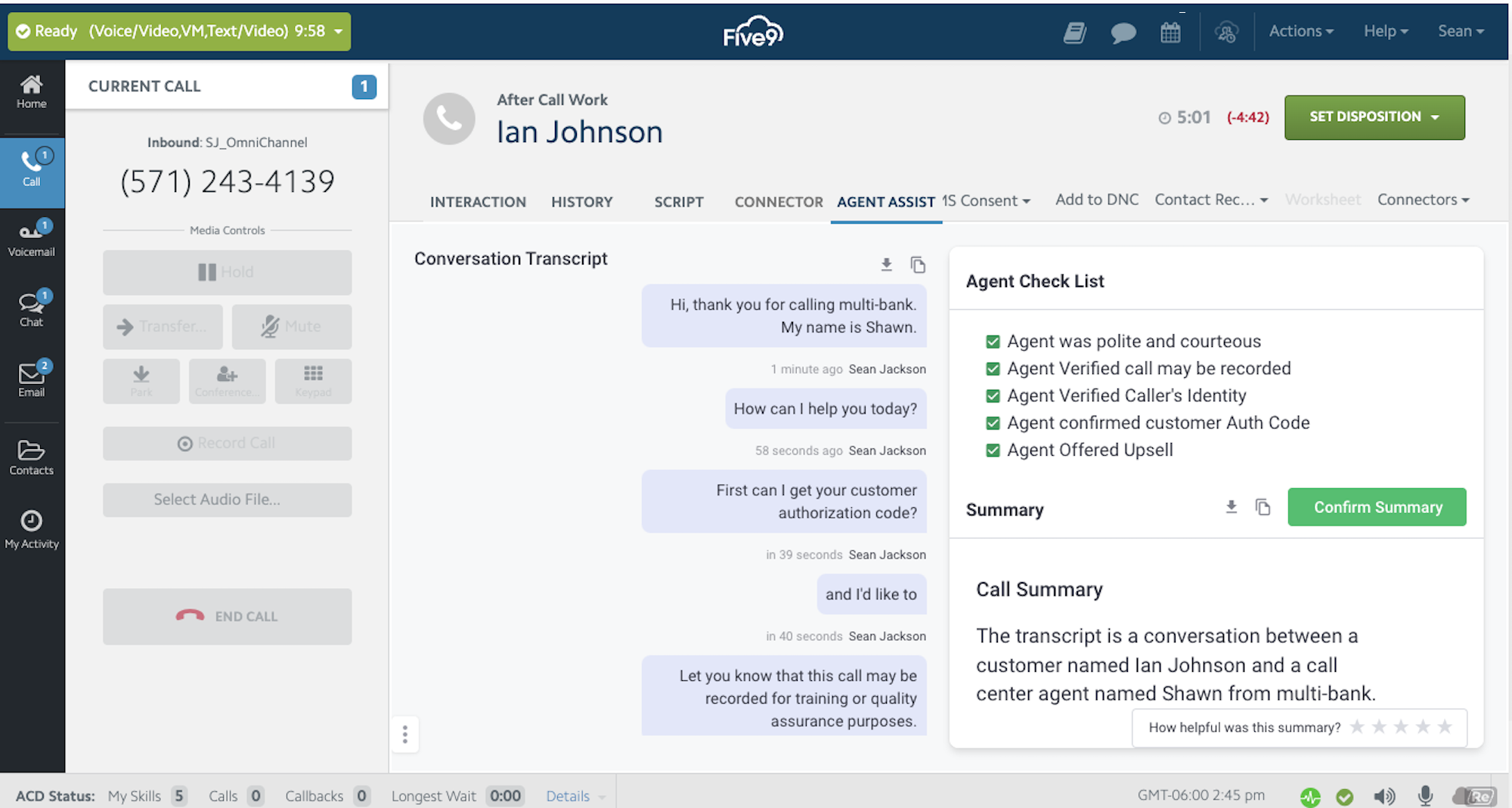
Essential call center business process automation and AI-powered features include:
- Interactive Voice Response (IVR): Uses pre-recorded call menu prompts to automatically guide callers through pre-configured and customizable call flow paths, connects customers to the best available agent based on their responses
- Call Routing: Automatically routes callers to the best agent or ring group according to preset rules. Strategies include business hour routing, round robin routing, most idle routing, relationship-based routing, etc.
- Automated Customer Callbacks: Instead of waiting on hold for an available agent, automated callbacks let customers schedule a time to receive a call back from a live agent
- Agent Assist: Integrates with your internal knowledge base to provide in-conversation next-best-action suggestions to agents
- Post-Call Summary: Automatically creates a summary of each call with suggested tasks, conversation highlights, and notes
- CRM Call Pops: Integrates with your CRM system to automatically display the caller’s CRM data on an agent’s screen
- Auto Dialer: Leverage power preview, progressive, or predictive outbound auto dialers with lead list management to improve the success of marketing campaigns and cold calls
Focus on Agent Engagement
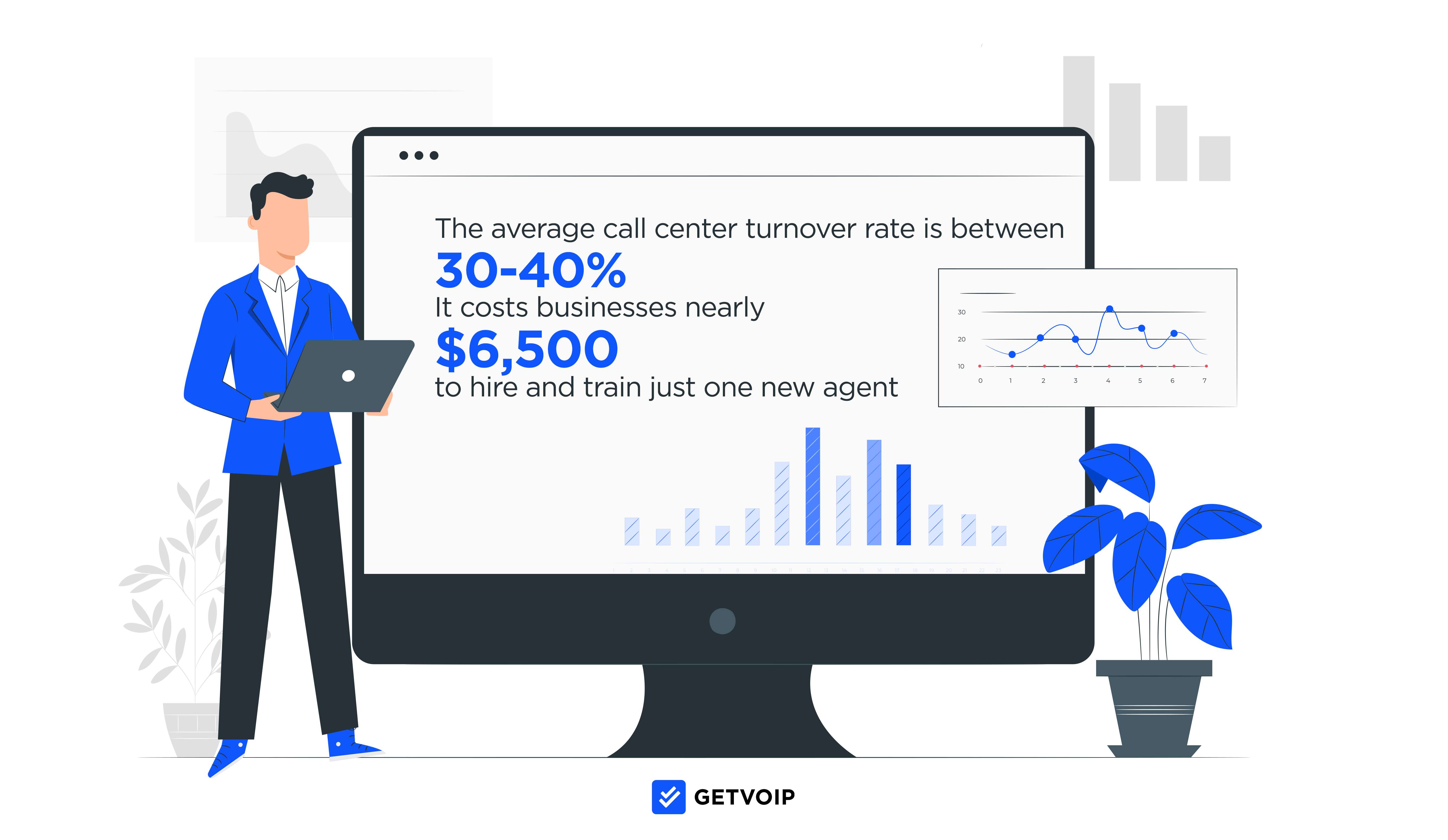
The average call center agent turnover rate is between 30-40%[*].
To combat this, make agent engagement a central part of your call center management strategy. Leverage performance gamification, real-time wallboards, and personalized agent coaching to increase agent retention–and improve performance in the process.
Team collaboration is another effective way to increase agent engagement.
Collaboration tools like video conferencing, team chat messaging, task management tools, and file co-editing ensure everyone is on the same page and foster a sense of community between agents/ Frequent team meetings reduce agent absenteeism, provide opportunities for employee recognition, and help boost team productivity. They also unite remote teams or agents from different time zones.
We also need to consider motivations beyond just chucking technology-driven engagement tools at your staff. Here's some ways to implement more holistic and human-centered foundation for your team to iron out relationships and keep morale from plummeting:
- Monthly brainstorming group talks where agents pitch their ideas for process improvement and keeping gunk out of the workflow
- Team social events like virtual coffee breaks, potluck lunches, or after-work hangouts
- Quarterly offsite team outings to unwind and break away from routine and celebrate what your team is doing right
- Cross-training opportunities to foster new agentic skills and remove silos between different departments
- Peer recognition programs where agents nominate colleagues tangible rewards and recognitions
- Wellness initiatives like stress management workshops or mindfulness meditation group talks
These activities create a sense of shared values, eradicate feelings of isolation (which still haunts remote teams to this day), and give agents real shots to connect beyond their daily workday.
Delegate Responsibilities and Learn to Trust Your Team with More
Effective call center managers think handling everything themselves is archaic and a foolish endeavor. Delegation is a healthy and natural part of the leadership cycle because it boosts productivity, elevates future leadership, and pushes agents to take true and total ownership of their work and environments
According to top research, engaged and satisfied call center agents are 3 times more likely to feel "extremely empowered" to tackle and crunch down customer problems to make everyone's day stronger.[*] Start by identifying tasks and responsibilities that can be spread around and across your team:
- Assign senior agents as team leads or mentors for new hires
- Delegate quality assurance review responsibilities on a rotating basis
- Enable and equip agents to resolve customer issues within defined parameters without requiring supervisor approval
- Create specialist roles (product experts, training coordinators, customer feedback analysts) based on agent strengths
- Involve team members in scheduling decisions and workflow planning
Delegation does demand you create clear frameworks that properly layout decision-making authority, escalation paths, and accountability measures to assuage your team you're not leaving them in a hole when things go sideways. Agents must understand their boundaries and have autonomy to further develop problem solving skills, find their true "inner boss", and require no need for micromanagement.
Invest in some regular one-on-one meetings to discuss delegated responsibilities, offer up your finest coaching, and tweak the workloads as needed. This approach not only cuts down the brutal fat of your management load but also supercharges your team from zeros to heroes.
Anticipate Common Call Center Problems
The best way to avoid common call center problems is to proactively prepare for them.
Routinely check for call quality issues like:
- Jitter/Latency: Run speed tests and check for adequate bandwidth
- Dropped Phone Calls/Choppy Audio: Run SaaS updates, review QoS settings
- Echoing: Ensure hardware is compatible and up-to-date, especially if team members are using personal devices and smartphones
Monitor Essential Call Center Metrics
The most important call center KPIs to monitor are:
First Call Resolution Rate (FCR)
FCR measures the percentage of customer calls completely resolved during the first interaction between a customer and a live agent and/or a customer and an IVR system (no follow-ups required.)
Industry Standard: 70-75%
Formula: FCR=(Total Resolved Cases ÷ Total Number of Cases) x 100
Net Promoter Score (NPS)
NPS measures the answer to one question: “How likely are you to recommend our services/products/business to someone you know?” Users respond with a ranking from 0 (least likely to recommend) to 10 (most likely to recommend.) Each number response is scored as a Promoter (9-10), Passive”(7-8) or Detractor (1-6).
Industry Standard: 20% and up
Formula: NPS=% of Promoters – % of Detractors
Customer Satisfaction Rate (CSAT)
CSAT measures the answer to the question, “On a scale of 1 (lowest) to 5 (highest) how satisfied are you with the service you received today?”
Industry Standard: 15%=average, 25%=good
Formula: CSAT=(# of Positive Scores ➗ # of Total Scores) x 100
Call Abandonment Rate
Call Abandonment Rate measures the percentage of incoming customer calls that are ended before a conversation begins (before a caller interacts with IVR or an agent.)
Industry Standard: 5-8% (Anything over 10% is cause for concern)
Formula: CAR=(# of Abandoned Calls➗Total Inbound Calls) x 100
Cost Per Call (CPC)
CPC measures the average cost of each call, indicating overall agent efficiency, productivity, and operational costs.
Industry Standard: Varies based on average revenue and products/services offered
Formula: CPC = Total Calls per Month or Year ÷ (Operating costs + Average Agent Salary)
Collect Customer Feedback
Though call center analytics provide hard data about agent performance and activity, they can’t tell the whole story.
To better understand customer journey roadblocks, customer satisfaction levels, and to identify areas for improvement, automate post-call voice or email customer surveys. You can also embed customer surveys on your website, or share them via email or social media.
Include a combination of yes/no, multiple choice, rankings-based (scale of 1-10), and open-ended survey questions.
AI analytics tools can create word clouds of common survey response topics, evaluate customer sentiment and satisfaction level, provide real-time survey responses, and create filterable survey result reports.
Common causes for low customer satisfaction include:
- Lack of follow-up and/or personalized customer service
- Lengthy IVR menus or automated-only customer support with no option to reach a live agent
- Having to repeat their issue to multiple agents/connecting to an unqualified agent
- Lack of customer self-service options (IVR/IVAs, chatbots, online knowledge base, etc.)
- Long hold times/inability to schedule an automated customer callback
Integrate Third-Party Tools
Switching between multiple business applications throughout the workday–and especially while on a live call–is frustrating to agents and customers. Save time and eliminate app switching by integrating your preferred third-party software into your call center platform.
Integration gives agents access to advanced features like real-time CRM CTI screen pops, automated outbound call center dialers, team chat messaging, on-demand web conferencing, and much more without having to disconnect a caller or put them on hold.
Also use APIs, which allow developers to create custom applications and functionalities to meet your call center’s unique needs.
Integrations and APIs increase first call resolution rates, lower call handle times, and provide a seamless, efficient support experience.
Re-evaluate Your Call Center Software
In addition to putting the above steps into practice, maintain effective call center management by routinely re-evaluating your call center software.
Key features to look for in a call center platform include:
- Scalable pricing with tiered plans and add-ons
- Real-time and historical analytics with pre-made and customizable reports
- CRM software integration
- Interactive Voice Response (IVR) and Automatic Call Distributor (ACD)
- Multiple call routing options (skills-based, time-based, round-robin, list-based, etc.)
- Automation and AI
- Team collaboration tools and web conferencing
- Call queuing and automated callbacks
- Call monitoring and quality monitoring (quality assurance)
- Outbound auto dialer modes (progressive, predictive, power, etc.)
- Workforce Optimization and Management
- Agent scripting and internal wikis
Especially for businesses in a growth phase or teams with difficulty managing a high daily call volume (a sudden increase in the daily number of calls) scalable omnichannel contact center software may be a better solution than a standard VoIP phone system.
How to Effectively Manage A Call Center: Dos and Don’ts
The below table outlines the top do’s and don’ts of effective call center management.
| The Problem | What To Do | What Not To Do |
| Poor Agent Scheduling and Employee Absenteeism | - Use workforce optimization tools like suggested agent scheduling
- Use forecasting tools to predict busy seasons - Create detailed internal wikis so agents from other departments can provide basic assistance during peak call times - Implement intelligent and skills-based routing |
- Fail to plan for peak call times in advance
- Overlook agent burnout - Fail to clearly state employee expectations and PTO/scheduling policies - Over-rely on temporary workers that don’t have in-depth product/service knowledge |
| Unmanageable Call Volumes | - Hire geographical diverse agents across time zones
- Provide estimated wait times - Purchase additional business phone numbers - Use workflow automation tools like IVR and ring groups
|
- Encourage customers to leave voicemail messages or send an email and wait for a response
- Hire additional agents (even if it’s not in your budget) - Place callers on long holds until an agent is available |
| Long Customer Wait Times | - Consider adding digital communication channels (website chat, social media messaging, SMS)
- Enable automated customer callbacks - Review and update current call routing and call path strategies - Review real-time call queue analytics to identify peak call times |
- Encourage support agents to rush through calls
- Over-rely on automated customer self-service with IVR/IVAs - Overlook forwarding calls to additional ring groups or remote agent devices like smartphones |
| Poor Call Quality | - Enable Quality of Service monitoring
- Invest in new hardware, especially if the provider offers native VoIP phones - Choose providers with features like background noise suppression |
- Inadvertently use incompatible or outdated hardware
- Forget to routinely update software and perform hardware maintenance - Run speed tests and check available bandwidth |
| Low Customer Satisfaction | - Send out customer surveys with coupon codes/discounts as incentives
- Review agent soft skills like empathy and active listening - Use automated Agent Assist to ensure agents provide fast and accurate customer service - Monitor CSAT and NPS scores |
- Blame customers and agents
- Ignore the issue - Fail to recognize agents for quality work - Encourage agents to push back against criticism |
Tools For Effective Call Center Management
The right technology streamlines the call center management process and gives agents the tools they need to succeed.
VoIP business phone systems (voice calling only) and cloud contact centers (voice and digital channels) are the most common types of call center software. Additional tools like CRM systems, outbound dialers, helpdesk platforms, and marketing tools further optimize your tech stack.
Top call and contact center software providers include RingCentral, NICE CXone, Nextiva, Genesys, and Five9. Our call center provider page compares each platform and helps you find the best option for your team.
FAQs
Below, we’ve answered popular call center management FAQs.