
Summary: Dialpad is a business communications provider promising AI innovations at competitive prices aimed at tech-savvy teams and growing businesses. Nextiva is a strong fit for organizations prioritizing scale, customer support, comprehensive analytics, built-in CRM capabilities, and overall reliability.
Dialpad and Nextiva are both established unified communications platforms with cloud-based business phone systems, video conferencing, and team collaboration features.
Dialpad boasts industry-leading AI-driven features like real-time transcription, sentiment analysis, and voice intelligence. For those wanting the cutting edge latest, Dialpad is the one to choose.
Nextiva positions itself as a premium unified communications platform with top-notch customer service, rich analytics, and enterprise-grade features at no extra cost. Nextiva also features AI but chooses to be centered around fundamentals more.
Which of these two business VoIP providers will work best for your business? Our full Dialpad vs Nextiva comparison will touch on pricing, plans, available features, user experience, and more.
Table of Contents
Dialpad vs Nextiva: At a Glance
Dialpad offers cutting-edge AI features and a more modern user experience at competitive price points. It is targeted more towards tech-forward companies looking for the latest innovations in business communications.
Nextiva is a strong pick for businesses looking for a rounded, feature-rich platform with exceptional customer support and proven scalability.
We've created this summary table for both providers to give you a general comparison.
| Dialpad | Nextiva | |
| Pricing | 3 Paid Plans for $15-$35/month, Enterprise plans available via quote | 3 Paid Plans for $15-$75/month |
| Video Conferencing | All plans, up to 150 participants | All plans, up to 250 participants |
| Uptime | 99.999% SLA | 99.999% SLA |
| Support | 24/7 chat and email support | 24/7 phone, chat, and email support |
| Security | TLS, SRTP, AES-256 encryption, SSO | TLS, SRTP, AES-256 encryption, SSO, HIPAA compliant |
| Compatible Hardware | Yealink, Poly, Cisco | Yealink, Poly, Cisco, Grandstream, Panasonic |
| Best For | Tech-forward teams wanting AI-powered features and modern UX | Businesses prioritizing customer support, CRM integration, and comprehensive analytics |
How We Compared Dialpad vs Nextiva
We used the following criteria to evaluate which places each platform excelled:
- Calling Features: We determined which provider offers the most robust set of voice call management features like call transfer, call forwarding, and call recording
- Auto-Attendant: We tested auto attendants and IVR systems from both providers to see which was more intuitive and provided customers a higher level of self-service
- Analytics: We looked at the analytics capabilities of each platform to see which solution had superior real-time and historical reporting, customizable and pre-made templates, and which KPIs are monitored
- Integrations: We compared available third-party integrations for the two solutions to see which app gallery had a wider selection and a more active developer community
- Scalability: We evaluated the costs and available plans from each provider to see which one can better evolve with your business needs
- Call Quality: We looked at Service Level Agreements (SLAs) and current user reviews to determine which provider offers the best call quality and network reliability
- Security: We analyzed the security of both providers, examining available protocol and feature standpoint to see which provider offers greater data protection, access controls, and third-party security certifications
- Hardware: We reviewed the catalogs of both providers to see which offered more variety in terms of analog desk phones, speakers, headsets, and other VoIP hardware and equipment
- Cross-Platform Compatibility: We downloaded and tested the two platforms' respective mobile apps to see which one offered a better, more complete experience on smartphones and other mobile devices
- Ease of Use: We looked at the account creation, installation, and intuitiveness of both providers to see which platform was easier to use
- Customer Support: We evaluated available support channels and hours, resolution times, and overall user satisfaction with the ticketing process
- Pricing: We compared plans from both providers, evaluating cost, overall value, and available bundles/packages
Dialpad vs Nextiva: Direct Comparison
We looked at each platform’s performance against these different major functionalities to help you choose the best provider:
Calling Features
Summary: Both Dialpad and Nextiva have great calling features for different use cases. Dialpad's AI-driven suite offers world-class transcription and sentiment analysis, while Nextiva has superior voicemail transcription accuracy and call pop functionality.
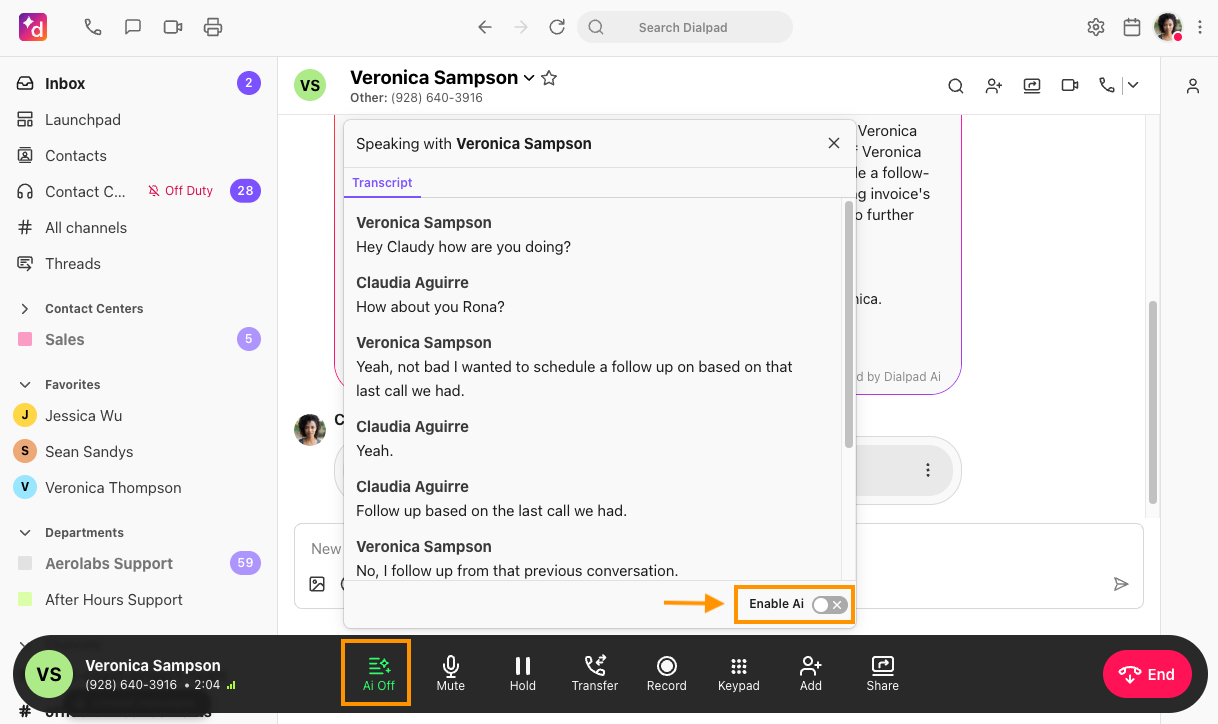
Dialpad is generous with calling features offering unlimited calling, call recording, visual voicemail, call forwarding, and video meetings on all paid plans. But the main differentiator here is Dialpad AI which unlocks real-time transcription during calls, post-call summaries, sentiment analysis, and automated action item detection.
Dialpad AI points out key moments conversations, tracks competitor mentions, and does live coaching recommendations to agents. Teams that want to leverage conversation intelligence without paying for third-party tools may like Dialpad better.
Nextiva does the fundamentals very well. It provides unlimited calling, call recording, call forwarding, call flip, multi-level auto attendant, voicemail-to-text, and video conferencing on all plans. The platform includes team chat, SMS/MMS messaging, and screen sharing capabilities built into every tier. Nextiva's call pop feature displays customer information from your CRM when they call, providing instant context for your team.
Nextiva's voicemail transcription uses advanced speech recognition technology for high accuracy. Other features like call queues, ring groups, and call monitoring that are essential for sales and support teams are included at all tiers.
Winner: It's a draw. Dialpad has innovative AI-powered voice intelligence features for proactive agent assistance, but Nextiva offers more traditional enterprise features at no charge.
Auto-Attendant
Summary: Both providers offer multi-level auto attendants, but Nextiva's system has more custom options with advanced scheduling and a visual and user-friendly configuration interface.
Nextiva includes an auto-attendant system across all pricing tiers. The setup wizard will create custom greetings, menu options, and call routing rules for you. You can even configure different routing behaviors based on business hours, set up holiday schedules, and create department-specific menus.
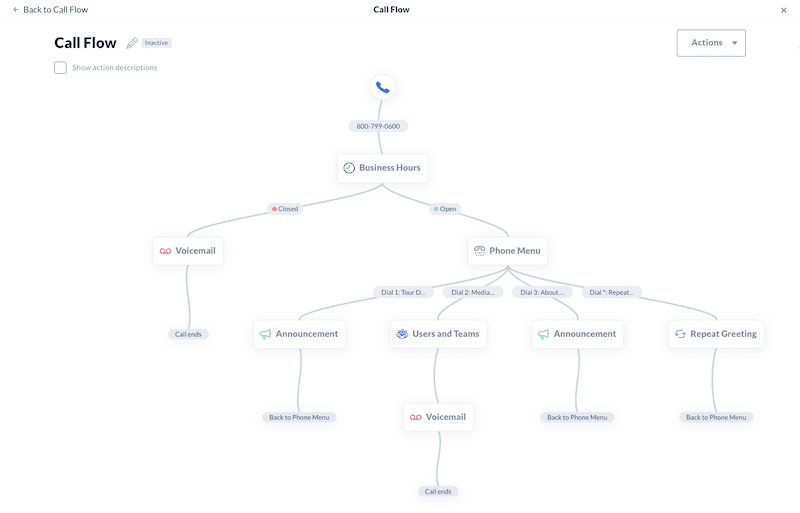
But its true killer feature is the interface built on easy drag-and-drop configuration. Nextiva also offers professional voice talent recording services if you prefer a professional greeting over your own recordings.
Dialpad provides multi-level IVR capabilities on all paid plans with options to create custom greetings and route calls based on time of day. Configuration happens through the web portal and is relatively straightforward. However, the interface is less visual than Nextiva's drag-and-drop system, requiring more manual looking through settings menus. For basic call routing, it works well. That said, complex multi-department setups are easier to manage in Nextiva.
Winner: Nextiva wins thanks to its more intuitive interface, visual workflow builder, and advanced scheduling capabilities.
Analytics
Summary: Nextiva has a more traditional take on analytics with over metrics and real-time dashboards. Dialpad provides innovative AI-powered conversation analytics that surface insights from actual call content.
Nextiva's analytics is one of the standout features. There are over 40 pre-built reports covering call volume, average handle time, first call resolution, abandoned call rates, and agent performance metrics. Your managers get real-time dashboards to monitor queue status, active calls, and service levels throughout the day. Nextiva even does conversation analytics using its AI to analyze sentiment, identify keywords, and pick up coaching opportunities.
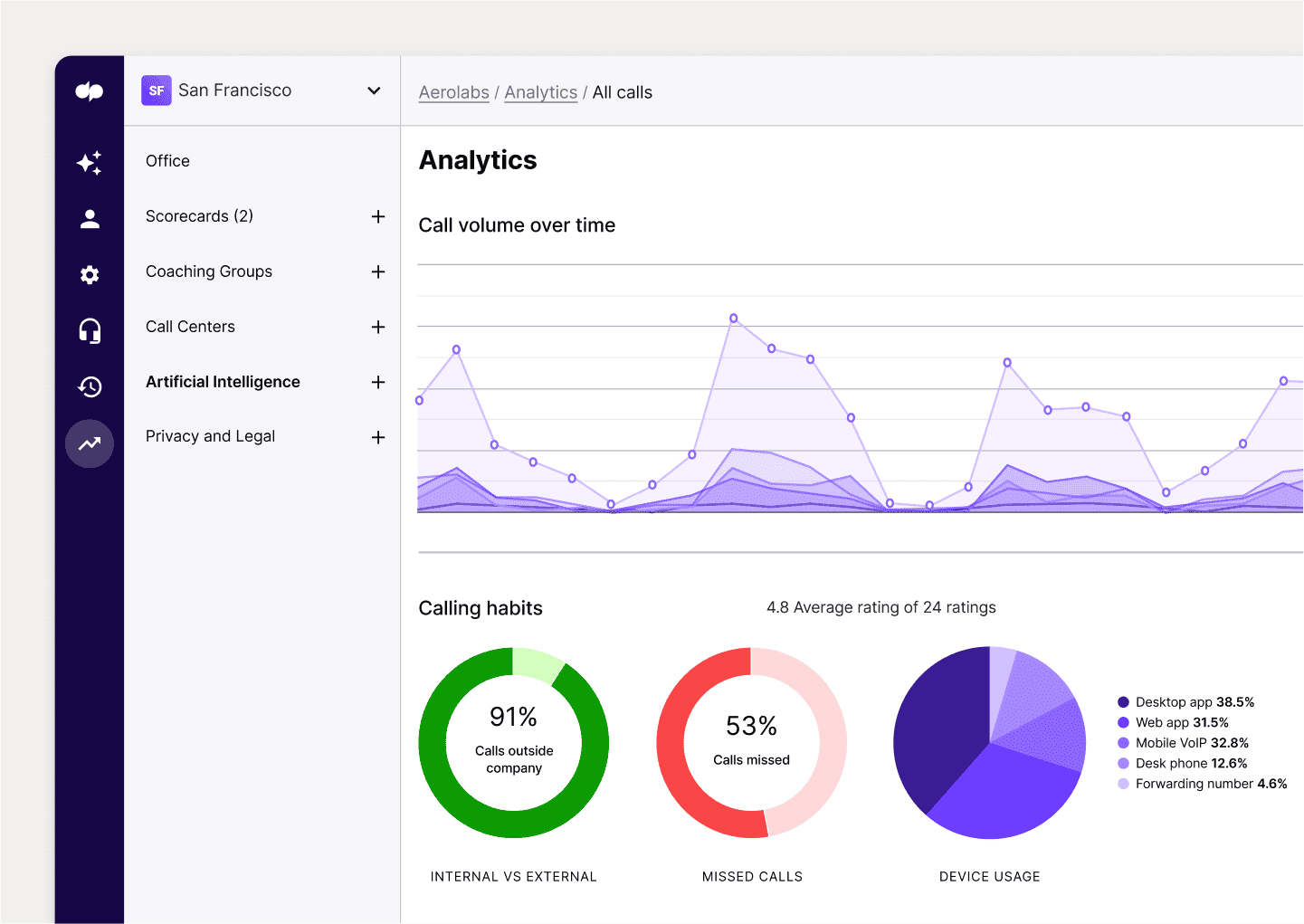
Dialpad has a more AI-native analytics approach. Its AI automatically analyzes every call to track talk time, competitor mentions, and custom keywords. The platform creates conversation insights to spot check for coaching opportunities, trace deal progress, and see customer satisfaction without manual reviews.
Dialpad has fewer traditional call center metrics than Nextiva, but it excels at deriving actionable insights from conversation content. For sales and support teams, this intelligence might mean more than standard call statistics.
Winner: It's a draw. Nextiva wins for those seeking traditional analytics breadth, but Dialpad offers more innovative conversation intelligence.
Scalability
Summary: Both platforms scale well, but Nextiva offers better support infrastructure for larger organizations who look for dedicated account management and more enterprise-grade features.
Dialpad scales from startups to mid-market companies and even supports enterprise customers. The platform makes it easy to add users and phone numbers through an intuitive administrative interface. It’s worth noting that Dialpad's enterprise support infrastructure is less mature than Nextiva's, with fewer dedicated account management options and not much emphasis on white-glove service.
In terms of scalability, Nextiva becomes cost-effective as your team grows. Nextiva does volume discounts for larger organizations and is generous with its features at every tier, meaning you're not tacking on costly add-ons scaling upwards. Nextiva's platform is built to support businesses from 1 to thousands of users. Its admin portal makes it a snap to add users, assign phone numbers, and manage permissions as your team fluctuates.
Winner: Nextiva is much more scalable with better pricing at scale, dedicated account management, and a proven track record with large enterprises.
Call Quality
Summary: Both providers deliver excellent HD call quality with 99.999% uptime guarantees and adaptive audio processing. They are virtually indistinguishable on paper.
User reviews for both platforms love both platform's call quality, with not many reports of dropped calls or audio issues. In real-world usage, both providers deliver professional-grade voice quality that exceeds traditional phone systems.
Dialpad provides excellent HD voice quality with support for the Opus codec, offering a mix of stellar audio quality and bandwidth efficiency. The platform also employs intelligent audio processing to adapt to network conditions and maintain call clarity. Both Dialpad and Nextiva provide the carrier grade 99.999% uptime SLA, meaning less than 5 minutes of downtime per year.
Nextiva's network was crafted for clear voice quality with minimal latency. The platform employs adaptive jitter buffering to smoothen out network inconsistencies and uses packet loss concealment to bolster call quality even when network conditions are messy. Users say they report clear, reliable calls with no noticeable degradation.
Winner: It's a tie as both providers offer excellent call quality and identical uptime guarantees.
Security
Summary: Both platforms provide strong security features, but Nextiva offers HIPAA compliance and more certifications, making it better for any regulated industries.
Dialpad provides TLS and SRTP encryption to secure calls and traffic, plus AES-256 encryption for stored data. The platform offers SSO, role-based permissions, and standard security features. Dialpad maintains SOC 2 Type II compliance as well. However, Dialpad is not HIPAA compliant, which limits its suitability for healthcare organizations. For most general business use cases, Dialpad's security is great, but organizations in regulated industries will find Nextiva's security posture superior.
Nextiva takes security seriously matching Dialpad's TLS encryption, SRTP, and AES-256 encryption. However, the platform is HIPAA compliant, making it suitable for healthcare organizations safeguarding patient information. Nextiva offers single sign-on (SSO) integration, maintains SOC 2 Type II certification and undergoes regular third-party security audits. Nextiva's data centers are even geographically distributed with redundancies.
Winner: Nextiva wins with HIPAA compliance, a wider range of certifications, and far better security features.
Hardware
Summary: Nextiva offers a wider selection of compatible hardware with rental options, Dialpad supports major brands but has a smaller catalog and a mobile-first philosophy.
Dialpad supports desk phones from Yealink, Poly, and Cisco. The selection is more limited than Nextiva's offering, and phones must be purchased outright. However, Dialpad's platform is designed with a mobile-first, softphone-first philosophy, so many users rely on the desktop and mobile apps rather than physical desk phones.
Nextiva is compatible with desk phones from Yealink, Poly, Cisco, Grandstream, and Panasonic. Nextiva does phone rental programs on top of selling them, giving businesses a way to help offset upfront costs. The rental option is particularly valuable for growing businesses that want to spread costs over time.
Nextiva throws in plug-and-play provisioning, meaning phones arrive pre-configured and ready to use. Its support team can also recommend specific models based on your business needs and use cases.
Winner: Nextiva takes the win with a wider hardware selection and flexible rental options that reduce upfront investment.
Cross-Platform Compatibility
Summary: Both providers offer great mobile apps, but Dialpad has the edge with a sleeker design and AI features on mobile.
Dialpad's mobile app receives stronger ratings on both the App Store (4.6 stars) and Google Play Store (4.5 stars). The app provides full access to your business phone system and the interface is well-designed and intuitive with easy-to-access controls. The killer feature is that Dialpad's AI features work on mobile as well as they do on desktop. This provides real-time transcription and post-call summaries even when you're away from your desk. This makes Dialpad particularly great for mobile or remote workers who want AI assistance on the fly.
Nextiva's mobile app also receives high marks across the App Store (4.1 stars) and Google Play Store (4.1 stars). The app is on par with the desktop business phone system with a user interface that is clean and intuitive. But it lacks the breadth of Dialpad’s AI suite and features, providing something more straightforward and no-frills.
Winner: Dialpad wins with a slightly more modern interface and AI features that work seamlessly on mobile.
Ease of Use
Summary: Dialpad offers a cleaner and more intuitive interface people pick up quickly. Nextiva provides stronger onboarding support but can feel more cluttered.
Dialpad is designed with a friendly and easy interface that feels familiar to users who have used other consumer communication apps. The setup process is straightforward with a slant to get users productive quickly. The platform's AI features work automatically in the background without any configuration or training. Most users just start making calls, hosting meetings, and using core features within minutes of account creation. The interface has intuitive iconography and a tinier learning curve.
Nextiva provides a guided onboarding experience with setup wizards and dedicated support. The admin portal is well-organized with intuitive navigation, though there are more options and settings to learn due to the platform's extensive capabilities. Most businesses report being fully operational within hours, but mastering all features takes longer. The interface maintains consistent design across platforms. Nextiva provides extensive documentation and video tutorials for self-service support.
Winner: Dialpad wins with a more intuitive, modern interface that gets users immediately up and running in moments.
Customer Service
Summary: Nextiva is renowned for exceptional 24/7 phone support and dedicated account management, while Dialpad offers solid support primarily through chat and email.
| Dialpad Support Channels | Nextiva Support Channels | |
| Live Chat | Yes (24/7) | Yes (24/7) |
| Yes (24/7) | Yes (24/7) | |
| Phone | Yes (business hours, Pro and higher) | Yes (24/7) |
| Knowledge Base | Yes | Yes |
Nextiva has built its reputation on the fact its support team is available at all times via phone, chat, and email. This is all with industry-leading response times. There's a good reason why its customer satisfaction ratings consistently place it squarely at around the top of VoIP providers for support quality.
Dialpad offers 24/7 chat and email support for all paid plans, with phone support available during business hours for Pro and Enterprise plans. The support team knows the product very well, but be aware response times can vary during peak periods. The knowledge base provides good documentation on setup and features.
Winner: Nextiva wins decisively with superior support quality, faster response times, and higher customer satisfaction ratings.
Dialpad vs Nextiva: Pricing and Plans
Dialpad offers three pricing plans ranging from $15 to $25 monthly per user when billed annually. Enterprise plans are available via quote. Month-to-month pricing is also available at higher rates. All paid plans include unlimited calling, video meetings, and basic AI features. Higher tiers add advanced analytics and integrations. Add-ons include additional AI capabilities and contact center features.
For more information, see our Dialpad pricing guide.
Nextiva provides three pricing tiers from $15 to $75 monthly per user with annual billing. Month-to-month pricing is also available from $23 to $75 monthly, per user. Add-ons include additional call recording storage, advanced call center features, and conversation intelligence tools for sales teams.
For more information, see our Nextiva pricing guide.
Pros and Cons of Dialpad and Nextiva
Here are some of the things that users liked and disliked about Dialpad and Nextiva.
Dialpad Pros
- AI-powered features provides real-time transcription and conversation insights
- Modern, intuitive interface with minimal learning curve
- Competitive pricing with AI features included in base plans
- Mobile-first design with excellent apps for iOS and Android
Dialpad Cons
- Not HIPAA compliant, limiting use in healthcare
- Limited phone support availability (business hours only for most plans)
- Smaller hardware ecosystem compared to competitors
- Less comprehensive traditional analytics than enterprise-focused
Nextiva Pros
- Exceptional 24/7 customer support with high satisfaction ratings
- Built-in CRM (NextOS) eliminates need for third-party tools
- Comprehensive analytics with over 40 metrics and real-time dashboards
- HIPAA compliant with enterprise-grade security features
Nextiva Cons
- Higher pricing tiers can be expensive for small teams
- More complex interface with steeper learning curve than simpler alternatives
- AI features require add-on purchase rather than being included
- Entry level offerings may add unwanted features (and costs) for smaller companies
Which Provider is Right for Your Business?
The below tables offer insight into who should or shouldn't consider each platform.
Dialpad Is Best For
- Tech-forward companies wanting cutting-edge AI features
- Teams that value modern UX and intuitive design
- Sales and support teams needing conversation intelligence
- Mobile-first organizations with distributed workforces
Dialpad Is Not Right For
- Healthcare organizations requiring HIPAA compliance
- Businesses needing 24/7 phone support
- Organizations preferring extensive hardware phone options
- Companies wanting traditional, comprehensive analytics dashboards
Nextiva Is Best For
- Businesses that prioritize exceptional customer support
- Organizations requiring HIPAA compliance or enterprise security
- Companies needing built-in CRM or extensive integrations
- Teams that want comprehensive analytics and reporting
Nextiva Is Not Right For
- Startups on extremely tight budgets
- Tech-forward teams wanting the latest AI innovations
- Organizations preferring modern, minimalist interfaces
- Teams that don't need comprehensive enterprise features
Dialpad vs Nextiva: Which is the Winner?
Though Dialpad and Nextiva both offer excellent unified communications platforms, the winner comes down to what you're looking for in a business phone system.
If you want cutting-edge AI features, a more modern UX, and innovative conversation intelligence at competitive pricing, then Dialpad offers exceptional value for forward-thinking businesses.
However, companies needing superior customer support, comprehensive analytics, built-in CRM capabilities, HIPAA compliance, and proven enterprise-grade reliability will find Nextiva a stronger option.
To learn how additional business phone systems like RingCentral, Vonage, 8x8, Zoom Phone, and more compare, review our comparisons of all the top VoIP platforms.