
Summary: Freshdesk is a budget-friendly customer support platform with great features and an easy-to-use design that works best for small to mid-sized businesses. Zendesk is stronger for growing businesses that rely on more advanced features, extensive integrations, and need deeper customization on all levels.
Freshdesk and Zendesk are both cloud-based customer support platforms that do automation, ticketing, and omnichannel communication well.
Freshdesk is better known as a great value option, even offering free tiers for both its voice-focused Freshcaller and chat platform Freshchat. Its Freshdesk Omni offering starts at just $29/user/month.
Zendesk positions itself as an industry leader in the support field thanks to richer features, a robust and grown ecosystem, and capabilities suitable for global scale operations.
Which of these two customer support platforms will work best with your business? Our Freshdesk vs Zendesk guide covers how they price, what features they offer, how well they scale, and much more.
Freshdesk vs Zendesk: At a Glance
Zendesk is by large the stronger choice for any business in need of a more advanced platform with extensive integration capabilities. It also scales aggressively with growth-friendly plans and pricing.
Still, Freshdesk offers a great value proposition with similar competitive features at lower prices for those cost-conscious customers running small to mid-sized businesses. Professional support tools without premium pricing is what Freshdesk offers.
Here’s a quick summary table to look at the two side-by-side:
| Freshdesk | Zendesk | |
| Pricing | $29-$119/agent/month | $55-$169/agent/month |
| Integrations | Over 650 integrations | Over 1,000+ integrations |
| AI Capabilities | Freddy AI for predictions and automation | Advanced AI for routing, CSAT prediction, content cues |
| Best For | Small to mid-sized businesses, budget-conscious teams | Growing businesses, enterprises, advanced feature needs |
| Advanced Features | Available on higher tiers | More extensive across all tiers |
How We Compared Freshdesk vs Zendesk
We used the below criteria to compare Freshdesk vs Zendesk as closely as possible as customer support platforms. Special care was given to:
- Ticketing and Case Management: We evaluated ticket creation, routing, organization, and workflow capabilities
- Omnichannel Support: We compared channel coverage and how they handled conversations across the realms of email, chat, phone, and social media
- Automation Capabilities: We tested workflow automation, rules, and and time-saving features each one offered
- AI Features: We examined which AI-powered routing, predictions, and agent assistance tools were offered on both
- Reporting and Analytics: We looked at each platform's priorities when it came to reporting depth, customization, and dashboard capabilities
- Integrations: We compared Freshdesk and Zendesk's third-party integrations and marketplace ecosystems based on maturity and availability
- Self-Service Tools: We evaluated knowledge base, community forums, and customer portal features
- Ease of Use: We assessed the learning curves both agents and administrators face when adapting to each platform
- Customization: We examined how each platform went about branding, custom fields, and workflow flexibility to fit business needs
- Scalability: We reviewed how each platform performs as organizations grow and face shifting needs
- Customer Support: We evaluated each vendor's availability, which support channels they used and quality of service
- Pricing and Value: We analyzed pricing structures and overall value proposition
Freshdesk vs Zendesk: Direct Comparison
To steer you towards your best-fit choice of platform, we took into consideration the following major categories to put Freshdesk and Zendesk head-to-head:
Ticketing and Case Management
Summary: Both platforms excel at ticketing functionality, but Zendesk has a wider set of features and customization for complex workflows.
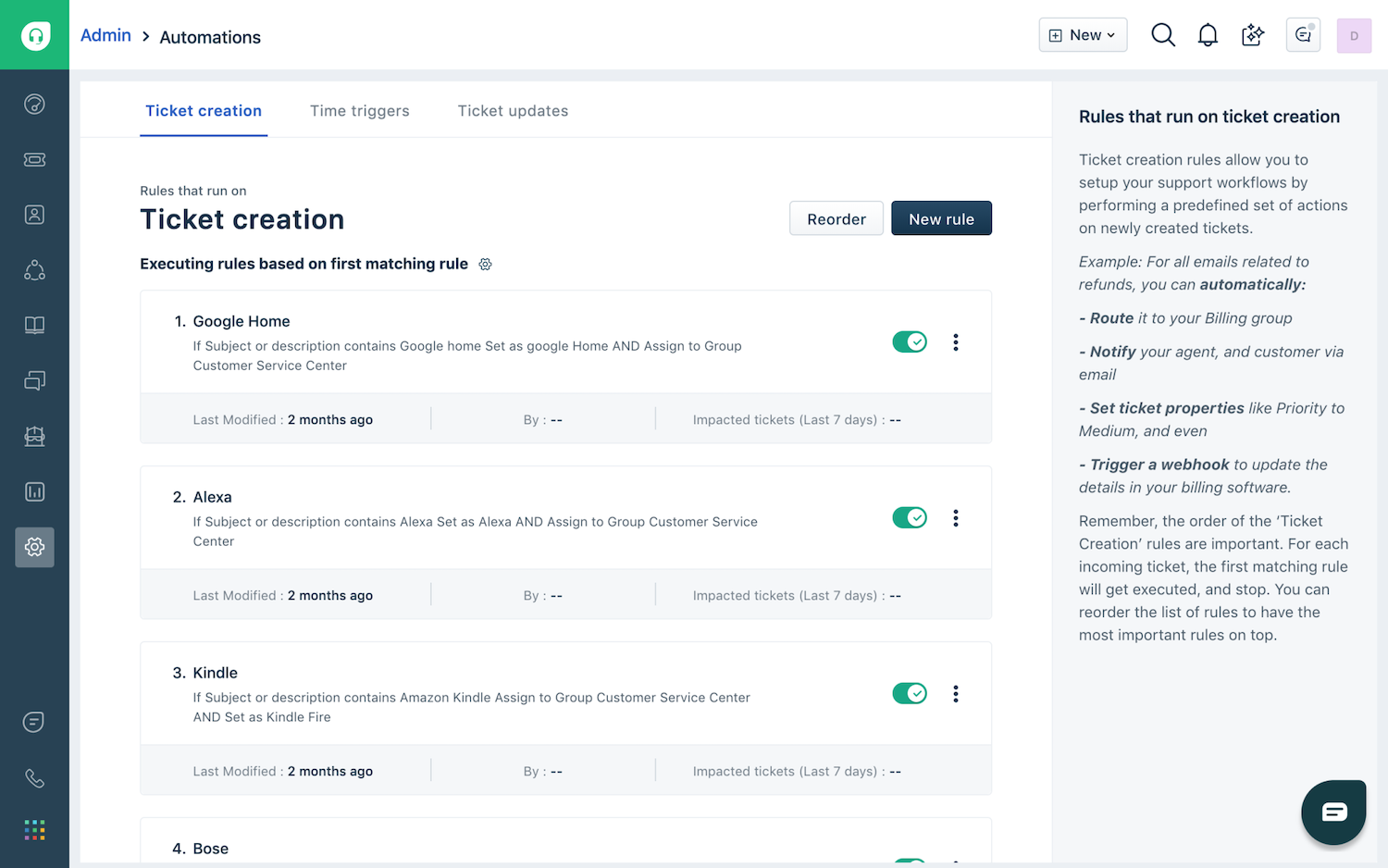
Freshdesk offers comprehensive ticketing. It does custom fields, can merge tickets, handles multi-level SLA policies well, and can do parent-child relationships for tickets. Its interface is clean and user-friendly, so agents of all levels can handle their workload fast and simple. However, on lower tier plans, the customization is much more limited than Zendesk’s.
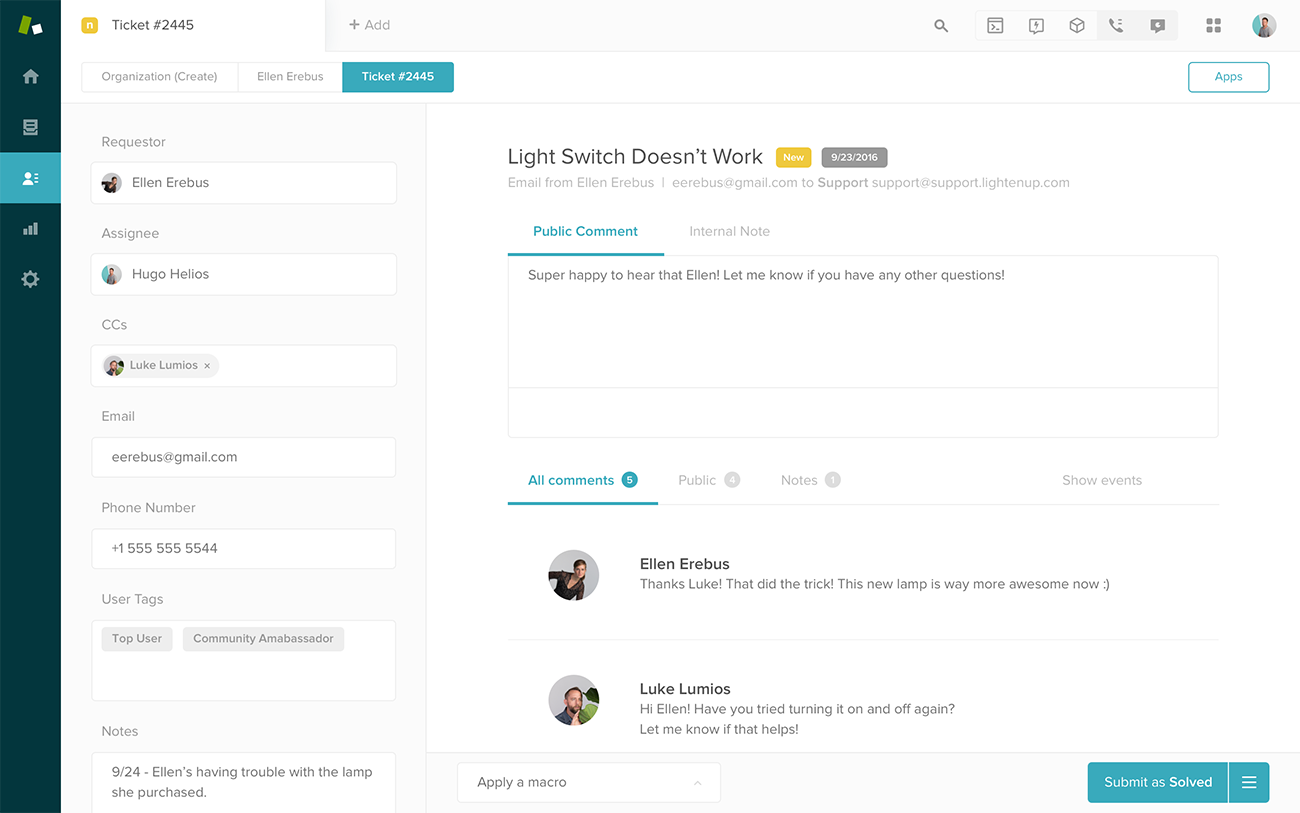
Zendesk provides custom ticket fields, priority levels, SLA policies (with escalatory features), automated routing, and cleaner views of tickets. Complex workflows can be whittled down thanks to triggers and it handles high volumes smarter with the ability to merge tickets or detect collisions. Collisions occur when agents are viewing the same ticket thus wasting time. Zendesk circumvents this with generous feature offerings.
Winner: Zendesk wins with more advanced ticketing features and richer customization opportunities on all tiers. Freshdesk is solid for most use cases, but for granular ticketing: Zendesk wins.
Omnichannel Support
Summary: Both platforms offer omnichannel support. Zendesk, however, offers more seamless native integrations where Freshdesk offers solid coverage at lower costs.
Freshdesk supports email, chat, phone (with Freshcaller), social media, and the most common messaging apps. It even provides omnichannel routing and ticketing where all channels can form tickets that flow seamlessly in one unified system. Though phone support will require a separate Freshcaller product, making it feel less all-inclusive than Zendesk.
Zendesk unifies chat, email, phone, social media (X/Facebook/etc.), SMS, and other apps into one singular agent interface. Zendesk provides voice via talk with IVR, call routing, and recording starting on Suite Team tiers.
Winner: Zendesk wins thanks to its more seamless native omnichannel integration, though that comes at a higher base cost than Freshdesk.
Automation
Summary: Zendesk offers powerful automation capabilities with more granular controls and flexibility than Freshdesk’s. Freshdesk’s automation works in a pinch for most common situations.
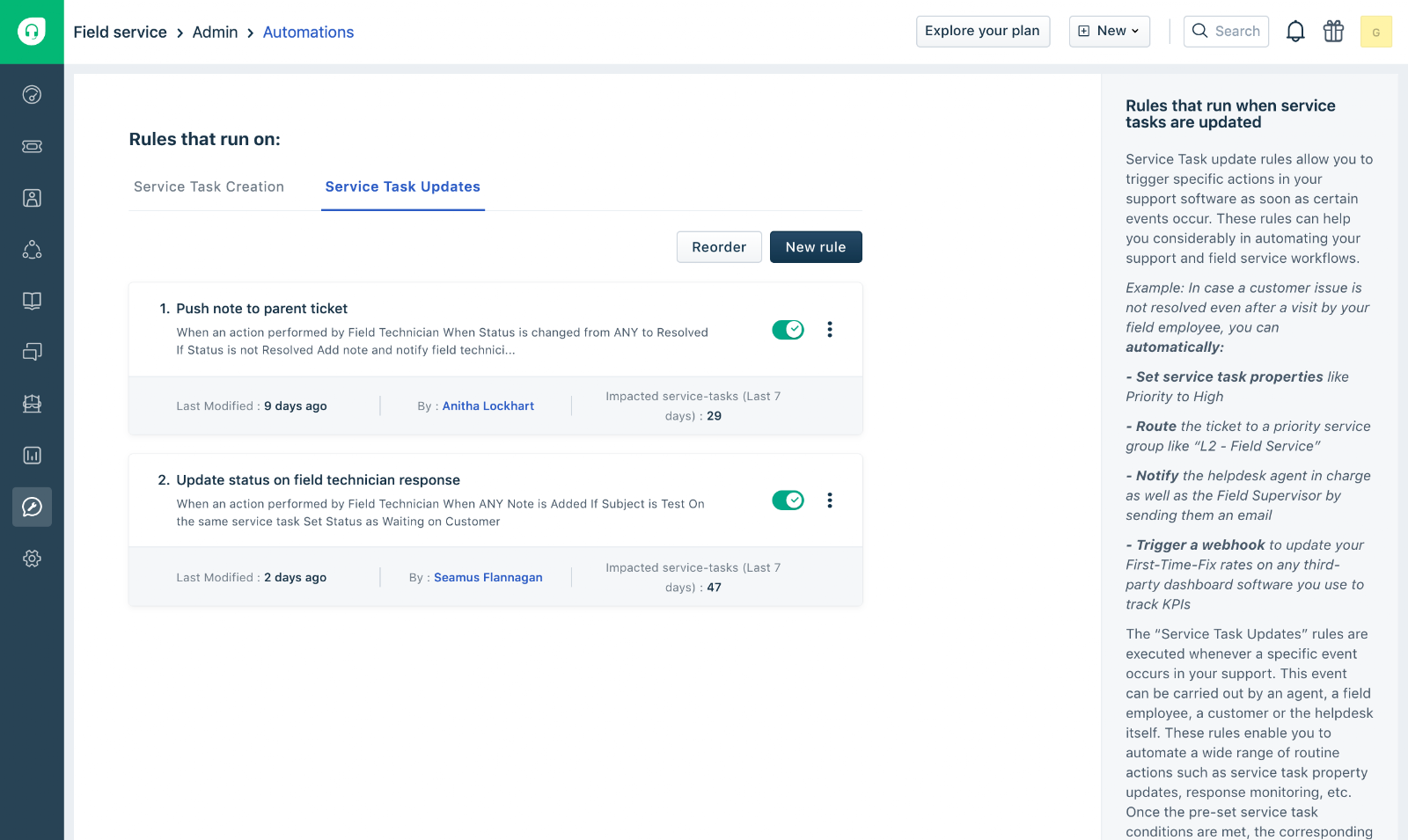
Freshdesk offers ticket automation rules, canned responses for common replies/fixes, and time triggers (which are handy for SLA-based actions). Its automation approach covers standard support scenarios like scheduled actions, automatic priority settings, and assigning tickets based on pre-defined keywords.
It only really falters when it comes to complex multi-step workflows or places where advanced conditional logic may force users to find workarounds.
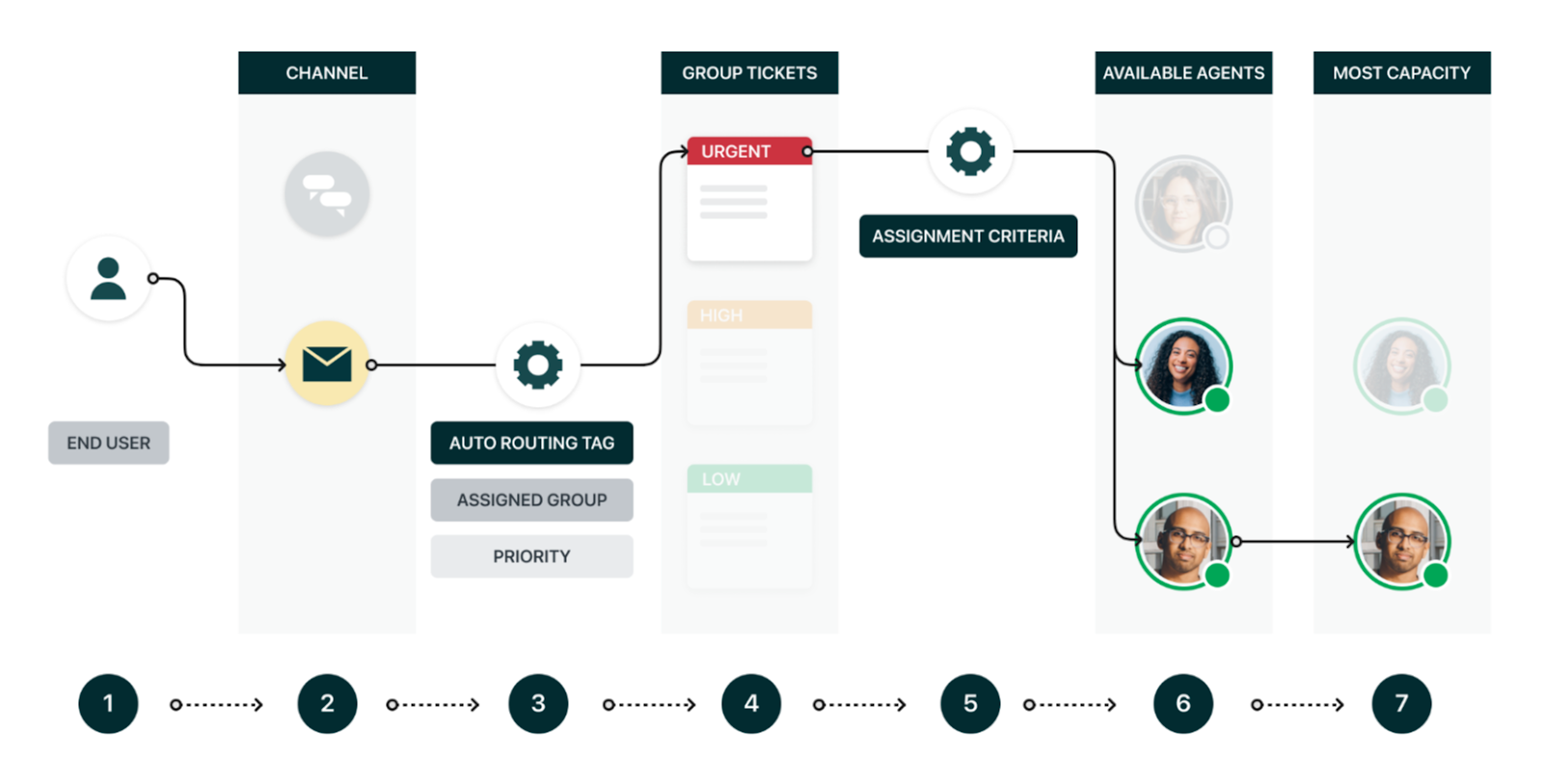
Zendesk provides a more detailed approach. It offers event-based automation via triggers and macros (one-click actions). Automations can be based on peak times to create sophisticated workflows with multiple conditions, take actions across different ticket fiends, and notify set stakeholders. Complex scenarios like automatic escalation chains or conditional routing based on set criterias are a breeze for the system.
Winner: Zendesk wins thanks to a more powerful and flexible approach to how automation can be done. Freshdesk’s offerings are adequate for most users, but power users will appreciate Zendesk's escalation chains.
AI Features
Summary: While both platforms offer AI capabilities at just about every tier, Freshdesk offers up a powerful conversational approach locked behind higher tiers. Zendesk’s approach is more modest but available more widely across all tiers.
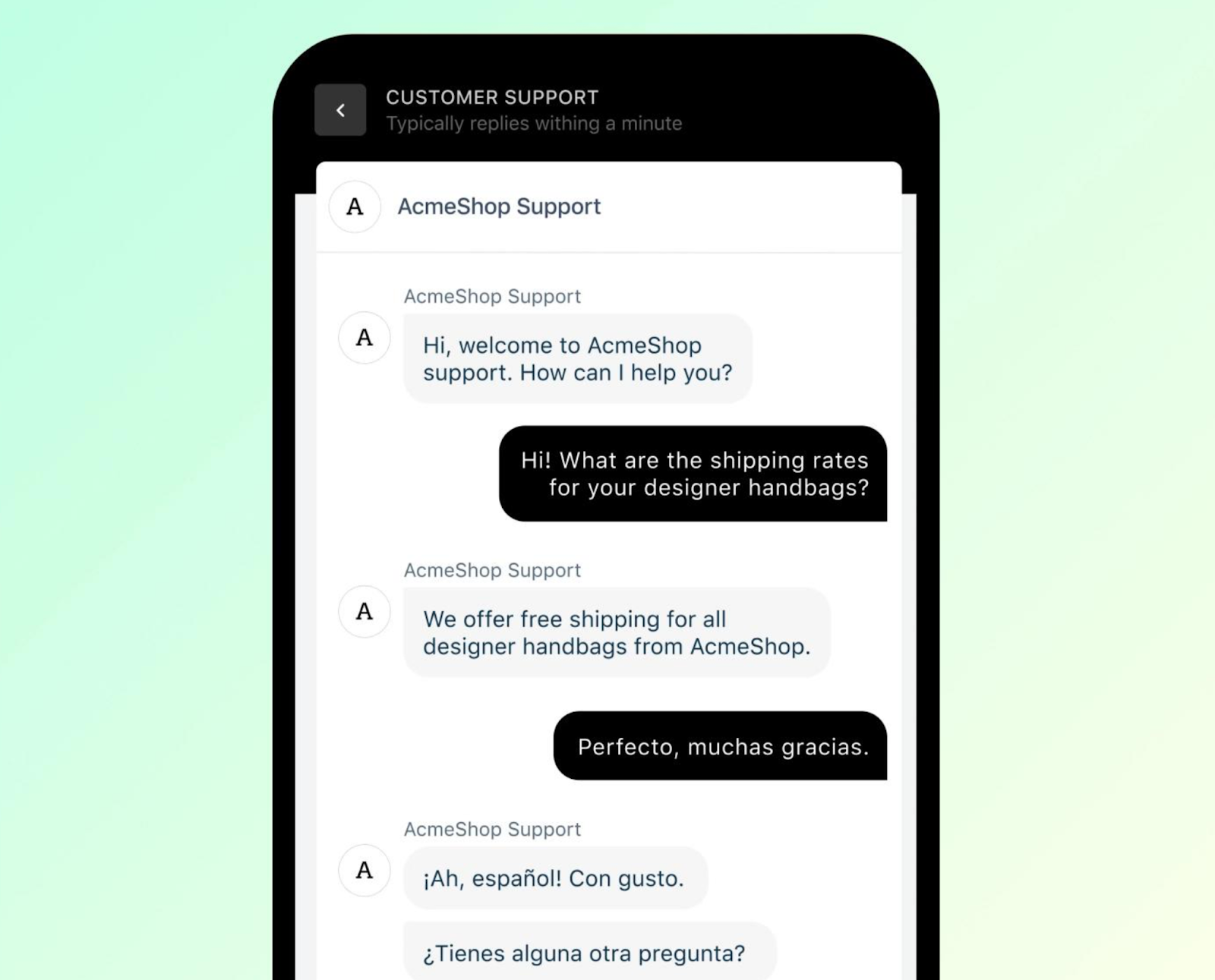
Freshdesk’s Freddy AI platform is powerful compared to Zendesk’s offerings when one opts for its higher tiers. It is included on all Omni plans, though features like its email AI agent are locked behind the Omni Pro tier which runs $50 over the base (and budget-friendly) tier. Freddy AI agent takes on a conversational AI approach which allows its AI agents to resolve issues faster without human intervention.
Freshdesk AI Features:
- Freddy AI ticket assignment prediction that routes tickets to the best-suited agent
- Field suggestion to auto-populate ticket fields like priority and category
- Agent assist with knowledge article recommendations based on ticket content
- Anomaly detection for unusual ticket patterns and volume spikes
- Chatbot capabilities through Freddy Self-Service for automated conversations
- CSAT prediction to identify potentially dissatisfied customers
- Email reply suggestions based on historical ticket data
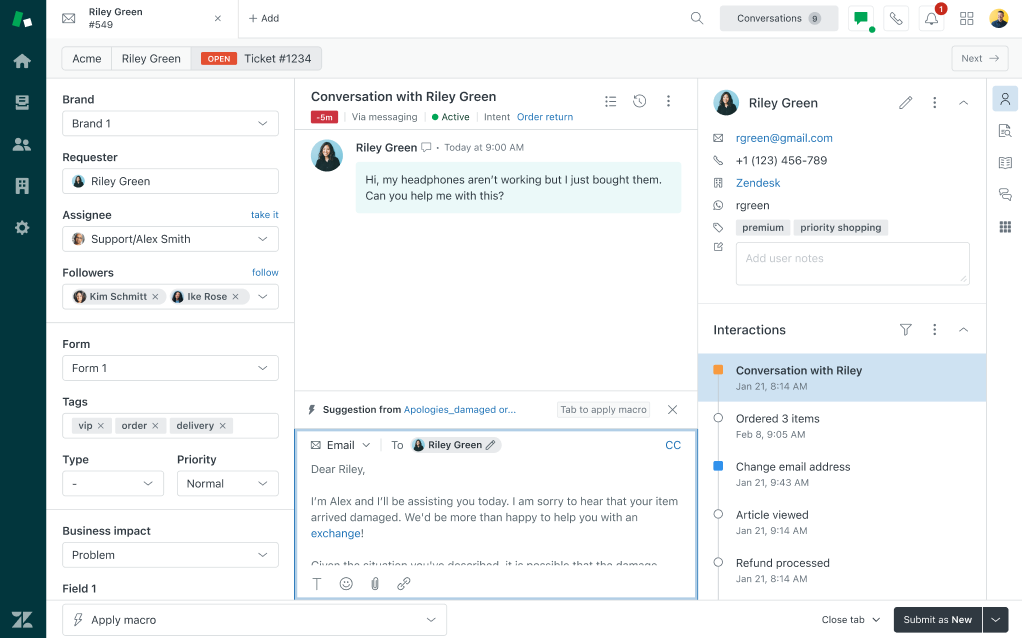
Zendesk's AI implementations are focused on the core concept of helping agents work more efficiently. The features require minimal configuration and work out of the box for most use cases. They also offer AI agents, though that will run as a premium outcome-based pricing add-on.
Zendesk AI Features:
- Intelligent ticket routing and classification based on content and context
- Intent detection that identifies customer needs from ticket text
- Macro suggestions that recommend responses based on ticket content
- CSAT prediction to identify at-risk customer interactions
- Article recommendations from knowledge base during ticket handling
- Sentiment analysis to gauge customer emotion
- Content Cues that flag potentially sensitive language
Winner: It’s a tie. Freshdesk’s Freddy AI is powerful even with some of its higher functions hidden away in more expensive tiers. Zendesk’s AI offerings are more modest but available more widely across all tiers.
Reporting and Analytics
Summary: Zendesk offers wider and more detailed analytics with more customization. Zendesk offers solid reporting for its price point.
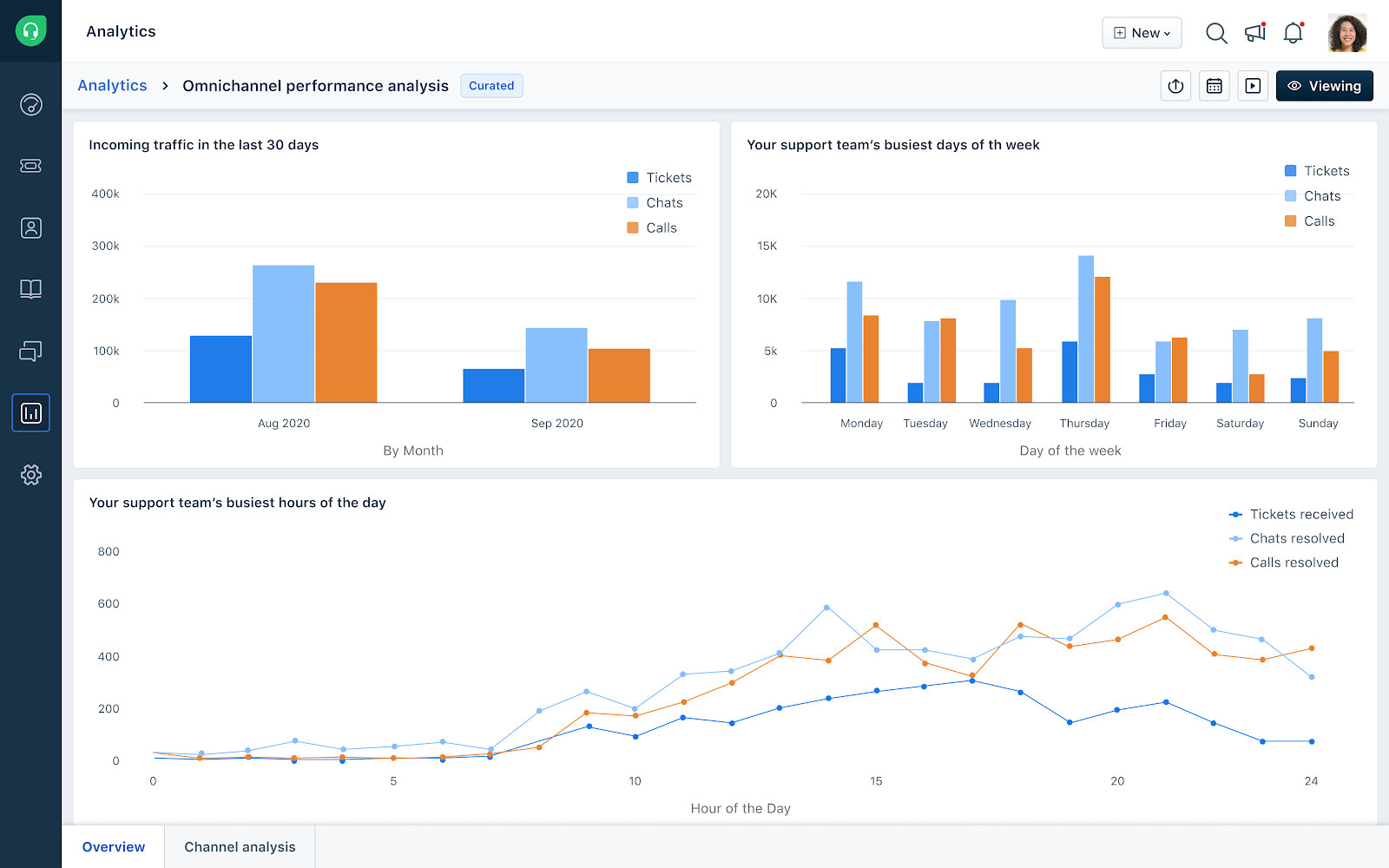
Freshdesk includes analytics and reporting with pre-build reports for things like response times, resolution times, agent performance, and other major KPIs. It can generate custom reports, export data to CRMs, and build basic dashboards. Higher tiers offer even more advanced capabilities but it’s still less customizable than Zendesk Explore.
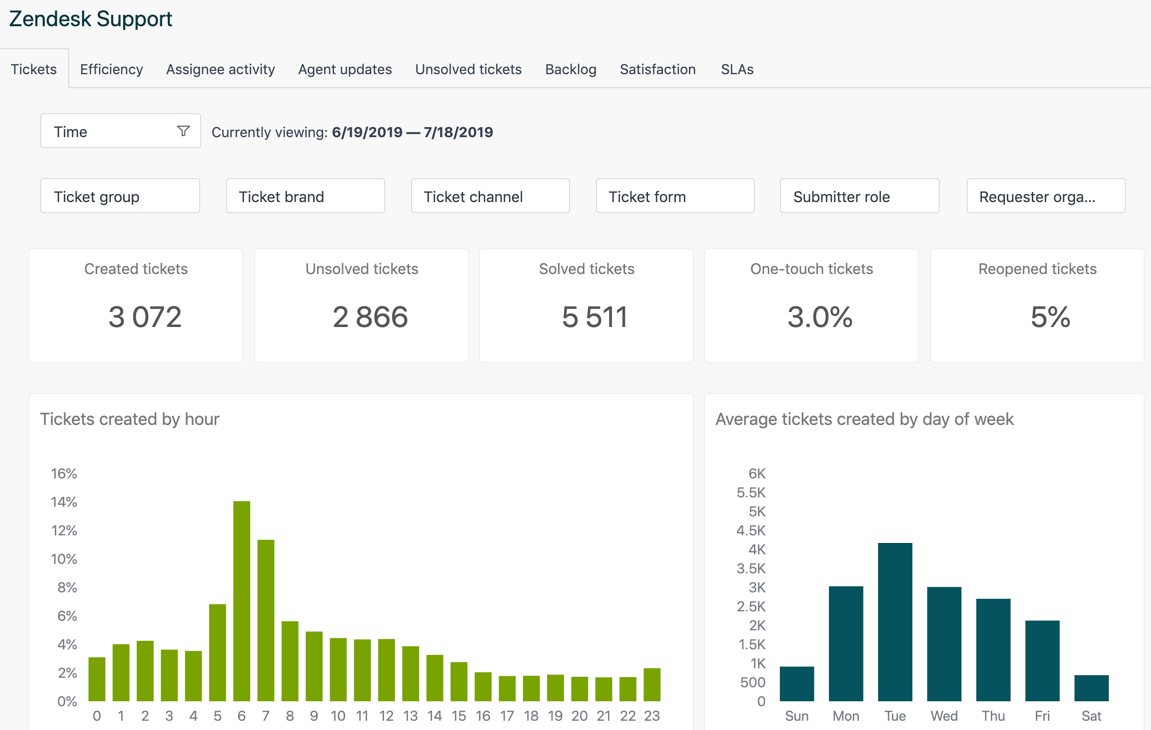
Zendesk provides extensive analytics thanks to an array of pre-built dashboards for ticket volume, CSAT scores, agent performance tracking, and response times. Zendesk Explore adds even more powerful reporting thanks to custom metrics and better filtering.
Winner: Zendesk wins here for more powerful analytics and customization on all fronts.
Integrations
Summary: Zendesk offers more integrations due to a more mature ecosystem that has a more native approach than Freshdesk’s integrations.
Freshdesk provides over 650 integrations including CRMs, productivity tools , e-commerce platforms, and other business applications. The integration marketplace covers essential business needs, though the total number of available integrations is smaller than Zendesk. Some integrations are community-maintained rather than officially supported.
Zendesk's over 1,000 integrations include the major CRMs businesses use daily, a ton of e-commerce platforms, productivity tools, and a few specialized support applications. It’s well-established thanks to the time advantage Zendesk has had in the market.
Winner: Zendesk takes this category for having a more mature and larger integration ecosystem. However, Freshdesk can cover most essential integration needs.
Self-Service Capabilities
Summary: Both platforms provide self-service capabilities, but Zendesk offers stronger features at its price point including its help center creation tool, Zendesk Guide.
Freshdesk includes knowledge bases with multi-language support, customizable portals, SEO-friendly URLs, and solid article categorization. Branded help centers are available as well as forums for customers to help each other.
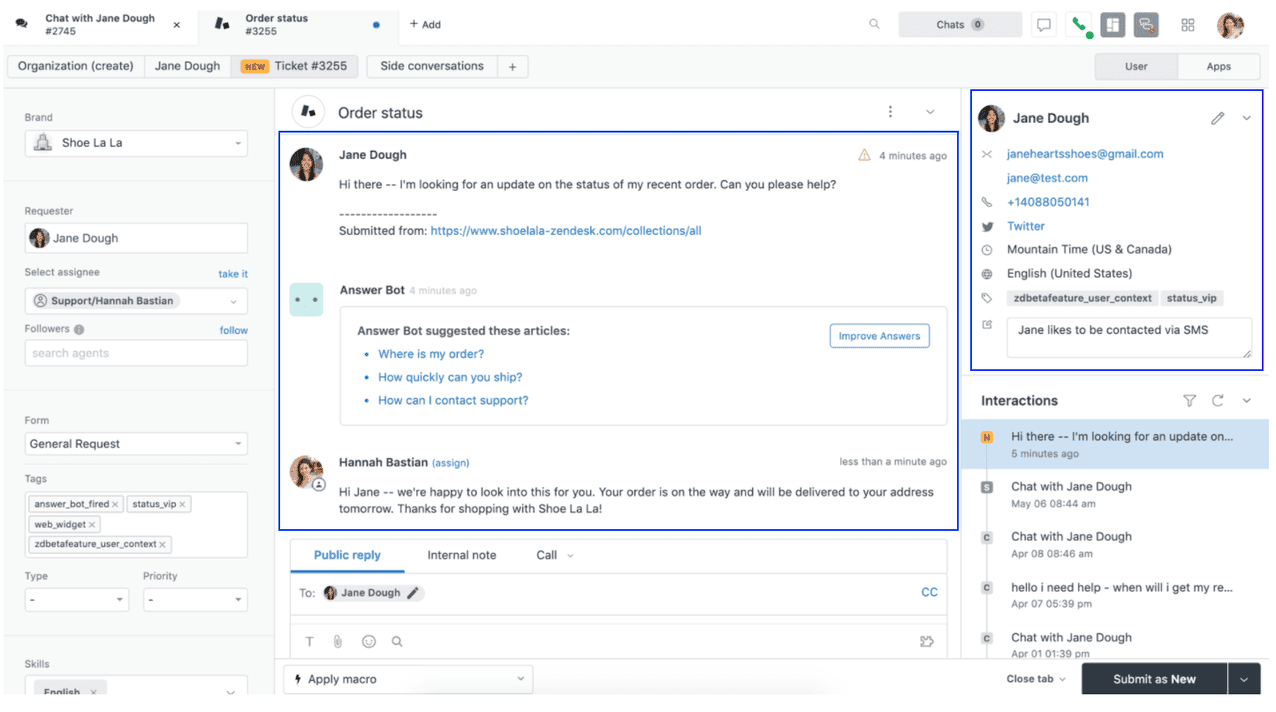
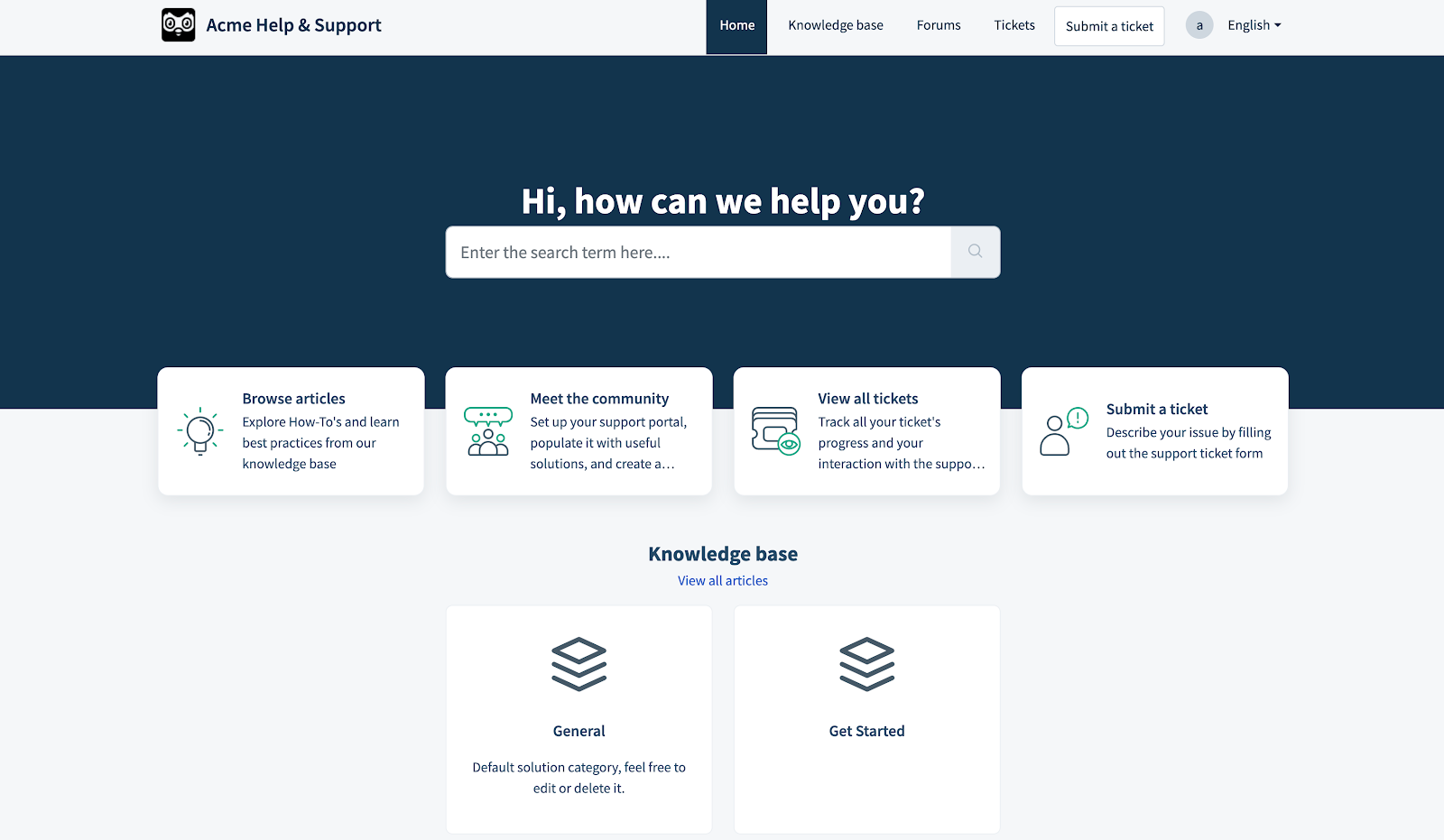
Zendesk Guide facilitates help center creation. The platform provides custom templates, multi-language support, and community forums. Knowledge base content seamlessly integrates with ticketing and will even suggest relevant articles as agents handle their tickets. Customer portals enable users to submit tickets, track query status, and even troubleshoot answers on their own without any human intervention needed.
Winner: Zendesk has a better take on self-service thanks to its advanced content management tools. Freshdesk’s offerings are great for its price point.
Ease of Use
Summary: Freshdesk offers a slightly easier to pick up interface that makes setup a breeze for new users. Zendesk is similarly easy to use but might have a slightly higher learning curve.
Freshdesk takes a simple approach when it comes to putting together its clean and modern interface. It’s a highly intuitive platform where new agents can take on tickets with little to no training. The setup wizard takes administrators through configuration with no hiccups. Freshdesk can get up and running within hours.
Zendesk is also designed for usability. The agent interface is clean and intuitive, with most functions accessible within one or two clicks. New agents can typically start handling tickets with just an hour or two of training. The admin interface is straightforward, and most configuration tasks can be accomplished without technical knowledge.
Winner: Freshdesk narrowly takes this category thanks to a simpler interface and quicker setup, but both platforms are great for all levels of agents.
Scalability
Summary: Both platforms scale when businesses grow, but Zendesk has a stronger track record amongst larger enterprises and known names.
Freshdesk scales effectively for growing businesses and can support large teams. It’s strong when it comes to high ticket volumes but the customer base skews towards smaller and mid-sized businesses. It doesn’t have Zendesk’s track record at large enterprise deployments.
Zendesk supports organizations from small teams to global support operations with thousands of agents. The platform handles high volumes efficiently with multi-brand configurations and administrative controls for large teams.
Winner: Zendesk wins with more proven scalability at the enterprise level, Freshdesk will work well for any small to mid-sized businesses but hits a wall fast.
Customer Support
Summary: Both services provide solid support, there are only a few slight variations as to which channels are available based on each tier or plan.
| Freshdesk Support | Zendesk Support | |
| Email Support | All paid plans | All paid plans |
| Phone Support | Estate and Forest plans | Professional and Enterprise |
| Chat Support | Garden plan and above | Growth and above |
| Knowledge Base | Extensive | Extensive |
Freshdesk provides email support on all paid plans, chat and phone support is locked behind higher tiers. The support team was responsive and helpful, user reviews agree on that. They also provide video tutorials, documentation, and have an active community forum.
Zendesk provides tiered support on all plans, with high tiers getting the best response times and even access to a dedicated phone line. Documentation is robust and comprehensive and the Zendesk Community forums provide peer support. Some users do report long wait times on the lower tiers.
Winner: It’s a tie. Both platforms are good at support with similar limitations based on how high or low your chosen tier is.
Pricing and Total Cost of Ownership
Below we’ve put each of the provider’s plans in a respective table since each offers a different pricing model.
Freshdesk Pricing
Freshdesk pricing starts at just $29/agent/month for its Omni Growth plan that includes ticketing, shared inbox, threads and tasks, and customer portals. All tiers come with access to their Freddy AI agent.
| Plan | Price per Agent/Month | Key Features |
| Omni Growth | $29 | Ticketing, messaging, help center, reporting across web, SMS, email and messaging, Freddy AI agent |
| Omni Pro | $79 | AI email agent, customized support portals, custom objects, advanced ticketing |
| Enterprise | $119 | Audit logs, approval workflows, skills-based assignments, better security |
Note: Freddy AI capabilities only extend to the first 500 sessions, anything past that incurs additional charges.
Zendesk Pricing
Zendesk pricing starts as low as $19/user/month for a barebones option that cuts out major nonnegotiable features like voice support, multilingual support, and AI found on the Suite tier at just $55/user/month. It also offers add-ons like Copilot at just $50/user/month and Advanced AI Agents at an outcome-based pricing model.
| Plan | Price per Agent/Month | Key Features |
| Support Team | $19 | Ticketing, messaging, help center, reporting |
| Suite Team | $55 | Advanced AI, multilingual support, SLA management, Voice (Zendesk Talk support starts at this tier) |
| Suite Professional | $115 | Custom roles, sandbox, HIPAA compliance, advanced analytics |
| Suite Enterprise | $169 | Dedicated success manager, advanced security, custom capacity |
| Copilot | $50 | Proactive AI-assistance to automate tasks, recommend next steps, and keep teams on the same page |
| Advanced AI Agents | Contact Sales | Autonomous resolution bots to take care of service issues |
Total Cost of Ownership
Freshdesk provides considerable savings, particularly in situations regarding smaller teams or any organization that has a tight budget. However, this does not take into account Zendesk’s higher pricing comes with much more advanced features and capabilities even on their lower tiers.
For a 10-person team:
- Freshdesk Omni Growth: $290/month ($3,480/year)
- Zendesk Suite Team: $550/month ($6,600/year)
For a 50-person team:
- Freshdesk Omni Pro: $3,950/month ($47,400/year)
- Zendesk Suite Professional: $5,750/month ($69,000/year)
Winner: Freshdesk wins on raw cost-effectiveness, offering great value across its tiers.
How to Choose Between Freshdesk and Zendesk
When choosing between these two robust customer support platforms, you need to consider these following factors and how they weigh in. Each business has its own needs, both platforms can fit into those needs but there are some places Freshdesk makes more sense than Zendesk and vice versa:
- Evaluate Your Budget: Operating on a tight budget or need a free plan? Choose Freshdesk. Have more budget for premium features and scalability? Consider Zendesk.
- Assess Feature Requirements: Need advanced automation, deep customization, and extensive integrations? Choose Zendesk. Need solid core features without premium pricing? Choose Freshdesk.
- Consider Your Growth Plans: Planning rapid growth to enterprise scale? Zendesk provides more proven scalability. Growing steadily in the small to mid-market range? Freshdesk scales appropriately at better value.
- Determine Complexity Needs: Supporting complex workflows with sophisticated routing and automation? Zendesk offers more power. Managing straightforward support operations? Freshdesk provides what you need at lower cost.
Other Alternatives to Consider
- Help Scout: A simple, email-based support platform focused on personal customer service, ideal for small teams wanting minimal complexity
- Zoho Desk: Another budget-friendly option with good features and deep integration with Zoho ecosystem for businesses using multiple Zoho products
Freshdesk vs Zendesk: Which is the Winner?
Though Freshdesk and Zendesk both provide excellent customer support capabilities, the winner depends on your budget and feature requirements.
If you want professional support features at affordable prices or operate as a small to mid-sized business watching costs, then Freshdesk offers exceptional value with solid capabilities.
Organizations searching for advanced automation, richer customization, extensive integrations, and proven enterprise scalability will find Zendesk's capabilities worth the investment. They just have to be willing to spend more for these premium advantages.
FAQs
Zendesk offers more powerful reporting and analytics through Zendesk Explore with greater customization and deeper insights. Freshdesk provides solid reporting capabilities that meet most needs at lower cost, though with less flexibility than Zendesk.