
Best AI SDR Agents (2026)

An AI SDR agent is an autonomous software system that handles Sales Development Representative (SDR) tasks like prospecting, account research, personalized outreach and follow-up, and meeting scheduling. AI SDR agents use third-party integrations and LLMs to provide 24/7, always-on, and personalized service across channels.
The category has matured quickly, evolving from glorified sales email generators to intelligent sales agents capable of handling complex sales workflows. The best AI SDR agents can automatically research every lead against real buying signals, intelligently classify replies, personalize outreach messages, manage deliverability infrastructure and objection handling, and instantly sync results back to your CRM.
The worst AI SDR agents spam templated emails at stale lists, lack meaningful personalization, and drive potential customers away for good.
In this post, we compare the top AI SDR agents on the market, what they actually do well, and where each one falls short.
Why You Can Trust GetVoIP + Our Research
We follow strict editorial guidelines and are committed to bringing you independently researched, valuable information.
Unlike other comparison and review sites, we exclusively research and analyze sales, communications, and customer-facing software categories. For this guide, we spent time with each AI SDR platform, reviewed their documentation, requested pricing where it wasn't listed publicly, and cross-referenced feature claims against verified user reviews on G2, Reddit, and founder communities.
All research was conducted hands-on by us and fact-checked against current vendor materials. We validated every data point by visiting product pages, reading pricing breakdowns, comparing plan structures, and checking customer reviews over a period of several weeks.
How We Evaluated and Tested AI SDR Agents
Our evaluation process meant going past the marketing pages. AI SDR vendors all claim the same thing: 24/7 automation, hyper-personalization, meetings on autopilot. The real differences show up in how each platform sources leads, how it decides who to contact, what the messages actually read like, and what happens when a prospect replies.
We used the following criteria to pick out leaders in the AI SDR space:
- Pricing and plans: We looked at whether each provider publishes pricing or gates it behind a demo, the billing model (per-lead, per-message, per-seat, or flat platform fee), contract length, and what's actually included versus sold as an add-on. We flagged hidden costs like mandatory supporting tools, setup fees, and auto-renewal friction
- Lead sourcing and data quality: We evaluated the size and freshness of each provider's contact database, how contacts are enriched, and whether data comes built-in or requires a separate subscription. We also tested how each agent handles ICP definition and whether leads are continuously refreshed versus pulled from a static list
- Intent and buying signals: We looked at how each platform detects when a prospect is actually in-market. This ranges from simple firmographic filters to real-time signal monitoring across job postings, funding rounds, hiring activity, LinkedIn posts, 10-K filings, and site visits. The quality of signals matters more than volume
- Message personalization: We assessed how deeply each agent researches before writing, whether messages reference specific context versus surface-level facts like job title and company name, and whether the output reads like a human wrote it or like obvious AI
- Channels covered: We checked which channels each agent can operate across, including email, LinkedIn, phone, and SMS. We also looked at whether the agent can handle inbound replies versus only send first-touch outreach
- Deliverability infrastructure: Email that doesn't reach the inbox generates zero pipeline. We evaluated whether each platform includes domain warmup, mailbox rotation, dedicated IPs, and deliverability monitoring, or whether those are sold separately
- CRM and tool integration: We reviewed native integrations with Salesforce and HubSpot, two-way sync, calendar connections, and how each platform fits into an existing sales stack without duplicating work
- Level of autonomy: Some agents are fully autonomous, others require human approval at each step. We evaluated where each platform sits on that spectrum and whether you can adjust the level of control
- Onboarding and support: We checked setup time, whether a dedicated GTM engineer or CSM is included, and how accessible support is after launch. Some platforms take a full day to go live, others take weeks
- Proof of performance: We weighed published case studies, reply rate benchmarks, and verified user reviews against each platform's marketing claims
Key Takeaways: Which AI SDR Should You Choose?
If you only have a minute, here's the quick pick guide. Each recommendation names the one thing this platform does better than the other five on the list.
- Choose 11x if you want a fully autonomous digital worker that replaces the SDR seat rather than assists it, and you have enterprise budget (around $5,000/month) plus a large addressable market to work.
- Choose Alta if you want one platform to run outbound, qualify inbound, and optimize targeting across all of it, rather than stitching together three separate tools. Alta is the only provider on this list with a coordinated three-agent architecture.
- Choose Coldreach if you want signal-driven outbound at the lowest transparent entry price on this list. Custom intent signals you can define in plain English, starting at $749/month.
- Choose AiSDR if you want to test AI outbound without signing a 12-month contract. Quarterly billing, public pricing, and one-day setup make it the lowest-risk way to validate whether AI SDR tooling works for your motion.
- Choose Artisan if you don't already pay for a data provider like ZoomInfo or Apollo. Artisan's 300M+ contact database is bundled into the platform, which changes the math if you were going to buy data separately anyway.
- Choose Regie.ai if you want AI agents working alongside human reps in one workflow, not replacing them. RegieOne is the only platform here that treats the SDR team as the customer, with Auto-Pilot agents handling the long tail while humans work warm conversations.
Top AI SDR Agents Compared
| Platform | Starting Price | Best For | Key Strength | Free Trial |
| 11x (Alice) | ~$5,000/month (annual contract) | Enterprise outbound at volume | Autonomous digital worker across email, LinkedIn, and calls (with Julian) | No self-serve trial |
| Alta (Katie) | Custom, quote-based | Teams wanting a full GTM system with RevOps intelligence | Katie, Alex, and Luna as a coordinated agent stack | Demo-based |
| Coldreach | $749/month | Signal-driven, research-first outbound | Custom intent signals in plain English across 97M+ accounts | Demo-based |
| AiSDR | $900/month (billed quarterly) | SMBs wanting transparent pricing and quick setup | Unlimited seats, true autopilot replies, quarterly commitments | Demo-based |
| Artisan (Ava) | ~$2,000+/month (quote-based) | High-volume outbound with bundled contact data | 300M+ contact database built into the platform | Limited |
| Regie.ai | $180/user/month (AI SEP); Force Multiplier Rep $499/user/month | Enterprise SDR teams blending AI and human reps | RegieOne AI SEP with 220M+ contacts and Auto-Pilot agents | Demo-based |
11x - Best for enterprise outbound at volume

11x positions its products as "digital workers" rather than software tools. AI SDR Alice handles email and LinkedIn outreach end-to-end, while AI phone rep Julian qualifies inbound leads in real time. Together, they're marketed as a replacement for a full SDR seat, not simply AI assistants to their human counterparts.
Alice runs autonomously once configured. She identifies prospects, enriches contacts, writes personalized emails and LinkedIn messages, handles replies, and books meetings on your calendar. The platform includes native contact data, multi-channel orchestration, deliverability infrastructure, and website visitor tracking, which 11x added over the past year.
What we like
- Fully autonomous operation: Once Alice is trained on your ICP, she operates without requiring approval at each step. For teams that want to remove humans from top-of-funnel work entirely, this is the most hands-off option on our list.
- Multi-channel worker stack: Alice covers email and LinkedIn, Julian covers phone. Combined, they address more of the SDR workflow than single-channel platforms. Julian is available as a separate digital worker license.
- Enterprise-grade posture: 11x has the procurement, security, and implementation process that larger orgs expect. Structured onboarding and dedicated success resources are included at this tier.
- Strong ICP operationalization: Reviewers consistently note that when the ICP is well-defined, 11x does a solid job turning that definition into outbound execution at scale.
What we don't like
- Opaque, high pricing: There's no public pricing page. Third-party reports and procurement data place Alice at around $5,000/month, or roughly $50,000 to $60,000 annually for the standard 3,000-contact plan. Adding Julian reportedly runs another $4,000 to $6,000/month.
- Annual contracts standard: Annual commitments are the default, and multi-year contracts are increasingly pushed. Users have reported difficulty exiting contracts when results don't materialize in the first quarter.
- Message quality complaints: The most consistent critique across G2 and Reddit is that Alice's emails read as generic AI output, even after detailed ICP and brand guideline setup. For teams where messaging quality is the competitive edge, this is a real concern.
- No self-serve trial: Evaluation requires a sales-led process. You can't test the product yourself before signing.
Cost
11x does not publish pricing. External procurement data from Vendr suggests median contracts land between $38,250 and $65,550 annually, with multi-worker enterprise deployments scaling higher. The base Alice package includes roughly 3,000 contacts per month with up to five touchpoints per contact. Julian pricing is quoted separately as an add-on digital worker.
Best for
- Enterprise outbound teams with real budget: 11x makes the most economic sense when you're replacing headcount rather than augmenting a small team. Teams running outbound at a global scale benefit from Alice's 24/7 operation across time zones.
- Organizations with large addressable markets: The platform's high-volume approach works best when you have tens of thousands of accounts to work. Lean ICPs under 10,000 prospects tend to get exhausted quickly.
- Teams prioritizing autonomy over control: If you want to truly automate the SDR seat and don't need deep message control, 11x offers the most hands-off operation in the category.
Alta - Best for teams wanting a full GTM system
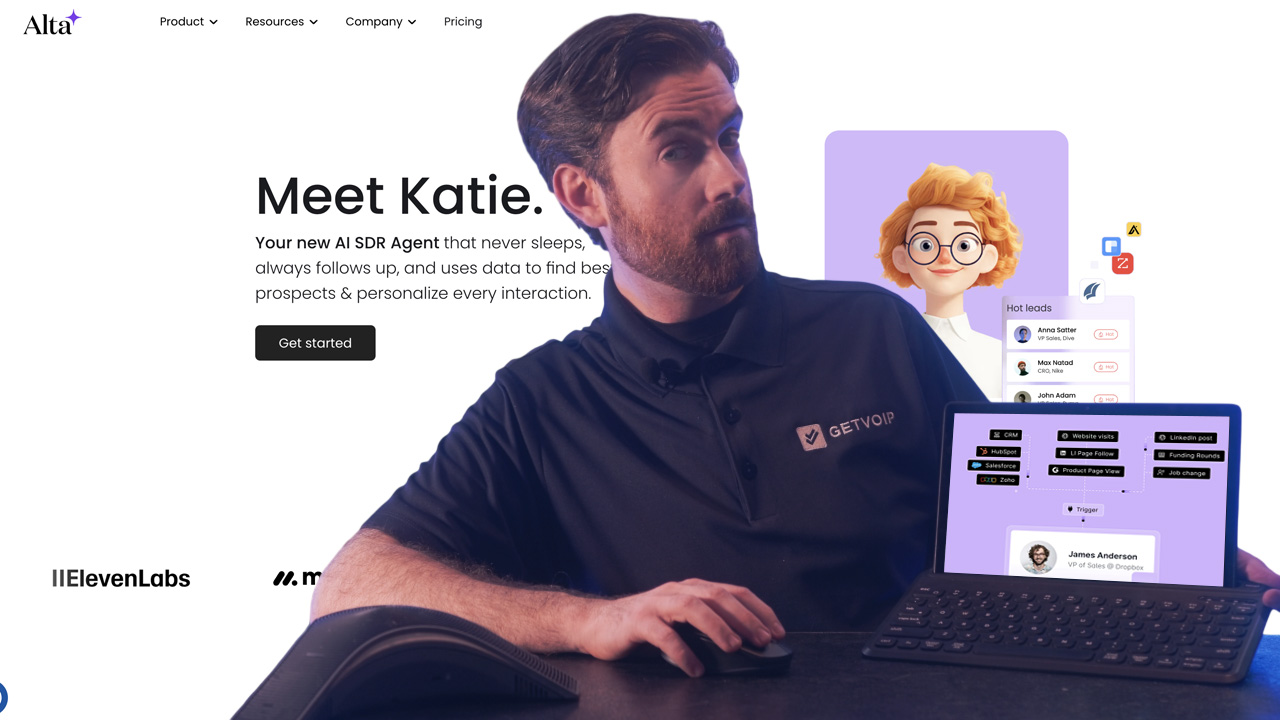
Alta takes a broader approach than most AI SDR platforms. Rather than selling a single agent, Alta positions itself as an "AI GTM System of Actions" with three coordinated agents. Katie is the AI SDR for outbound, Alex handles inbound lead qualification, and Luna acts as the intelligence layer that feeds targeting and messaging decisions to both.
Katie analyzes your CRM alongside 50+ data sources to identify ICP fit and buying signals, then runs multi-channel outreach across email, LinkedIn, SMS, WhatsApp, and calls. Luna sits underneath as the optimization layer, running A/B tests, surfacing insights to Slack or Teams, and improving targeting over time based on what converts.
What we like
- Coordinated agent architecture: Katie, Alex, and Luna share data and optimize together. Most competitors sell standalone agents that don't learn from each other. Alta's approach compounds intelligence across outbound, inbound, and RevOps.
- 50+ data sources for signals: Alta integrates intent data, job postings, product usage, engagement patterns, and news events to trigger outreach at the right moment. This is closer to Coldreach's signal-first approach than to the static-list approach of older AI SDRs.
- Multi-channel condition-based sequences: Katie handles email, LinkedIn, SMS, WhatsApp, and calls with branching logic that adapts in real time. For global teams, this channel breadth is unusual at this price point.
- Native Salesforce and HubSpot integration: Alta lists as an AppExchange partner and integrates natively with both major CRMs. Setup is quoted in minutes rather than months.
- Compliance-ready: SOC 2 certification, GDPR compliance, and EU, UK, and US data-protection support. Important for regulated industries and European deployments.
What we don't like
- No public pricing: Alta doesn't publish pricing, requiring a demo and sales conversation. The product is capable but you can't easily benchmark cost against alternatives without that call.
- Onboarding feedback is mixed: Some reviewers note that the onboarding process could be more intuitive, particularly for teams without a dedicated GTM or RevOps lead to drive configuration.
- Customization gaps for complex workflows: Larger teams with highly specific sales processes have flagged that the platform can feel constrained for heavily customized plays.
Cost
Alta uses a quote-based model with no public pricing. Plans are shaped around team size, data sources required, and which agents you deploy. You can request a quote through their plans page.
Best for
- Teams wanting one system instead of a stack: If you're consolidating prospecting, inbound qualification, and revenue intelligence into one platform rather than stitching together point solutions, Alta's agent architecture is built for that.
- Global outbound with localized campaigns: Customers have reported running Italian-language outbound at 10% reply rates. Multi-language support combined with SMS, WhatsApp, and calls makes Alta a fit for international teams.
- Signal-driven sales motions: Teams that care about reaching prospects at the right moment, not just reaching more prospects, get value from Luna's signal layer and Katie's real-time targeting adjustments.
Coldreach - Best for signal-driven, research-first outbound
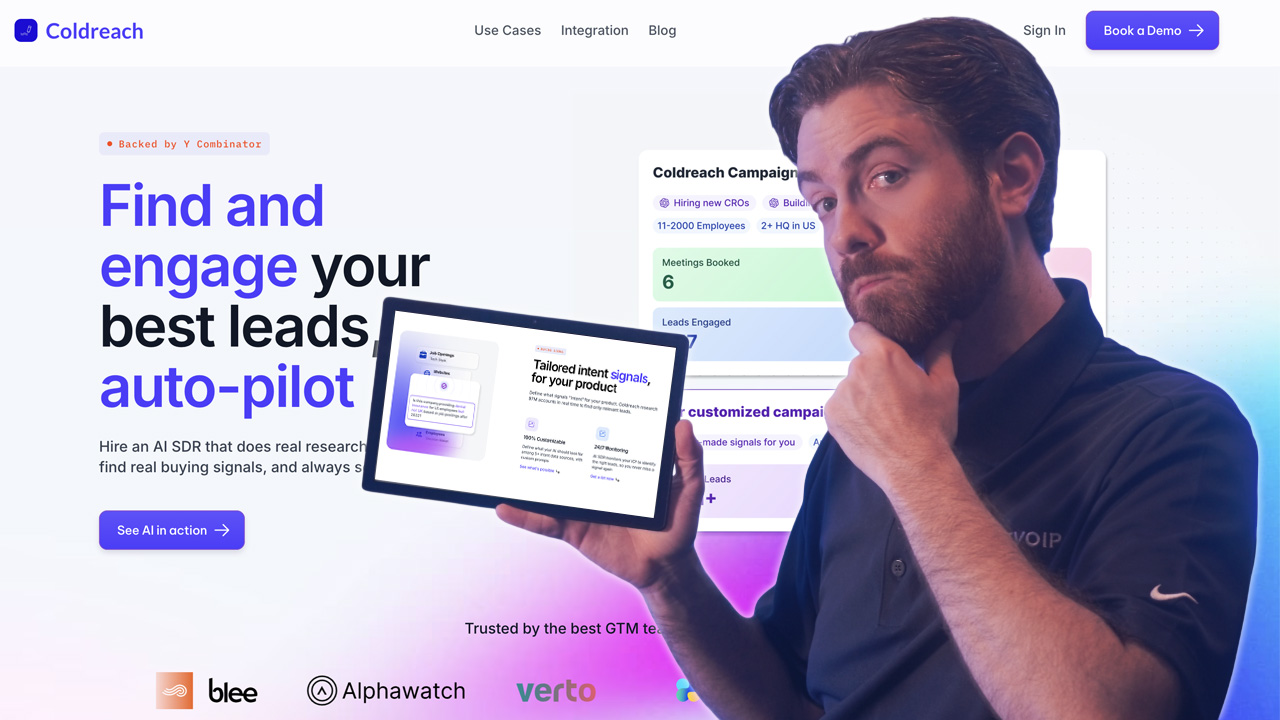
Coldreach is an AI SDR built around a single idea that most cold emails fail because they are sent at the wrong time to the wrong person. Coldreach monitors 97M+ accounts in real time across five or more data sources, including job postings, company news, websites, LinkedIn activity, and SEC 10-K filings, then only reaches out when a verified buying signal appears.
What makes it different is the signal customization. You define what "intent" means for your product in plain English. For example, "companies hiring 3+ engineers with Next.js experience" or "recently mentioned data compliance challenges on their website." The AI monitors for those exact criteria and surfaces only leads that match.
What we like
- Custom signals in natural language: You're not locked into predefined categories like "funding raised" or "hiring detected." If you can describe what an in-market prospect looks like, Coldreach will find them.
- Research-first personalization: Before writing a single message, the AI researches each lead's tech stack, recent events, and in-market timing. The published reply rate is 3.8% across 500,000+ sent emails, which is roughly 10x the industry average of 0.3 to 0.5%.
- Built-in deliverability infrastructure: Aged domains, DNS setup, premium warmup pools, dedicated IPs, and mailbox rotation are all included. You don't need a separate deliverability vendor.
- Transparent starting price: Self-service plans start at $749/month for 2,600+ emails per month with full signal research included. That's the lowest transparent entry point among signal-based AI SDRs on this list.
- Y Combinator backed with public proof points: Coldreach books around 70% of its own pipeline, roughly 20 qualified meetings per week, using its own AI SDR. That's a meaningful signal that the product works for at least one ICP.
What we don't like
- Pricing tiers above $749 are demo-only: The self-serve starting price is published, but larger plans move to custom quotes based on signals tracked, seats, and lead volume.
- Email-first by design: Coldreach is heavier on email research than multi-channel orchestration. If you want coordinated phone and LinkedIn motion out of the box, you'll likely layer other tools.
- Signal setup takes real thought: The custom signal feature is powerful, but it requires you to actually know what an in-market prospect looks like for your product. Teams with a fuzzy ICP won't get the same results.
Cost
Self-service plans start at $749/month, including full signal research, deliverability infrastructure, and outreach execution. Higher tiers scale by signal volume, team seats, and integration complexity, with custom quotes via demo.
Best for
- Lean teams and founders running outbound themselves: Coldreach customers include founders who run campaigns that would otherwise require 2-3 dedicated SDRs. The self-serve entry price makes it accessible without an enterprise budget.
- Products with a defined niche ICP: If you sell into a specific technical or industry niche where buying signals are identifiable (tech stack changes, regulatory mentions, specific hiring patterns), Coldreach will find them better than generic contact databases.
- Teams burned by templated AI outreach: If you've tried an AI SDR and felt the messaging was too generic, Coldreach's research-first approach is a meaningful architectural difference.
AiSDR - Best for transparent pricing and quick setup
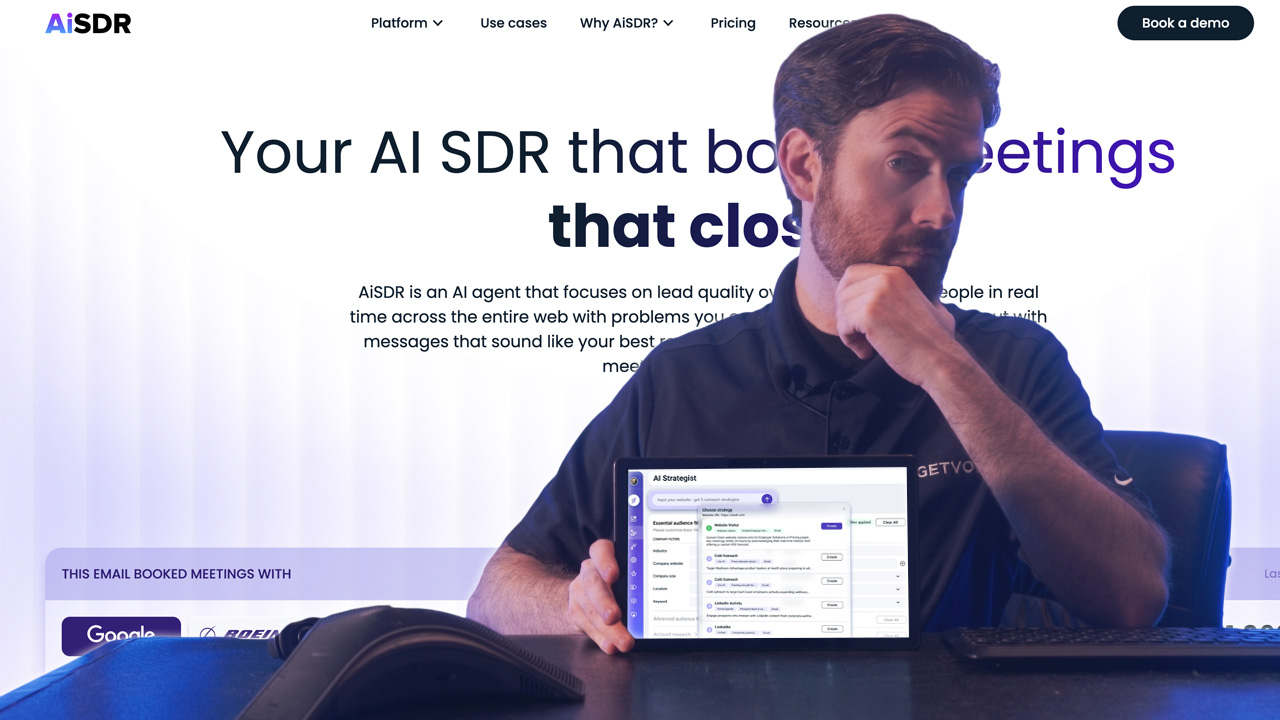
AiSDR (whose AI agent is named Enigma) is an AI SDR aimed squarely at SMBs who want to run outbound without committing to annual enterprise contracts. The pricing is public, quarterly billing is the default, and the entry plan includes unlimited seats, personas, and campaigns.
Enigma handles prospecting, outreach, follow-ups, and reply handling across email, LinkedIn, and phone with AI-generated call scripts. AiSDR's Live AI researches each prospect in real time from 323+ sources, and the platform supports LinkedIn keyword search, profile views, and post engagement as native intent signals, which few competitors offer as first-party data.
What we like
- Transparent, predictable pricing: Plans start at $900/month for 1,200 messages, billed quarterly. Annual plans get a 20% discount. Leads, seats, mailboxes, and personas are included in the base price. The only variable is sending volume.
- Quarterly commitments, not annual: Most AI SDR vendors push 12-month contracts. AiSDR's 90-day billing cycle lets you prove the concept before locking in, which matters for a category where results can take 6 weeks to show up.
- Fast onboarding: Setup takes roughly one day once payment clears, assuming your domain is ready. If new mailboxes are needed, warmup runs 3 to 5 days before sending. Every customer gets a dedicated GTM engineer and shared Slack channel.
- True autopilot replies: Unlike some competitors where AI only drafts responses, Enigma sends first-touch messages and handles replies without manual approval, unless you want oversight. The platform also works for inbound messages.
- Native HubSpot integration with scoring: Two-way HubSpot sync is native, including list syncing, HubSpot property personalization, activity logging, and company list scoring.
What we don't like
- Still sales-led for enterprise plans: The $900/month Explore tier is public, but Enterprise plans are quote-based with Net-30 invoicing. Budget planning at that tier requires a sales call.
- Less depth on signal research than Coldreach: Enigma uses Live AI and LinkedIn signals, but the approach is more breadth than depth. Teams chasing highly specific technical buying signals may find Coldreach a sharper fit.
- Message volume is the only scaling lever: Because pricing scales with message volume and not features, teams with low-volume, high-touch motions may not see obvious cost optimization paths.
Cost
Plans start at $900/month for 1,200 messages, billed quarterly. The mid-tier Grow plan adds more volume at a discounted per-message rate. Enterprise plans include custom volume and Net-30 invoicing. Annual billing saves 20% across tiers.
Best for
- SMBs and startups testing AI outbound: Quarterly billing and transparent pricing make AiSDR one of the lowest-risk ways to evaluate whether AI SDR tooling fits your motion.
- HubSpot-first sales teams: The native two-way integration with scoring is deeper than most competitors in this price range.
- Teams that need full multi-channel execution on day one: Email, LinkedIn, calls, and replies are all in-platform. You don't need to layer Orum or a separate dialer on top.
Artisan - Best for high-volume outbound with bundled data
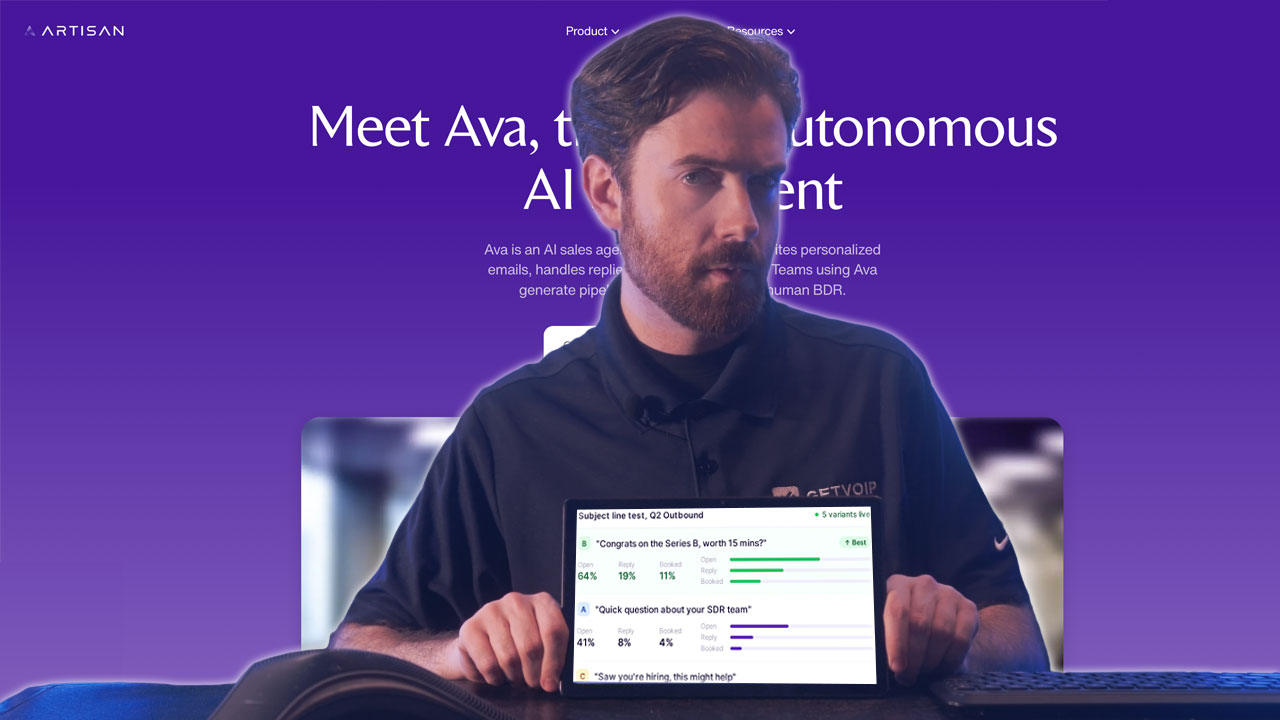
Artisan is an AI outbound platform whose flagship agent, Ava, is marketed as an AI BDR. What sets Artisan apart from most competitors on this list is that it bundles a 300M+ verified B2B contact database directly into the platform, so you don't need a separate ZoomInfo, Apollo, or Clay subscription to feed it leads.
Ava runs the full outbound cycle from lead sourcing and personalized email writing to multichannel sequences across email and LinkedIn, email warmup, and campaign management. Artisan also markets add-on agents for local data, cross-sell and upsell motions, and inbound handling, giving it a broader product footprint than most single-agent SDRs.
What we like
- 300M+ contact database built-in: For teams that don't already pay for a data provider, this is a meaningful bundled value. Contacts span 200+ countries with firmographic and technographic enrichment.
- Strong deliverability suite: Artisan includes email warmup, mailbox health scoring, placement tests, dynamic send limits, spam avoidance, and unique content generation. These are typically add-ons elsewhere.
- Website visitor identification and retargeting: Ava can track anonymous visitors at the company and decision-maker level and trigger outreach when someone views your pricing page. This closes a common gap for AI SDRs.
- Intent signals via Data Miner/Watchtower: Ava detects funding rounds, hiring news, and similar trigger events to time outreach, though the signal depth is less customizable than Coldreach.
What we don't like
- Pricing is opaque and high: Artisan's pricing page now mentions custom plans by business size but still routes buyers to sales. Third-party estimates place the Accelerate plan around $2,000/month with higher tiers scaling to $5,000+/month. All-in annual costs reportedly run $31,000 to $147,000 once supporting tools are included.
- Reply handling is limited: Ava can suggest replies but can't send responses autonomously once a prospect engages. Your team takes over after first touch, which reduces the "set and forget" promise.
- Cancellation friction reported: Multiple reviewers have flagged difficulty canceling subscriptions, with annual contracts and limited cancellation windows as the pattern. Worth confirming terms upfront.
- Messaging feels templated at volume: User reviews consistently flag that personalization quality degrades at high send volumes, despite the marketing around hyper-personalization.
- No built-in dialer: Ava covers email and LinkedIn. If your SDR motion includes calls, you need a separate tool.
Cost
Artisan does not publish standard pricing. Third-party estimates place the Accelerate plan around $2,000/month (approximately 12,000 leads/year), with higher tiers reportedly scaling to $5,000+/month (65,000+ leads/year). Pricing is structured around lead volume and differentiates between BDR seats (Ava) and AE seats (humans handling booked meetings). Annual contracts are the norm.
Best for
- Teams without an existing data provider: If you'd otherwise pay for ZoomInfo or Apollo separately, Artisan's bundled database changes the math favorably.
- Broad-market B2B outbound: Ava works best with wide ICPs and volume-driven strategies. Niche ICPs with fewer than 10,000 accounts tend to exhaust quickly.
- Teams prioritizing deliverability: The built-in warmup and placement infrastructure is genuinely strong, particularly for companies sending from multiple new domains.
Regie.ai - Best for enterprise SDR teams blending AI and human reps
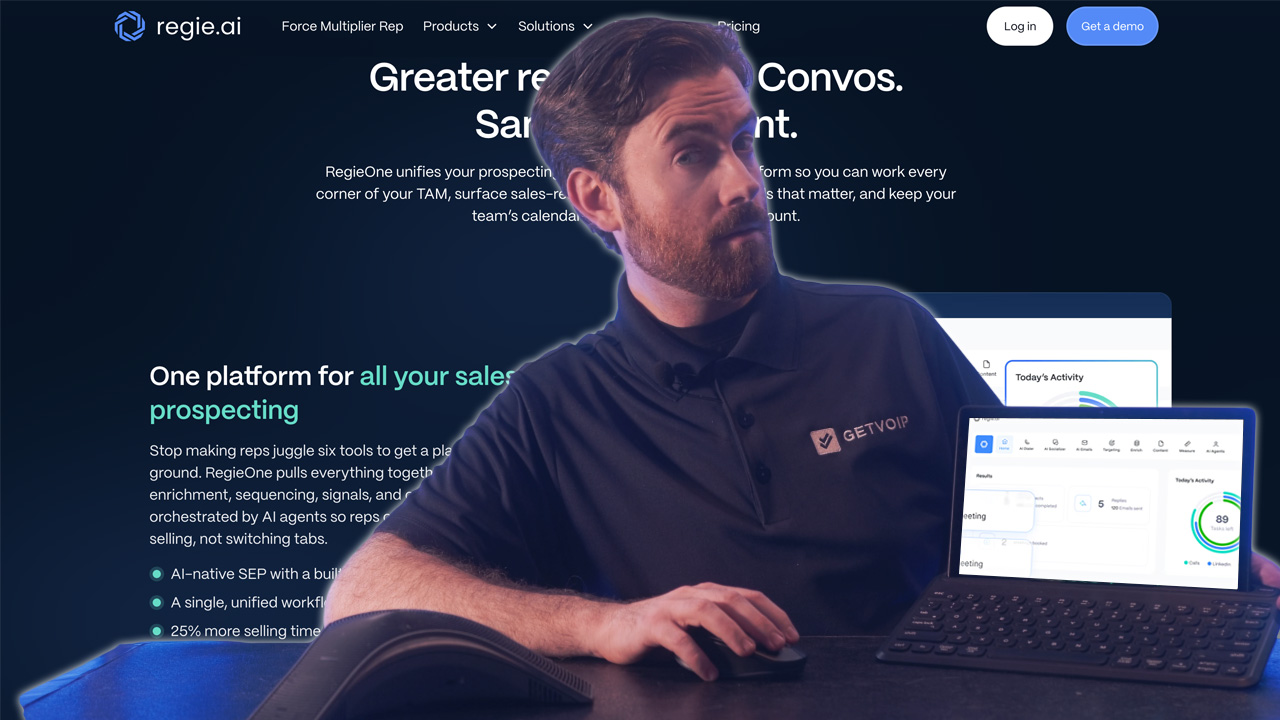
Regie.ai takes a different architectural position than the fully autonomous agents on this list. Instead of replacing the SDR, Regie's flagship RegieOne product combines human reps and AI agents in a single sales engagement workflow. Reps work alongside Auto-Pilot Agents that handle lead sourcing, enrichment, personalized writing, CRM logging, and follow-up across email, calls, and LinkedIn.
The platform includes a 220M+ contact database with verified mobile numbers, 100+ built-in intent signals from sources like Google, LinkedIn, 10-K filings, G2, Crunchbase, BuiltWith, and company news, and a parallel AI Dialer for high-volume calling. Regie's own GTM team reports that Auto-Pilot Agents now drive 40%+ of all SDR-sourced meetings internally.
What we like
- Single workflow for AI and humans: RegieOne orchestrates AI agent tasks and human rep tasks in one interface. Reps handle warm conversations, agents handle the long tail of the TAM. This is a meaningfully different design than "replace the SDR" platforms.
- 220M+ contacts with mobile numbers built-in: The contact database is included at no extra fee, reducing reliance on separate data providers. Mobile numbers are a real differentiator for calling motions.
- 100+ intent signals: Regie monitors signals from Google, LinkedIn, 10-K filings, BuiltWith, G2, company news, call transcripts, and more. Breadth is strong for signal-based prospecting.
- AI Parallel Dialer integrated with agent workflow: The dialer is powered by leads that agents have already warmed up, so reps are calling prospects with engagement history rather than cold lists.
- Published pricing for core tiers: Regie publishes AI SEP at $180/user/month and Force Multiplier Rep at $499/user/month. Enterprise RegieOne pricing is custom but the lower tiers give you a credible starting benchmark.
What we don't like
- Robotic message tone is a consistent critique: Across G2's 339+ reviews, the most common complaint is that AI output reads as "salesy" and often requires heavy editing. For a platform built on content generation, this matters.
- Annual contracts with seat minimums: Both published plans are on annual contracts with minimum seat counts, which limits flexibility for smaller teams or pilots.
- AI Dialer is an add-on: At $150/user/month on top of AI SEP or Force Multiplier Rep, the dialer meaningfully changes total cost. Worth negotiating into the base contract.
- Best fit narrows to enterprise: At $499/user/month for Force Multiplier Rep plus dialer, total per-rep cost approaches $650/month before setup. For a 10-rep team, that's $78,000+ per year, which is enterprise-tier pricing regardless of the published starting rate.
Cost
Two published tiers: AI SEP at $180/user/month and Force Multiplier Rep at $499/user/month, both on annual contracts with seat minimums. Enterprise RegieOne pricing is custom and quote-based. The AI Parallel Dialer add-on is $150/user/month and is only available bundled with an Agents package. Implementation services include domain setup and two months of warming.
Best for
- Enterprise SDR teams running high-volume outbound: The combination of agent workflow, 220M+ contacts, and integrated dialer fits the motion of a 20+ rep SDR org at scale.
- Teams that want AI + human workflow, not AI-only: If you believe humans should stay in the loop for warm conversations while AI handles the long tail, Regie's architecture is designed for exactly that split.
- Organizations already running a traditional SEP: Regie positions itself as a modern replacement for Outreach or Salesloft. Teams looking to consolidate SEP, AI SDR, data, and dialer into one vendor get a credible one-platform option.
How to Choose the Right AI SDR Agent
Choosing the best-fit AI SDR means matching the platform's architecture to your motion, not just comparing feature lists. Below are the questions that actually change the decision.
Step 1: Define your ICP before evaluating any tool
AI SDRs are force multipliers. If your IDC (Ideal Customer Profile) is clear, the right tool compounds your results. If your ICP is vague, no platform will fix it for you. Before you book a single demo, write down exactly who you sell to, what triggers their interest, and what signal would tell you they're in-market this quarter. Every vendor comparison becomes easier once this is on paper.
Step 2: Decide between replacement and augmentation
11x and Artisan are designed to replace the human SDR seat entirely. Regie.ai and Alta are designed to augment and assist existing reps. Coldreach and AiSDR sit in the middle, automating execution but staying light enough to be owned by a single operator.
Step 3: Choose a pricing model you can actually budget against
Sales-led quotes (11x, Artisan, Alta, Coldreach's upper tiers) mean you can't compare total cost of ownership without multiple calls. Published pricing (AiSDR, Coldreach's entry plan, Regie.ai's core tiers) lets you model ROI before talking to a rep. If procurement cycles or board reviews require predictability, the second group is easier to defend.
Step 4: Weigh contract flexibility
Annual contracts are the norm. Quarterly (AiSDR) is the exception. If you're piloting AI SDR for the first time, shorter commitments reduce the downside if the tool doesn't land. Teams that have already proven the category can often negotiate multi-year terms for discounts.
Step 5: Verify data and signal coverage match your motion
A contact database of 300M records is only useful if your ICP lives inside it. For niche B2B products, Coldreach's custom signals or Alta's 50+ data sources often outperform larger but more generic databases. For broad-market motions, Artisan's or Regie's built-in data is more cost-effective than paying for an external provider.
Step 6: Stress-test message quality
Ask for examples of actual messages sent from the platform for a prospect like yours. If the demo emails feel templated, they'll feel templated to your prospects too. This is the single biggest difference between the category leaders and the also-rans, and it doesn't show up on feature grids.
Step 7: Confirm reply handling and handoff
Some agents send first-touch only and hand replies back to your team. Others respond autonomously. Neither approach is wrong, but they're different products. Match the autonomy level to how much bandwidth your team has to handle inbound conversations.
How AI SDR Agents Differ From Traditional Sales Engagement Platforms
Traditional sales engagement platforms like Outreach and Salesloft automate the sending of pre-written sequences. A human writes the templates, a human picks the list, a human decides who gets added, and the software handles the timing. AI SDR agents flip that: the agent decides who to contact based on ICP criteria and signals, writes the message based on prospect research, and sends it without human input on each touch.
Here's how they compare:
- List building: Traditional Sales Engagement Platforms (SEPs) require you to upload or sync lists from a separate data provider. AI SDR agents source leads directly from a built-in database or real-time signal monitoring
- Message creation: SEPs use static templates with merge fields. AI SDR agents research each prospect and write from scratch based on current context
- Timing: SEPs send on a fixed cadence. AI SDR agents trigger outreach when a buying signal appears
- Reply handling: SEPs route replies to a rep inbox. AI SDR agents vary: some reply autonomously, some draft for review, some hand off immediately
- Configuration effort: SEPs require you to write sequences upfront. AI SDR agents require you to configure an ICP and let the AI generate the sequences
The trade-off is control. SEPs give you precise control over exactly what goes out. AI SDRs give you less control over individual messages but scale research and writing that a human couldn't do at volume. Most high-performing teams in 2026 use both: an AI SDR for the long tail of the TAM, and a traditional SEP for highly curated named-account plays.
Benefits of AI SDR Agents
AI SDR agents deliver advantages that extend beyond simple automation. They change the unit economics of outbound, which has downstream effects on headcount planning, pipeline predictability, and how small teams compete with larger ones.
Cost efficiency
A junior SDR costs $60,000 to $80,000 per year in salary alone, before benefits, tools, management overhead, and ramp time. AI SDR platforms range from $749/month to $5,000+/month. At standard volume, one AI SDR typically matches the output of 2 to 3 human reps at a fraction of the loaded cost.
24/7 operation
AI agents run continuously across time zones. For teams selling internationally, this removes the coverage gap that human teams create. Alice, Katie, Ava, Enigma, and Coldreach all operate outside business hours without additional cost.
Faster list building and research
List building and prospect research consume 50%+ of a typical SDR's time. AI SDR agents collapse that work into seconds per lead. Regie.ai's internal data shows SDRs went from 25 prospects added to sequences per day to 60 to 100 after deploying Auto-Pilot agents.
Consistent execution
AI agents don't skip follow-ups, don't forget to log activity, don't have bad weeks, and don't quit. For mature outbound operations, consistency at the execution layer is often a bigger lever than better messaging.
Signal-based timing
The strongest agents monitor real-time buying signals and trigger outreach at the right moment. This is the single largest driver of reply rate improvement in 2026. Coldreach's 3.8% reply rate versus the industry baseline of 0.3 to 0.5% is largely attributable to signal timing.
Scalability without hiring
Scaling a human SDR team requires recruiting, onboarding, and managing new reps. Scaling an AI SDR requires a contract change. For high-growth companies with pipeline targets that outpace hiring, this is the main reason to adopt.
Key Features to Look For
Picking an AI SDR means evaluating the features that most affect output quality. Not every feature carries equal weight, and the right choice depends on your ICP, channel mix, and level of sales maturity. Here's what we consider universal must-haves.
- Signal-based lead sourcing: The agent should pull leads based on real-time buying signals, not static filters. Job postings, funding, hiring, tech stack changes, and LinkedIn activity are the most common signals
- Deep personalization from research: Messages should reference specific context about the prospect's company, role, or recent activity, not just firmographic merge fields
- Multi-channel orchestration: Email alone is table stakes. Strong platforms coordinate email, LinkedIn, phone, and sometimes SMS with branching logic
- Reply handling and handoff: The platform should either reply autonomously or hand off cleanly to a human rep, with clear rules for which conversations escalate
- Built-in deliverability: Domain warmup, mailbox rotation, dedicated IPs, and placement monitoring should be included, not sold separately
- CRM integration with two-way sync: Native Salesforce and HubSpot integration with activity logging, contact sync, and pipeline updates
- Contact database or BYO flexibility: Either a built-in database of 200M+ contacts or the ability to work against your existing lists without forcing a data switch
- Campaign performance analytics: Reply rate, meeting rate, and pipeline attribution by signal type, persona, and channel. Without this, you can't optimize
- Customizable ICP and signal definition: The ability to describe your ICP and buying signals in natural language, not just predefined categories
- Compliance and security: SOC 2, GDPR, and regional data protection compliance matter for regulated industries and EU deployments
The platforms that combine these features without charging for each as an add-on are the ones worth paying for. A low headline price with five required add-ons usually ends up more expensive than a higher all-in package.
Pricing Considerations
Understanding AI SDR pricing requires looking beyond the monthly rate to total cost of ownership. The category uses several different pricing models, each favoring different use cases.
- Per-message pricing ($900/month and up): Scales with sending volume. Works well when your message volume is predictable and you want unlimited seats and personas
- Per-user pricing ($180 to $499/user/month): Scales with team size. Makes sense when you're adding AI capabilities to an existing rep team rather than replacing headcount
- Flat platform fee ($2,000 to $5,000/month): Scales with leads contacted. Works best for high-volume motions where volume is the primary driver
- Custom enterprise quotes: Most common at the top of the market. Budget for $40,000 to $150,000 annually when supporting tools and services are included
What to expect by team size
Small teams and startups typically spend $900 to $2,000 per month. Mid-market teams land in the $2,000 to $5,000 range. Enterprise plans start around $35,000 per year and scale from there. The AI Dialer add-on common to SEP-style platforms adds another layer to model.
Test before committing
Few AI SDR vendors offer self-serve free trials. Coldreach, AiSDR, and Alta offer demo-led evaluations, sometimes with pilot periods. 11x and Artisan are strictly sales-led.
Use pilot periods aggressively: a 30 to 90-day window tells you whether reply rates and meeting volume justify the contract.
Watch for hidden costs
- Data provider on top: Some platforms require a separate ZoomInfo or Apollo subscription
- Dialer as an add-on: Common on SEP-style platforms at $100 to $200/user/month
- Warmup and deliverability: Usually included, but confirm before signing
- Setup fees: Typically waived for annual contracts but can appear on shorter terms
- Overage charges: Per-message platforms can run over budget quickly if volume spikes
AI SDR Implementation Best Practices
Implementing an AI SDR is less about the tool and more about the inputs you feed it. The teams that get the best results tend to follow the same patterns.
- Lock your ICP before you start: The single biggest factor in AI SDR performance is ICP clarity. Spend time defining exactly who you sell to before turning on any outreach
- Define buying signals in plain language: Write down what an in-market prospect looks like this quarter. "Hiring a VP of Customer Success," "mentioned security audits on their site," "posted about compliance on LinkedIn." The more specific, the better the targeting
- Start with one channel, then layer: Don't launch email, LinkedIn, SMS, and calls on day one. Prove the channel that converts best, then expand
- Review the first 100 messages manually: Even on autopilot platforms, read the first batch before scaling. This is where you catch personalization misfires and tone drift
- Set clear escalation rules: Decide upfront which replies route to a human and which the AI handles. Ambiguity here is where deals leak
- Protect your TAM: Don't let the agent blast your entire addressable market in month one. Exhausting contacts permanently damages future conversion. Keep segments in reserve
- Measure meetings, not messages: Reply rate, meeting rate, and qualified opportunity rate matter. Volume sent is a vanity metric
- Treat it as an evolving system, not a set-it-and-forget-it tool: The best-performing AI SDR deployments get reviewed weekly. Signal definitions, messaging, and targeting should all iterate
FAQs
An AI SDR agent uses a combination of contact databases, buying signal monitoring, and large language models to identify prospects, research each one, write personalized outreach, and send messages across email, LinkedIn, and sometimes phone. Most agents also handle follow-ups and, depending on the platform, respond to replies autonomously.
Partially. AI agents handle prospecting, research, message writing, and basic reply handling well. They don't replace the human judgment needed for discovery calls, objection handling on complex deals, or relationship building with large accounts. Most mature teams use AI SDRs to fill the top of the funnel so human reps focus on warm conversations and closing.
Pricing ranges from around $749/month on the low end for self-service plans to several thousand dollars per month for enterprise autonomous agents. Per-user SEP pricing typically runs between $180 and $499/user/month. Total annual costs vary widely based on team size, sending volume, and which add-ons are included, so model total cost of ownership before signing.
Setup time depends on integrations, outreach channels, and campaign complexity. Basic deployments can be live in one to seven days, while setups that require new mailbox infrastructure, CRM syncing, or deliverability preparation may take several additional weeks. Larger enterprise rollouts with custom workflows and optimization often take one to three months.
Poorly configured ones do. Well-configured platforms include domain warmup, mailbox rotation, and placement monitoring. The deliverability infrastructure matters more than the AI itself for inbox placement. Always ask what's included before signing.
Sometimes. The best-performing platforms produce messages that are indistinguishable from a well-written human email. The weaker ones produce obvious AI output that prospects learn to filter out. Message quality is the single largest differentiator in the category right now.