
AI sales agents boost sales teams who are drowning in the manual work that sits before the actual selling begins. These tools will prospect research, build lists, sequence outreach, manage follow-up cadences, and even update your CRMs. All of these tasks consume hours every day that could be spent in conversations that move deals forward.
We compared AI sales agents directly and identified which could fit your team's workflow, technical capacity, and budget. This guide compares the top offerings across categories and use cases.
How We Compared These AI Sales Agents
Every AI sales agent tool in this guide was evaluated against the same set of criteria:
- Autonomy level: We assessed how each agent operated on an independent level while also considering how much human oversight does it require day to day
- Prospecting capability: We examined whether each offering could identify and source prospects independently, or if it did only just work from lists you provided
- Personalization quality: We assessed whether outreach feels contextually relevant, or if it relies on basic template variables
- Reply handling: We tested whether the agent read, interpreted, and responded to replies correctly enough for common use cases
- CRM integration: We evaluated how deeply each agent connected to your existing stack, and how clean they maintained the data flow
- Deliverability infrastructure: We examined if each platform managed mailbox warming, sending rotation, and spam risk
- Pricing transparency: We delved into whether pricing is publicly available and if the cost structure is clear before you enter a sales process
- Setup complexity: We also took into account what technical capacity does each implementation require as well as how long before the tool is performing well on average per organization
At A Glance: Overview
We’ve assembled a quick table to glance over the top options in the AI sales agent space, pointing out pricing and best use cases:
| Agent | Best For | Pricing | Standout Feature |
| Amplemarket Duo | Full-cycle outbound with intent data | From $600/month with custom enterprise pricing | Buying intent signals combined with autonomous execution |
| Artisan (Ava) | Autonomous outbound prospecting | Custom pricing | Signal-based lead discovery with minimal human input |
| 11x.ai | High-volume outbound at scale | Custom pricing | Dual inbound and outbound AI worker model |
| Regie.ai | AI-assisted prospecting with rep control | From $180/month per user | Human-in-the-loop automation with strong content generation |
| Reply.io | Multi-channel outreach automation | From $500/month | Multi-channel sequence execution across email, LinkedIn, calls, SMS, and WhatsApp within a single workflow |
| AiSDR | LinkedIn-led personalized outreach | From $750/month | LinkedIn activity-based personalization at scale |
| Salesforge | Email deliverability and outbound at scale | From $40/month | Mailbox warming and management infrastructure that protects sender reputation at outbound scale |
Best AI Sales Agents in 2026
Below are the top performers in the AI sales agents space, we discovered each of these options suited different use cases and demands. We’ve provided a quick overview for each as well as pros and cons to consider before selection:
Amplemarket Duo - Best for Account-Based Outreach

Amplemarket has been a data enrichment and intelligence platform for B2B sales teams for several years, and Duo is its move into the autonomous agent category. Rather than building a standalone AI SDR, Amplemarket layered autonomous execution on top of its existing intent data infrastructure. The result is an agent that does not just send outreach, it identifies who to contact and when based on real buying signals before the first message goes out.
Duo also includes a copilot mode that sits alongside human reps during their workflow, surfacing recommendations and automating administrative tasks rather than operating fully autonomously. That hybrid approach makes it one of the more flexible options for teams that are not ready to hand the entire top-of-funnel process to an AI agent but want more than basic automation.
Key Features
- Real-time buying intent signals from job changes, technology adoption, and web activity feeding autonomous prospecting decisions
- Autonomous outreach sequence building and execution based on signal triggers rather than static lists
- Copilot mode for human reps that surfaces recommendations and handles CRM updates during live workflow
- Multi-channel sequence management across email and LinkedIn with reply detection and handling
- Data enrichment built into the core platform, reducing reliance on third-party enrichment tools
Pricing
Custom enterprise pricing for most plans, but they do offer a Startup plan at $600/month. Budget conversations typically require engaging their sales team directly.
Pros and Cons
Pros
- Intent data infrastructure is stronger than most standalone AI SDR platforms
- Flexible autonomous and copilot modes suit different team readiness levels
- Enrichment built in reduces the need for additional data tools
Cons
- No public pricing makes early budget evaluation difficult
- Setup and calibration complexity is higher than plug-and-play alternatives
- Better suited to teams already comfortable with signal-based selling
Best For
B2B sales teams that want autonomous outbound execution grounded in real buying intent data, particularly those running account-based strategies where timing and signal quality determine outreach effectiveness.
Artisan (Ava) - Best for Automation-focused Outbound Operations
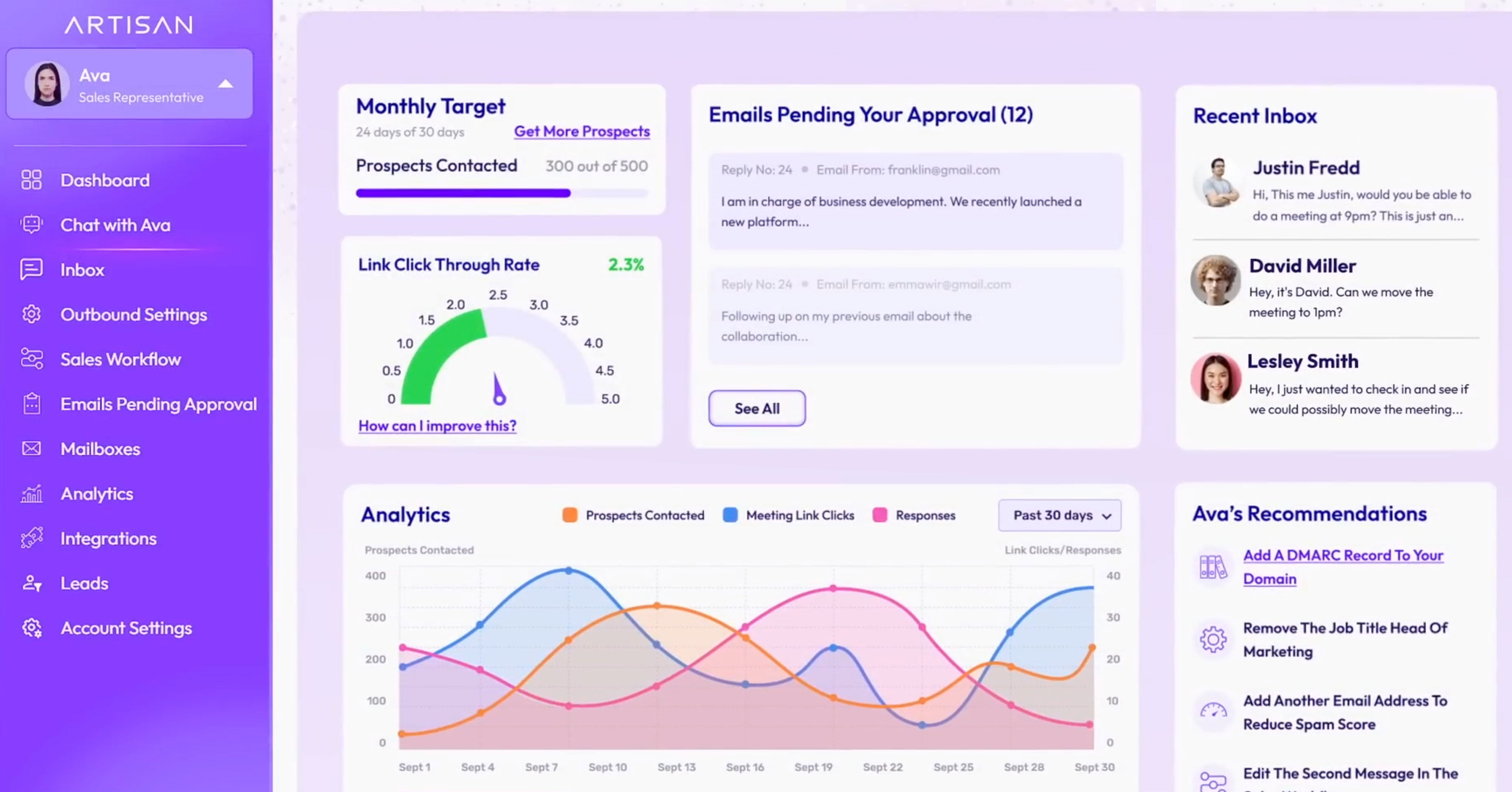
Artisan built its platform around a single positioning idea: AI employees, not AI tools. Ava is designed to operate as an autonomous member of the sales team rather than software a human configures and monitors, handling the full outbound workflow end to end from prospect identification through to meeting booking without requiring a human to approve each stage.
The prospecting engine monitors buying signals including job postings, funding announcements, leadership changes, and technology stack shifts to identify prospects at moments of genuine relevance. Artisan also handles the operational infrastructure many teams underestimate, including mailbox warming, deliverability monitoring, sending rotation, and CRM sync, making it one of the more complete out-of-the-box options in the market.
Key Features
- Autonomous prospect identification using signal-based triggers including job postings, funding, and tech stack changes
- Personalized multi-channel sequences across email and LinkedIn built and executed without human input
- Automated mailbox warming and deliverability infrastructure to protect sender reputation at scale
- Reply detection and response generation for common objections and follow-up scenarios
- CRM sync with real-time activity logging across the full outreach workflow
Pricing
Custom pricing based on contact volume and feature requirements. No public pricing tier available.
Pros and Cons
Pros
- Highly autonomous with minimal day-to-day human oversight required
- Signal-based prospecting improves outreach relevance and timing
- Strong deliverability infrastructure built into the platform
Cons
- Brand voice calibration requires meaningful upfront investment
- No public pricing creates friction in early evaluation
- Less suited to teams that want significant human control over each outreach step
Best For
Outbound-focused B2B teams that want a high degree of autonomous operation across the full prospecting workflow and are willing to invest in proper onboarding and brand voice calibration to get there.
11x.ai (Alice) - Best for Inbound Response and Outbound Prospecting
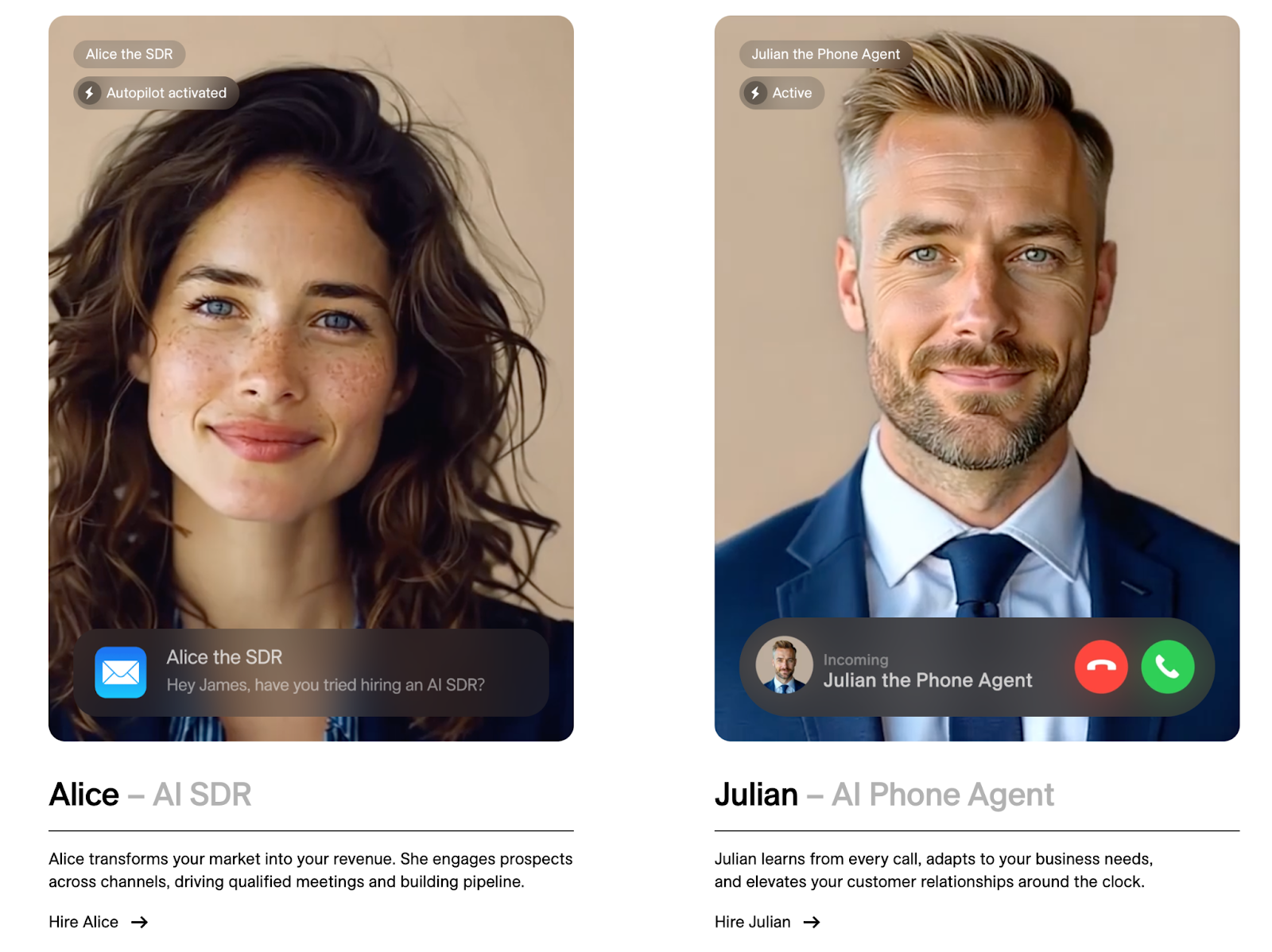
11x takes a two-agent approach that covers both sides of the pipeline in a single platform. Alice handles outbound prospecting and Jordan handles inbound qualification, and the two are designed to work in tandem for revenue teams that need coverage across both without adding headcount on either side.
Alice runs multi-channel sequences across email and LinkedIn around the clock, monitors engagement signals, interprets replies, and books meetings regardless of time zone. Jordan engages inbound leads immediately, qualifies them through conversation, and routes the right ones to a human rep with context already documented, addressing the response-time conversion leak that affects most teams with significant inbound traffic.
Key Features
- Alice manages end-to-end outbound including prospect research, sequence building, reply handling, and meeting booking
- Jordan qualifies inbound leads in real time and routes them to the appropriate human rep with context captured
- 24/7 operation across time zones with instant response capability on both inbound and outbound workflows
- Multi-channel execution across email and LinkedIn with engagement signal tracking
- CRM integration with major platforms and automated activity logging
Pricing
Custom pricing positioned for mid-market and enterprise buyers. No public pricing tiers available.
Pros and Cons
Pros
- Dual-agent model covers inbound and outbound in a single platform
- Strong volume capacity with consistent 24/7 operation
- Solid CRM integration across major platforms
Cons
- Custom-only pricing makes early budget comparison difficult
- Personalization depth is lighter than LinkedIn-focused competitors
- Dual agent setup adds onboarding complexity compared to single-focus tools
Best For
Revenue teams that need to scale both inbound response and outbound prospecting simultaneously without proportional headcount growth, particularly those where response speed on inbound is a known conversion problem.
Regie.ai - Best for Enhancing Rep Performance with AI
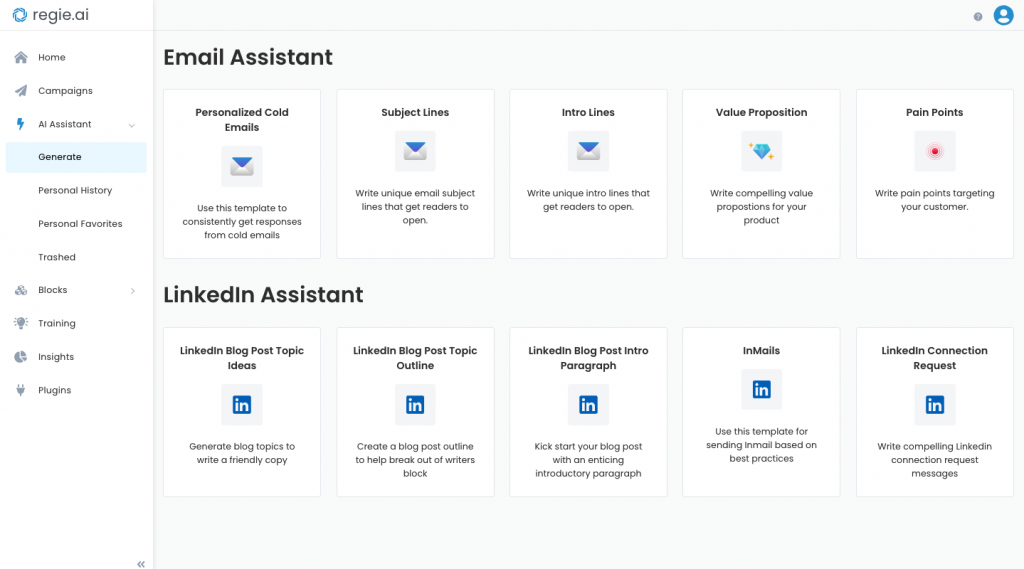
Regie.ai sits in a different part of the AI sales agent spectrum from the fully autonomous platforms on this list. Rather than replacing the human rep in the prospecting workflow, it positions itself as an AI copilot that makes human reps significantly faster and more effective. Sequences, messaging, personalization, and research are handled by the AI, but a rep stays in the loop for review and approval before outreach goes out.
The content generation capability draws on your company's own messaging library and past performance data, producing personalized sequences and call scripts that read better than generic AI output. Regie also offers an autonomous prospecting mode for teams ready to reduce oversight over time, making it one of the more accessible entry points for teams newer to this category.
Key Features
- AI-generated personalized sequences, follow-up messages, and call scripts grounded in prospect research
- Human-in-the-loop review flow for teams that want oversight before outreach is sent
- Autonomous prospecting mode for teams ready to reduce manual approval steps
- Messaging library integration that draws on your company's existing content and positioning
- Performance data feedback loop that improves content suggestions based on what has worked historically
Pricing
Starts from $180 per month per user for entry-level plans. Enterprise pricing available for teams requiring full autonomous operation and deeper integrations.
Pros and Cons
Pros
- Human-in-the-loop model suits teams not ready for full autonomy
- Strong content generation quality grounded in your own messaging library
- Accessible entry pricing makes evaluation low-risk
Cons
- Less autonomous than competitors built for hands-off operation
- Per-user pricing scales less favorably for larger teams
- Autonomous mode is less proven than dedicated AI SDR platforms
Best For
B2B sales teams that want AI to accelerate rep productivity rather than replace rep involvement, particularly those earlier in their AI adoption journey who want to build confidence before moving toward more autonomous operation.
Reply.io (Jason AI) - Best for True Multi-channel Outreach
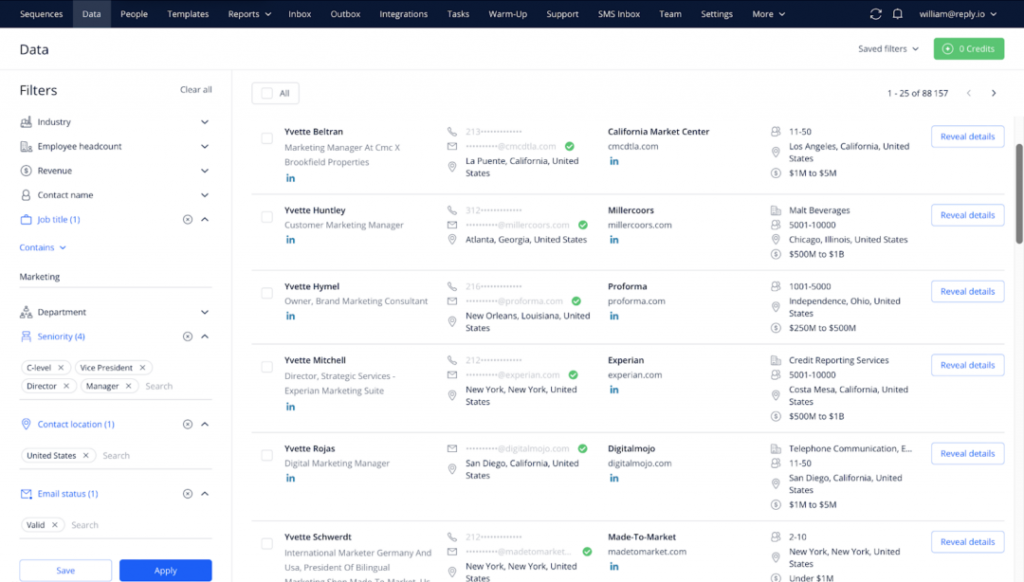
Reply.io has been a multi-channel sales engagement platform for several years, and Jason AI is the company's AI agent layer built on top of that existing infrastructure. The platform covers email, LinkedIn, calls, SMS, and WhatsApp within a single sequence, giving it broader channel coverage than most AI SDR platforms that focus primarily on email and LinkedIn.
Entry-level plans start at $500 per month, putting genuine AI-assisted outreach automation within reach for smaller teams and individual reps who cannot justify the custom enterprise pricing most dedicated AI SDR platforms require. The reply handling is one of the more capable in this price range, interpreting intent and responding contextually rather than just firing the next step in a fixed sequence.
Key Features
- Multi-channel sequence execution across email, LinkedIn, calls, SMS, and WhatsApp within a single workflow
- AI-powered prospect research and personalized sequence building without manual input for each contact
- Contextual reply detection and response generation across channels
- Meeting booking integrated directly into the outreach workflow
- CRM integration with major platforms and automated contact and activity sync
Pricing
Starts from $500 per month for Jason AI. Higher tiers required for full autonomous operation and advanced AI features.
Pros and Cons
Pros
- Broadest channel coverage of any platform on this list
- Accessible entry pricing for smaller teams and individual reps
- Strong reply handling quality relative to price point
Cons
- Depth of AI autonomy increases significantly in price at higher tiers
- Jack-of-all-trades positioning means it is not the deepest in any single channel
- Platform complexity increases with multi-channel configuration
Best For
B2B sales teams running true multi-channel outreach who need consistent AI-powered execution across email, LinkedIn, and calls within a single platform, particularly those working with tighter budgets than enterprise AI SDR platforms require.
AiSDR - Best for LinkedIn Outreach
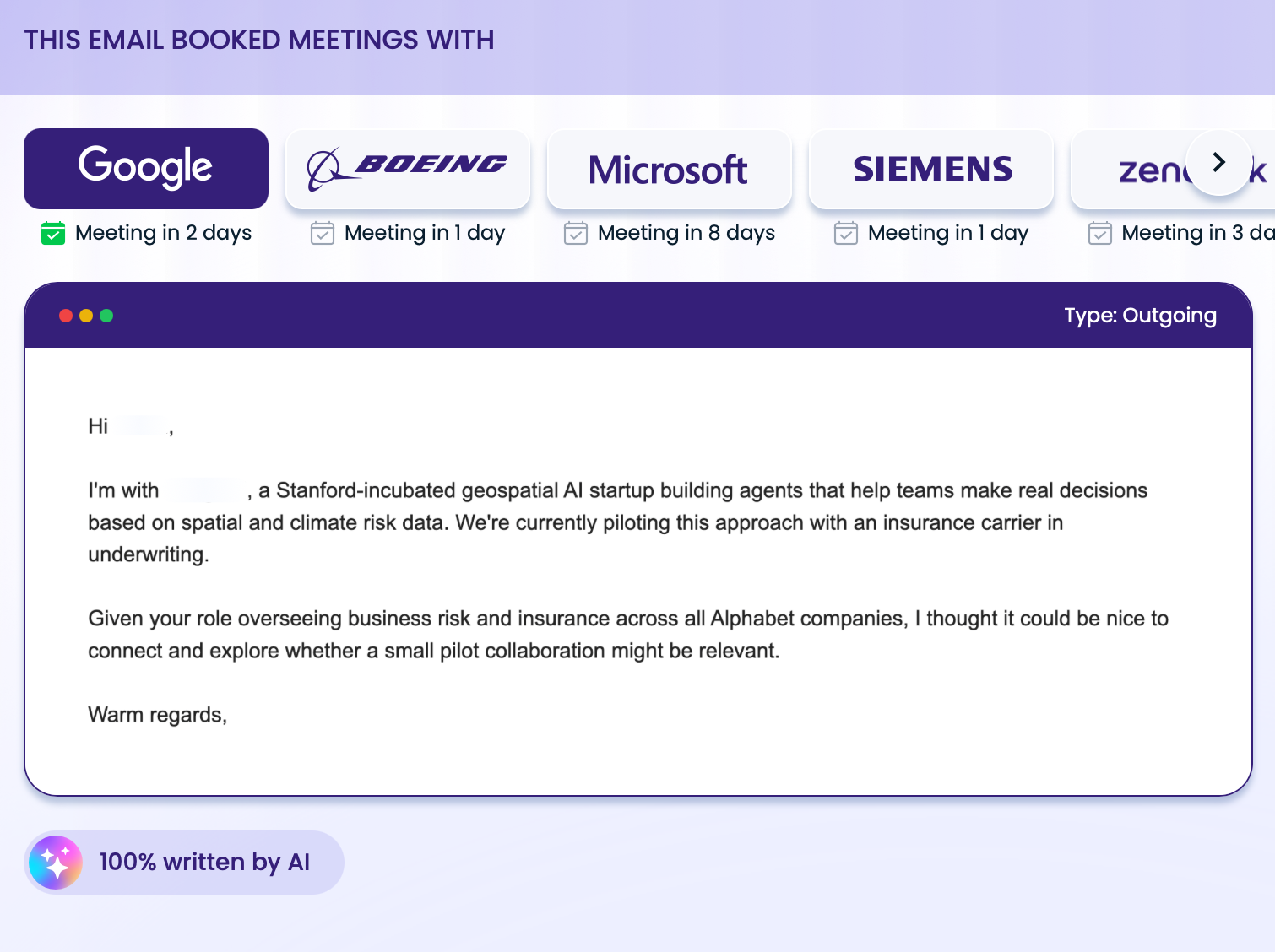
AiSDR has a key primary differentiator: personalization depth, specifically its use of LinkedIn activity data to inform outreach at the individual level. Rather than personalizing based on company-level signals, it pulls from what a specific prospect has posted, commented on, or engaged with recently, producing outreach that reads less like automated prospecting and more like genuine research.
The platform covers the full outreach workflow including sequence management, reply handling, lead scoring, and meeting booking. Pricing transparency is also a practical advantage here, with a published starting point around $750 per month, making early budget evaluation possible without entering a sales process just to get a number.
Key Features
- LinkedIn activity-based personalization drawing from prospect posts, comments, and engagement
- Automated outreach sequences across email with reply detection and contextual response generation
- Lead scoring based on engagement signals and qualification criteria configured to your ICP
- Meeting booking integrated into the reply workflow autonomously
- Native CRM integration with automated field updates and activity logging
Pricing
Starts from approximately $750 per month depending on contact volume and feature requirements.
Pros and Cons
Pros
- LinkedIn-based personalization produces more relevant and credible outreach
- Published pricing makes budget evaluation straightforward
- Strong reply handling and follow-up automation
Cons
- Personalization advantage diminishes if target market is not active on LinkedIn
- Higher starting price than multi-channel competitors at entry level
- Narrower channel focus than platforms covering email, calls, and LinkedIn together
Best For
B2B sales teams where LinkedIn is a core outreach channel and personalization quality is the primary lever for improving reply rates, particularly in markets where generic automated outreach is easy for prospects to spot and ignore.
Salesforge - Best for High-volume Email Outreach
Salesforge is built around a problem most AI SDR platforms treat as secondary: email deliverability. While competitors lead with prospecting intelligence or personalization, Salesforge leads with the infrastructure required to actually get outbound email into inboxes at scale. Mailbox management, warming, sending rotation, and deliverability monitoring are core to the product rather than features bolted on after the fact.
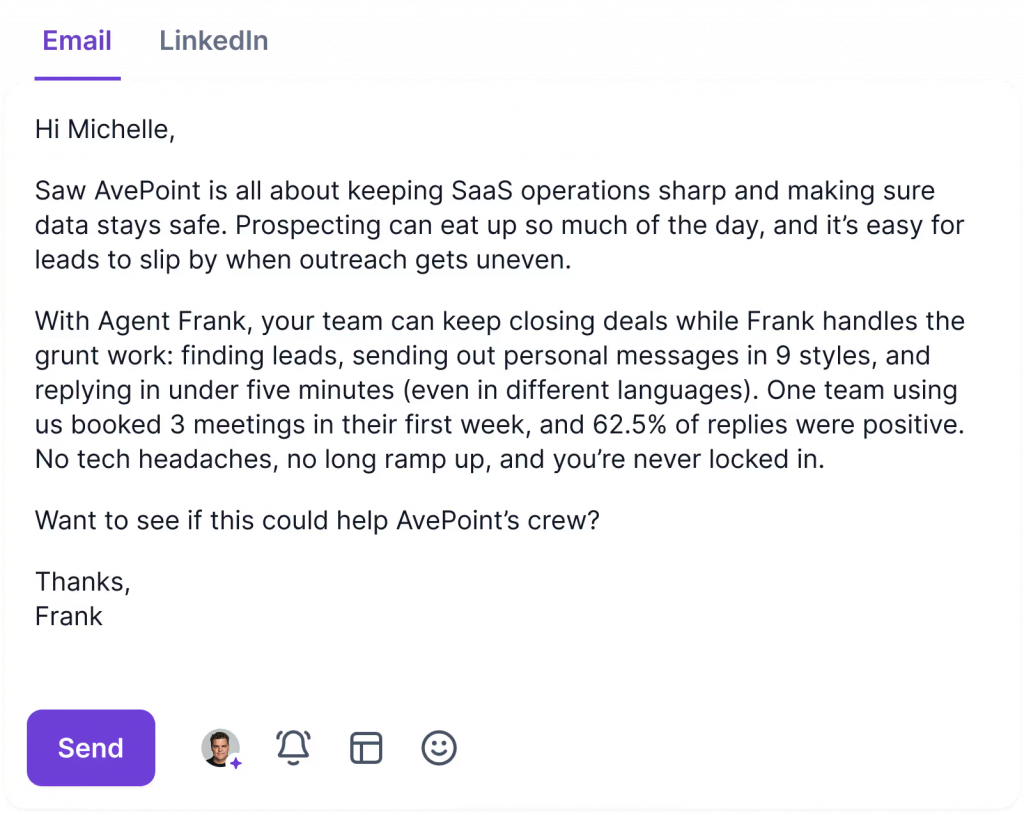
The AI outreach capability sits on top of that deliverability foundation, handling prospect research, sequence building, personalized email generation, and reply management with solid autonomy. Entry plans start around $40 per month (billed annually), and for teams that have had deliverability problems or are scaling outbound email for the first time, the cost-to-value ratio is one of the stronger cases in this category.
Key Features
- Mailbox warming and management infrastructure that protects sender reputation at outbound scale
- Sending rotation across multiple mailboxes to distribute volume and reduce spam risk
- AI-generated personalized email sequences with reply detection and response handling
- Deliverability monitoring with alerts when sending patterns indicate risk
- CRM integration with automated contact and activity sync
Pricing
Starts from approximately $40 per month for entry-level plans when billed annually. Higher tiers available for increased contact volume and advanced mailbox management features.
Pros and Cons
Pros
- Best-in-class deliverability infrastructure for high-volume email outreach
- Accessible pricing with a clear tier structure
- Strong foundation for teams scaling outbound email for the first time
Cons
- Less focus on prospecting intelligence compared to signal-based competitors
- Primarily email-focused with lighter LinkedIn and multi-channel capability
- Personalization depth is functional rather than a standout differentiator
Best For
B2B sales teams running high-volume email outreach who have experienced deliverability problems or are scaling outbound for the first time and want the sending infrastructure handled properly from the start.
How to Choose an AI Sales Agent
The most common mistake in evaluating AI sales agents is leading with features rather than fit. A platform with an impressive feature list is worthless unless it can match your team's primary use case, technical capacity, or existing stack. It is doomed to underperform relative to a simpler tool that slots cleanly into how your team actually works.
Always start off by listing out your primary use cases. Outbound automation, inbound qualification, personalization quality, and deliverability infrastructure are all distinct and different problems. Truth is that platforms built to solve each one are meaningfully different from each other. Trying to find a single tool that leads in all four categories will either end in compromise or in paying for capabilities you will not use.
Work through these evaluation criteria before shortlisting platforms:
- Primary use case: Are you solving an outbound volume problem, an inbound response time problem, a personalization quality problem, or a deliverability problem? Start there
- Autonomy comfort level: How much human oversight does your team want to maintain over outreach? Fully autonomous platforms require trust and solid onboarding. Human-in-the-loop platforms are more forgiving but require more rep involvement
- Integration requirements: Which CRM and sales tools does the agent need to connect to? Weak or incomplete integrations create data silos that undermine the whole point of automation
- Budget range: AI sales agents do not run cheap, most of the full featured options involve significant monthly investment. Fully autonomous AI SDR platforms typically start at $750 per month and scale to custom enterprise pricing
- Team technical capacity: Some platforms are genuinely plug-and-play. Others require meaningful configuration, data cleaning, and ongoing optimization. Be honest about who on your team will own this after the implementation call ends
One red flag we have to point out is that any platform that promises full human replacement across complex deal cycles is overpromising. AI sales agents are excellent at high-volume, repeatable, top-of-funnel work. They are not a substitute for experienced human judgment in multi-stakeholder enterprise deals or relationship-dependent sales motions. Category fit matters more than feature count.
FAQs
AI sales agents use machine learning and natural language processing to execute sales tasks autonomously, from identifying prospects and building outreach sequences to interpreting replies and booking meetings. They integrate with your CRM and sales tools to act on real data and improve their performance over time based on what they learn from interactions.
An AI sales agent operates autonomously, taking actions and making decisions independently for each step. An AI sales assistant augments what a human rep does by surfacing recommendations or drafting content while the human retains control over what gets sent and when.
A basic deployment can be operational within one to two weeks, but meaningful performance typically takes four to eight weeks of calibration and optimization. Teams that invest in proper brand voice setup and data quality upfront see results faster than those who deploy with default settings.
Most enterprise platforms build compliance features into their infrastructure including opt-out handling and consent management, but compliance responsibility ultimately sits with your organization. Verify that any platform you deploy meets the specific requirements of the regions you are prospecting into before sending at scale.
They can replace the high-volume repetitive prospecting work that consumes a large share of an SDR's time, but not the relationship development, complex negotiation, and strategic judgment that experienced reps bring to mid-cycle and late-stage deals. The teams getting the best results combine both.
Late-stage enterprise deals, situations requiring genuine empathy and nuanced judgment, and outreach where a misread response could damage a key relationship are all areas where human reps should stay in control. AI sales agents are optimized for volume and consistency at the top of the funnel, not the opposite.