
Summary: Zendesk is a user-friendly customer support platform crafted with an intuitive design and reasonable pricing perfect for dedicated support teams and small to mid-sized businesses. ServiceNow is a smarter fit for large enterprises searching for IT service management (ITSM) solutions mixed with customer service, complex workflow automation, and integration across enterprise systems.
Zendesk and ServiceNow are both established platforms offering customer service capabilities, but they serve fundamentally different organizational needs and contexts.
Zendesk has built its reputation as a dedicated customer support solution. It offers ticketing, omnichannel support, and analytics designed specifically for customer service teams.
ServiceNow conversely positions itself as an enterprise platform with a focus on customer service management (CSM) working as a single presence within a wider ITSM and enterprise service management ecosystem.
Which of the two customer service platforms will work best for your business? Our full Zendesk vs ServiceNow comparison will discuss pricing models, AI capabilities, features, use cases, and more.
- At A Glance
- How We Compared
- Key Differences
- Direct Comparison
- Pricing
- How To Choose
- Who's the Winner?
Zendesk vs ServiceNow: At a Glance
While both platforms fit different needs, ServiceNow is the strongest pick of the two for large enterprises who need to integrate IT service management with their customer service. Other better fit use cases are complex workflow automation across different departments and serving as a unified platform for all service-related tasks.
Still, Zendesk offers a plug-and-play and focused customer support solution that has faster implementation times and lower overall costs. Businesses that just want dedicated support tools without any enterprise-level complexity (or granularity) can rely on Zendesk.
Here’s a quick summary table for both providers to give you a general idea of where they stand toe-to-toe:
| Zendesk | ServiceNow | |
| Pricing | $55-$169 per agent/month | $100-$200+ per user/month (estimated, contact sales) |
| Primary Focus | Dedicated customer support | Enterprise service management with CSM module |
| Implementation Time | Days to weeks | Months to over a year |
| AI Capabilities | Ticket classification, routing, agent assistance | Predictive intelligence, virtual agents, automation |
| Best For | Support teams, SMBs, companies wanting dedicated support tools | Enterprises needing ITSM + CSM integration, complex workflows |
| Ease of Use | Intuitive, minimal training required | Steep learning curve, requires technical expertise |
How We Compared Zendesk vs ServiceNow
We used the following factors to compare Zendesk vs. ServiceNow. Below are some of the categories where they fundamentally differ:
- Core Functionality: We evaluated each platform's management of ticketing, case management, and customer service workflows
- AI Capabilities: We tested AI-powered features including those aimed in common categories like automation, predictive intelligence, and virtual agents
- Omnichannel Support: We compared channel coverage and how well each platform unifies customer communications overall to streamline support
- Analytics and Reporting: We looked at each platform's priorities when it came to reporting depth, customization options, and operational insights
- Integrations and Ecosystem: We compared available integrations and how each platform connects to existing and major enterprise systems
- Workflow Automation: We evaluated automation capabilities and complexity of workflow design
- Ease of Use: We assessed learning curves for agents, administrators, and technical teams
- Implementation Complexity: We examined setup requirements, time to value, and resource needs
- Scalability: We reviewed how each platform performs as organizations grow
- Pricing and Total Cost of Ownership: We analyzed pricing structures and calculated TCO scenarios
- Support and Resources: We evaluated vendor support, documentation, and community resources
- Target Use Cases: We identified which organizational contexts favor each platform
Key Differences Between Zendesk and ServiceNow
Before diving into detailed comparisons, it's imperative to comprehend that Zendesk and ServiceNow represent discrete categories, namely dedicated customer support versus enterprise service management.
As you consider each solution for your business, do consider core differences that exist in these major facets of how it handles functions:
- Platform Philosophy: Zendesk is entirely built ground-up for customer support with an intuitive interface designed for support agents. ServiceNow is an enterprise platform where customer service is one module within a broader ITSM ecosystem
- Complexity and Scope: Zendesk focuses on doing customer support exceptionally well. ServiceNow offers extensive capabilities across IT, HR, facilities, and customer service with complex workflow automation
- Implementation: Zendesk can be deployed in days or weeks with minimal technical expertise. ServiceNow typically requires months of implementation with dedicated technical resources or consultants
- Pricing Structure: Zendesk uses transparent per-agent pricing. ServiceNow pricing is customized per enterprise with significant variation based on modules and user counts
Zendesk vs ServiceNow: Direct Comparison
To assist you in choosing a platform for your needs, we’ve put each platform through tests across different facets of operation, here’s what we found:
Core Customer Support Functionality
Summary: Zendesk offers superior all-around customer support features with intuitive ticketing and agent tools. ServiceNow provides enterprise-grade case management, primarily in a service management context.
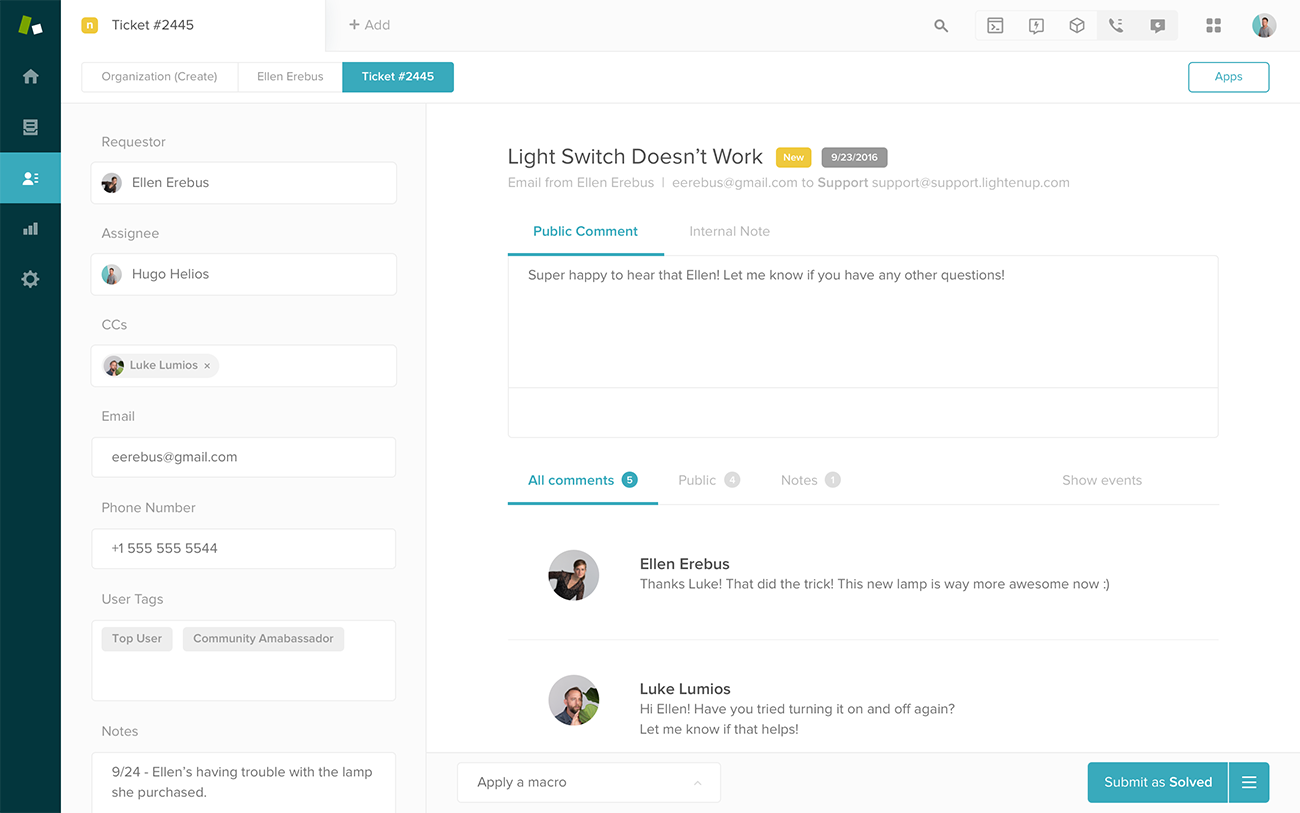
Zendesk is designed exclusively for customer support with ticketing at its core. The platform provides intuitive ticket views, collision detection (when agents accidentally take on the same case), SLA management, and side conversations. Most agents can manage tickets efficiently with minimal training due to its low learning curve. The interface focuses entirely on customer service workflows.
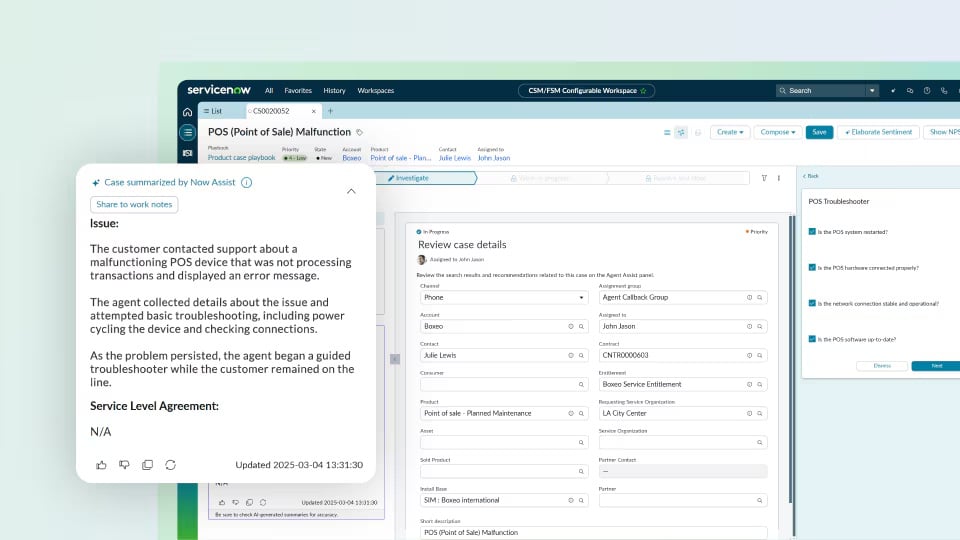
ServiceNow Customer Service Management (CSM) does offer case management as part of its enterprise platform. Cases can be linked to configuration items, incidents, and other records across ServiceNow's ecosystem. There is powerful workflow automation and extensive customization capabilities.
That being said, ServiceNow's interface is more complex and requires lengthy training. The platform is for enterprise service scenarios where customer support intersects with IT, operations, and other departments.
Winner: Zendesk wins for its dedicated customer support functionality with better usability and faster agent productivity.
AI Capabilities
Summary: Both platforms offer AI-powered features, but ServiceNow provides more comprehensive predictive intelligence and workflow automation, while Zendesk focuses on practical AI for support agents.
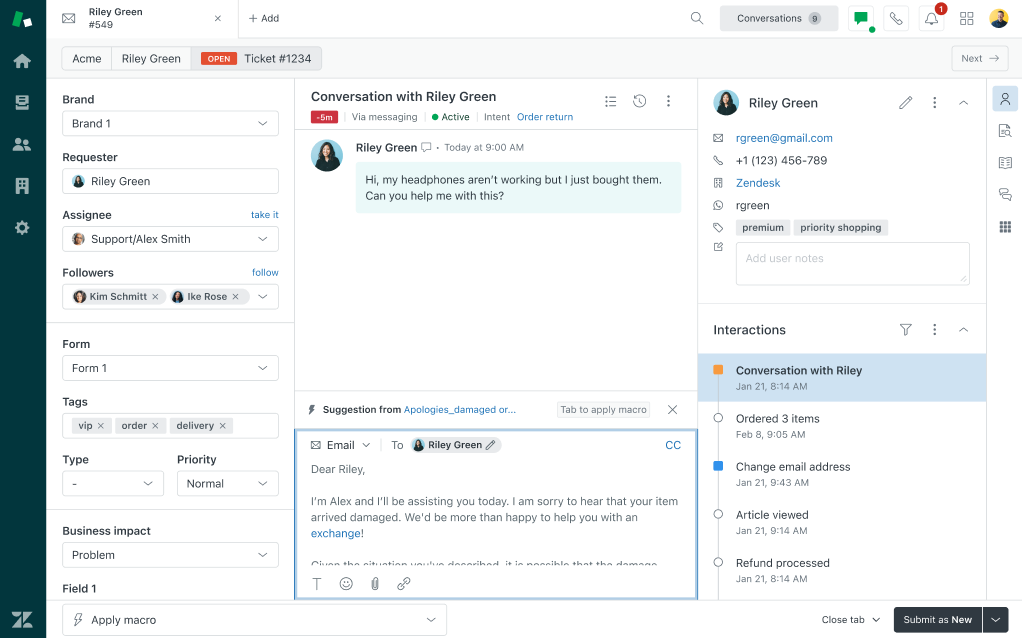
Zendesk's AI implementations are more practical and focused on the core concept of helping agents work more efficiently. The features require minimal configuration and work out of the box for most use cases. They even offer AI agents, though that will run as a premium outcome-based pricing add-on.
Zendesk AI Features:
- Intelligent ticket routing and classification based on content and context
- Intent detection that identifies customer needs from ticket text
- Macro suggestions that recommend responses based on ticket content
- CSAT prediction to identify at-risk customer interactions
- Article recommendations from knowledge base during ticket handling
- Sentiment analysis to gauge customer emotion
- Content Cues that flag potentially sensitive language
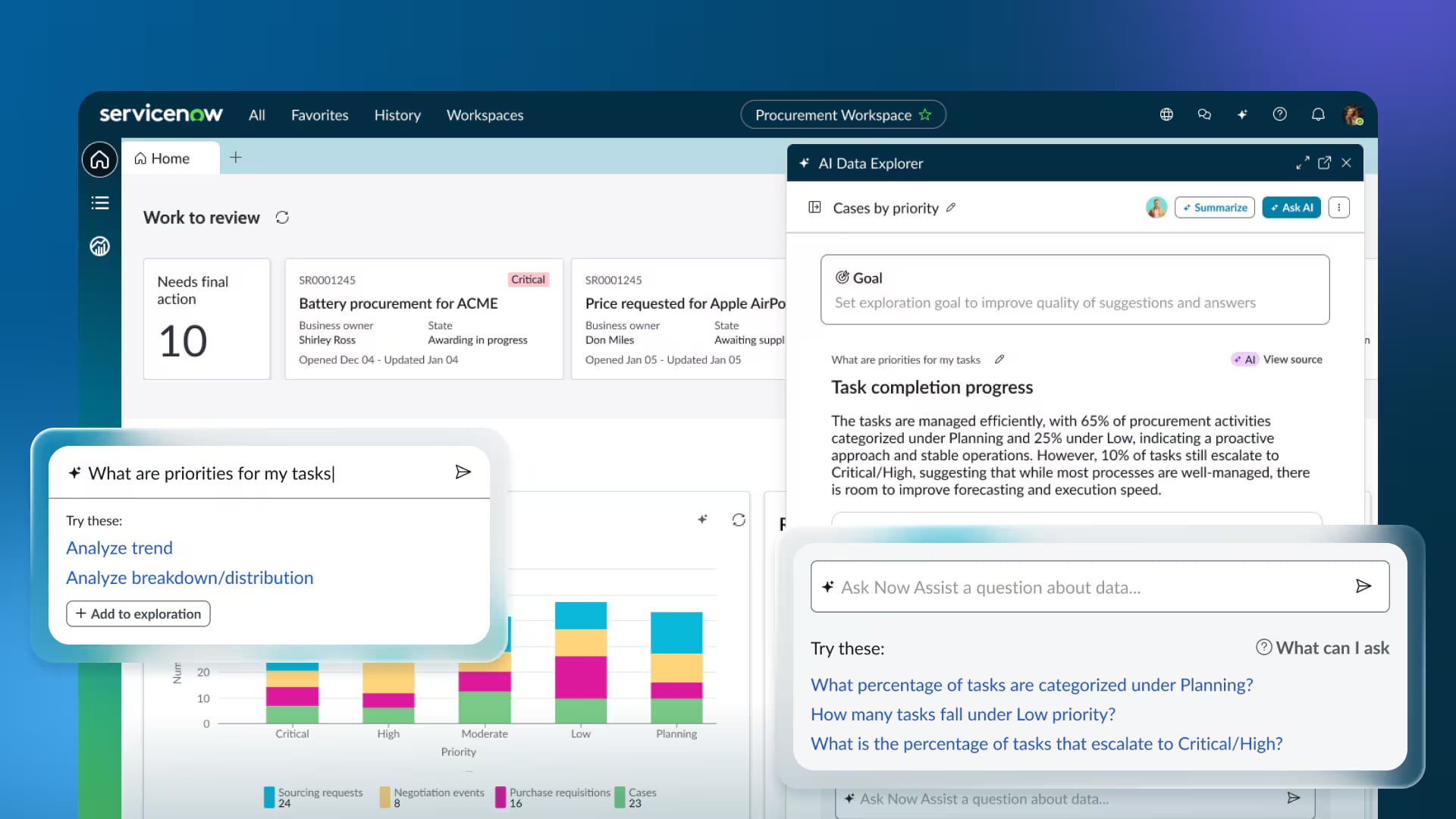
ServiceNow's AI capabilities are more extensive and integrate across the entire platform, even at the most basic configurations. Virtual Agent can handle complex multi-turn conversations and perform actions across systems. However, implementation will require significant configuration and technical expertise to maximize what your business can derive from it.
ServiceNow AI Features:
- Virtual Agent for conversational AI and autonomous issue resolution
- Predictive Intelligence for forecasting case volumes and SLA breaches
- Performance Analytics with AI-powered insights and anomaly detection
- Agent Intelligence that suggests knowledge articles and similar cases
- Automated case categorization and routing using machine learning
- Natural language understanding for complex query interpretation
- Workflow automation with AI-driven decision engines
Winner: ServiceNow wins with more comprehensive AI capabilities and deeper automation, though Zendesk offers more practical, ready-to-use AI for support teams.
Omnichannel Support
Summary: Zendesk provides comprehensive native omnichannel support, while ServiceNow offers channel coverage but with less seamless native integration.
Zendesk unifies chat, email, phone, social media (X/Facebook/etc.), SMS, and other apps into one singular agent interface. Zendesk provides voice via talk with IVR, call routing, and recording starting on Suite Team tiers.
ServiceNow offers omnichannel support for emails, chats, phone calls (via integrations), and information from self-service portals. The platform also integrates with telephony systems and messaging channels, but you'll need third-party connectors or customization via development.
Winner: Zendesk has better native overall omnichannel support and easier channel management compared with ServiceNow.
Analytics and Reporting
Summary: ServiceNow offers more powerful analytics with advanced customization and cross-platform reporting. Zendesk provides excellent support-focused analytics without much technical knowledge needed prior.
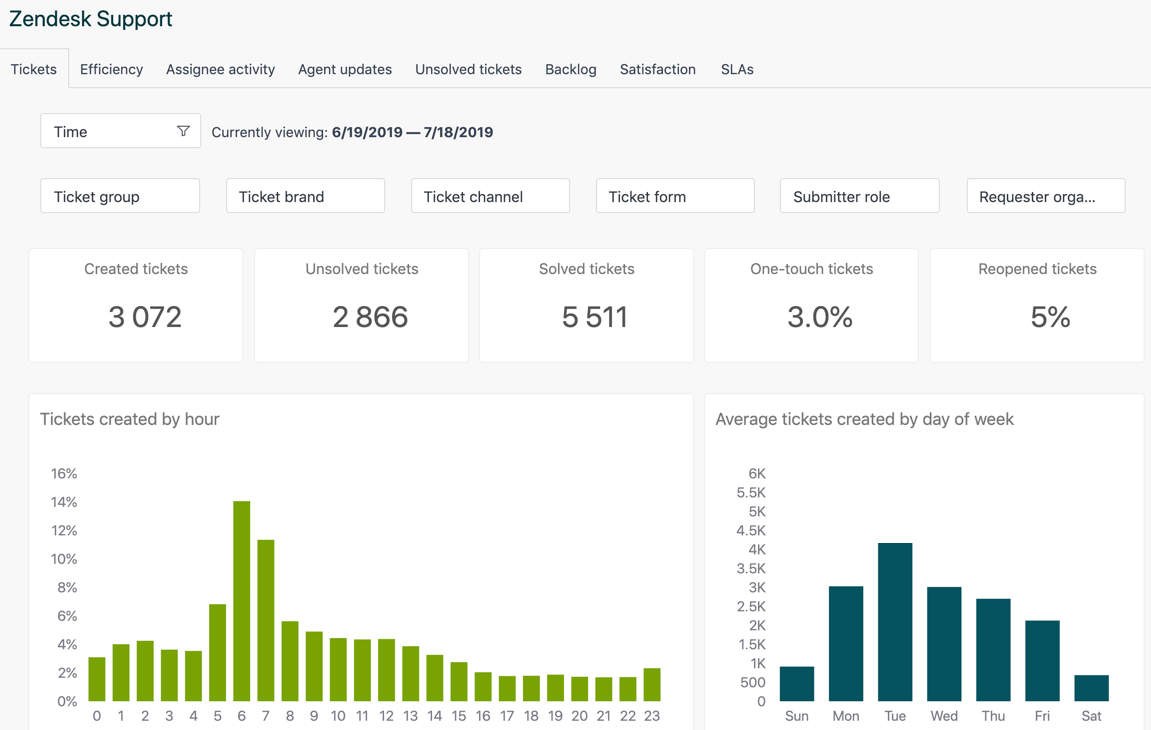
Zendesk provides extensive analytics thanks to an array of pre-built dashboards for ticket volume, CSAT scores, agent performance tracking, and response times. Zendesk Explore adds even more powerful reporting thanks to custom metrics and better filtering.
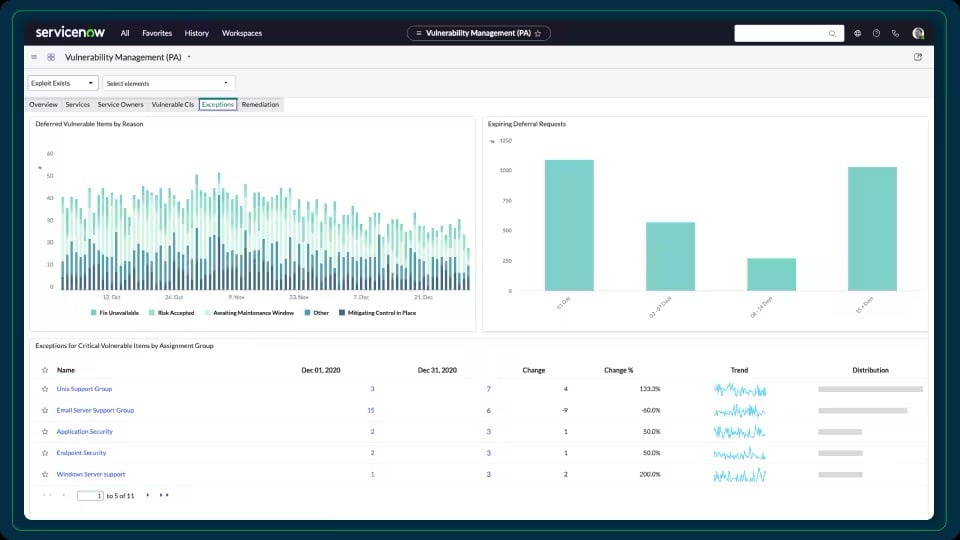
ServiceNow Performance Analytics delivers enterprise-grade reporting. It boasts robust customization, predictive analytics, and the added bonus of creating complex metrics across multiple modules. Power and flexibility come with complexity; those who want something plug-and-play may find this frustrating, but the depth is undeniable.
Winner: ServiceNow wins in raw analytics power and customization. Zendesk wins for those seeking ease of use. The right choice is based on whether you need cross-platform enterprise analytics or more support-focused metrics.
Integrations
Summary: Both platforms offer extensive integrations, with Zendesk providing more straightforward connections to support tools and ServiceNow excelling at enterprise system integration.
Zendesk's over 1,000 integrations include the major CRMs businesses use daily, a ton of e-commerce platforms, productivity tools, and a few specialized support applications. It’s well-established thanks to the time advantage Zendesk has had in the market.
ServiceNow integrates deeply with enterprise systems including ERPs (SAP, Oracle), HR systems ( likeWorkday), IT management tools (SCCM, SCOM), and major CRMs. ServiceNow's Integration Hub provides pre-built connectors as well as extensive API capabilities. That being said complex integrations need technical resources or consultants to implement properly, factor that in before choosing.
Winner: Draw. ServiceNow wins for enterprise system integration depth, while Zendesk wins for ease of integration with support tools. Your choice depends on integration complexity needs.
Ease of Use
Summary: Zendesk is much easier to use with an intuitive interface and minimal learning curve. ServiceNow requires much more training and technical expertise to wield to its fullest potential.
Zendesk is designed for usability. The agent interface is clean and intuitive, with most functions accessible within one or two clicks. New agents can typically start handling tickets with just an hour or two of training. The admin interface is straightforward, and most configuration tasks can be accomplished without technical knowledge.
ServiceNow has a steep learning curve for agents and administrators. The interface is powerful but the extensive menus, configuration options, and technical terminology leaves agents typically needing several days of training to become proficient. The platform assumes enterprise IT context and uses terminology unfamiliar to some support teams. This complexity enables extensive customization and enterprise-scale capabilities but at the cost of time.
Winner: Zendesk wins clearly within the realm of ease of use as it is accessible to teams without dedicated technical resources.
Implementation Complexity
Summary: Zendesk can be deployed in days to weeks with minimal resources, while ServiceNow typically requires months of implementation with consultants or dedicated teams.
Zendesk implementation is straightforward. Most organizations can configure basic ticketing, set up email integration, create help centers, and onboard agents within days. Full implementation with customization, integrations, and training typically takes 2-6 weeks. Most teams do not need external consultants (an added expense) to get started.
ServiceNow implementation is a major enterprise undergoing. Initial CSM deployment typically takes 3-6 months, and comprehensive implementations can take well over a year to be done properly. The process requires technical resources familiar with ServiceNow architecture. We found most businesses end up hiring ServiceNow consultants or system integrators (another unexpected cost).
Winner: Zendesk wins with drastically faster implementation with lower resource requirements.
Scalability
Summary: Both platforms scale to enterprise size, but ServiceNow is purpose-built for the largest global organizations while Zendesk scales efficiently for most businesses.
Zendesk supports organizations from small teams to global support operations with thousands of agents. The platform handles high volumes efficiently with multi-brand configurations and administrative controls for large teams.
ServiceNow is designed specifically for the largest global enterprises with tens of thousands of users across multiple service functions. The platform handles extreme complexity and integrates across massive enterprise technology stacks. ServiceNow provides capabilities Zendesk cannot match on a global level.
Winner: ServiceNow wins for the most demanding enterprise scenarios, while Zendesk scales appropriately for dedicated customer support at most organizational sizes.
Self-Service Capabilities
Summary: Both platforms offer self-service portals and knowledge bases, with Zendesk providing easier setup and ServiceNow offering more customization.
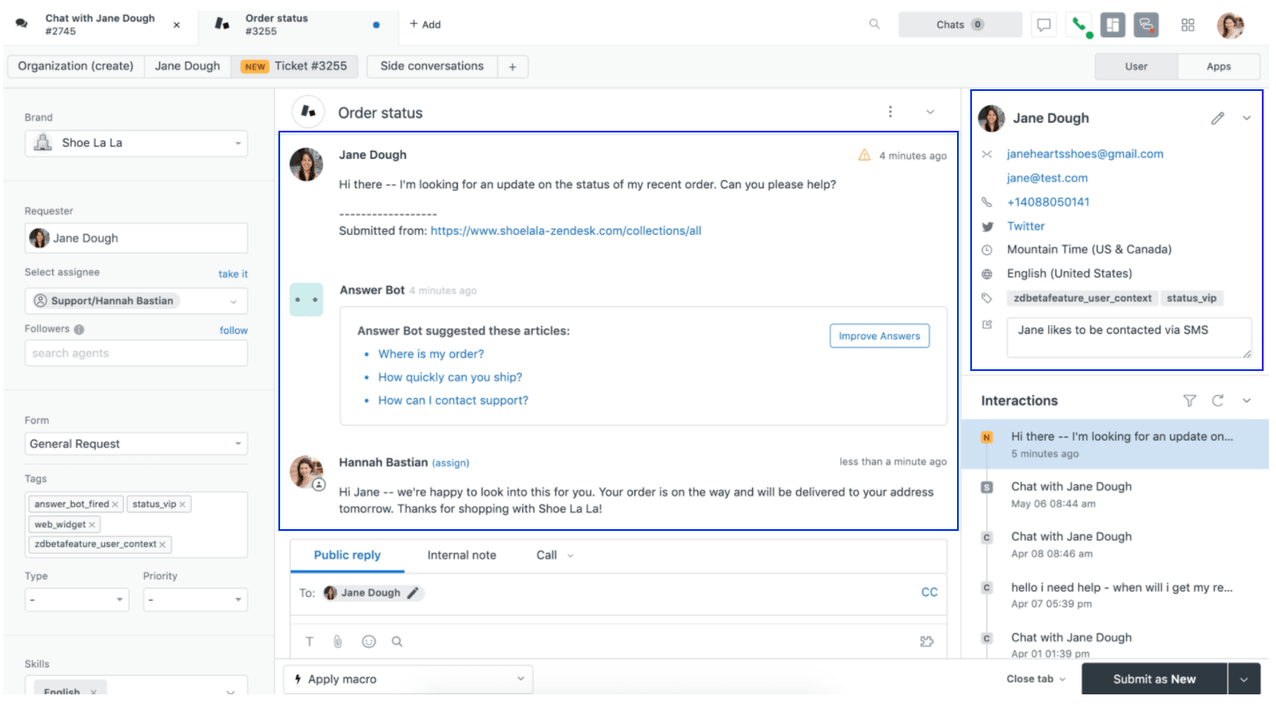
Zendesk Guide facilitates help center creation. The platform provides custom templates, multi-language support, and community forums. Knowledge base content seamlessly integrates with ticketing and will even suggest relevant articles as agents handle their tickets. Customer portals enable users to submit tickets, track query status, and even troubleshoot answers on their own without any human intervention needed.
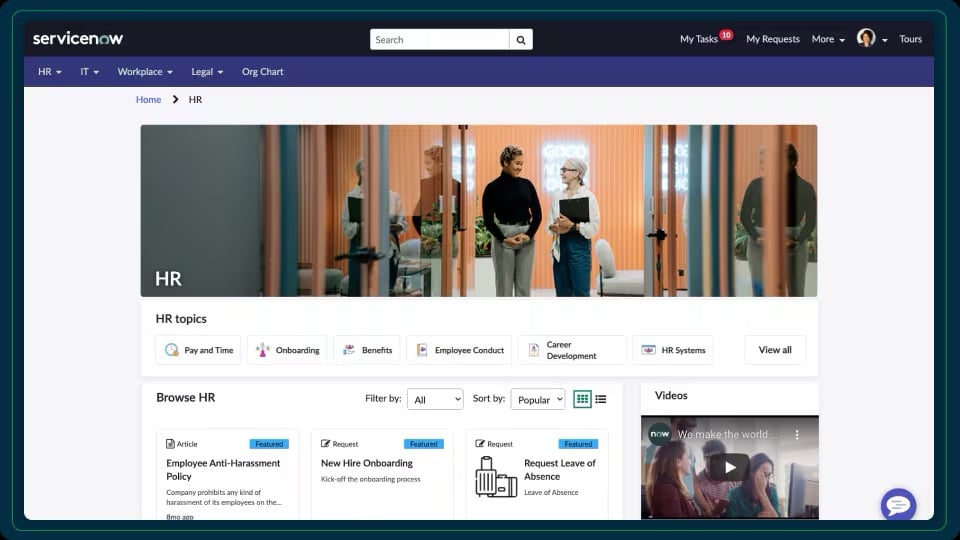
ServiceNow Service Portal provides richly customizable self-service experiences via widgets, custom pages, and layouts. The platform supports branded portals for different audiences with role-based content. Knowledge Management in ServiceNow offers powerful capabilities including knowledge lifecycle management, article feedback, and integration across modules. However, portal customization requires development skills and more human effort.
Winner: It's a draw. Zendesk wins for ease of setup and use. ServiceNow wins for those seeking customization depth.
Customer Support
Summary: Both vendors provide enterprise support, with Zendesk offering more accessible resources and ServiceNow providing dedicated account teams for large implementations.
| Zendesk Support | ServiceNow Support | |
| Support Tiers | Based on plan level | Based on contract |
| Phone Support | Enterprise plans | Available |
| Documentation | Extensive, well-organized | Comprehensive, technical |
| Community | Active forums | Large partner ecosystem |
| Training | Self-paced and instructor-led | ServiceNow University, certifications |
Zendesk provides tiered support with faster response times on higher plans. The documentation is excellent and written for support professionals rather than technical administrators. The community is active with helpful content.
ServiceNow provides enterprise support with dedicated Technical Account Managers for large customers. ServiceNow University offers extensive training, certifications, and professional development paths.
The ecosystem includes thousands of implementation partners and consultants. However, the technical nature of the platform means organizations typically need professional services for complex implementations.
Winner: Zendesk wins for accessibility and ease of learning, but note that ServiceNow provides deeper enterprise support for complex deployments.
Pricing and Total Cost of Ownership
Summary: Zendesk offers far more predictable cost of ownership through an available pricing model, whereas ServiceNow will require a sales quote. ServiceNow is considerably more expensive.
Below we’ve put each of the provider’s plans in a respective table since each offers a different pricing model.
Zendesk Pricing
Zendesk pricing starts as low as $19/user/month though that tier cuts out major nonnegotiable features like voice support, multilingual support, and AI found on the Suite tier at just $55/user/month. It also offers up add-ons like Copilot at just $50/user/month and Advanced AI Agents at an outcome-based pricing model.
| Plan | Price per Agent/Month | Key Features |
| Support Team | $19 | Ticketing, messaging, help center, reporting |
| Suite Team | $55 | Advanced AI, multilingual support, SLA management, Voice (Zendesk Talk support starts at this tier) |
| Suite Professional | $115 | Custom roles, sandbox, HIPAA compliance, advanced analytics |
| Suite Enterprise | $169 | Dedicated success manager, advanced security, custom capacity |
| Copilot | $50 | Proactive AI-assistance to automate tasks, recommend next steps, and keep teams on the same page |
| Advanced AI Agents | Contact Sales | Autonomous resolution bots to take care of service issues |
ServiceNow Pricing
ServiceNow uses custom enterprise pricing that varies significantly based on modules, user counts, and contract terms. These are the estimated costs based on some users’ disclosed pricing:
| Configuration | Estimated Annual Cost |
| CSM for Small Team (25 users) | $50,000-$75,000+ |
| CSM for Mid-Market (100 users) | $150,000-$250,000+ |
| Enterprise CSM + ITSM (500+ users) | $500,000-$1,000,000+ |
Note: ServiceNow pricing includes platform fees, user licenses, and module subscriptions. Implementation costs (consultants, customization) often equal or exceed licensing costs.
Total Cost of Ownership Comparison
Zendesk TCO is predictable with clear per-agent pricing and optional add-ons. Implementation costs are minimal, and ongoing administration doesn't require dedicated technical staff.
ServiceNow TCO is just overall higher, including not just licensing but significant implementation costs (running in the six-figure range on average), ongoing administrator/developer resources, and consultant fees for customization. However, for enterprises replacing multiple systems, the consolidation might provide long-term ROI.
Winner: Zendesk is far more cost-effective for dedicated customer support. ServiceNow pricing reflects its enterprise platform positioning and may provide value when replacing multiple systems.
How to Choose Between Zendesk and ServiceNow
Choosing between these two platforms will come down to some core questions that fall under some basic umbrellas and tenets. Before you choose consider the following:
- Assess Your Organizational Context: Dedicated customer support team? Choose Zendesk. Enterprise needing customer service integrated with IT, HR, and operations? Consider ServiceNow.
- Evaluate Implementation Resources: Can you deploy in weeks with minimal technical resources? Choose Zendesk. Have months for implementation with dedicated technical teams or consultants? ServiceNow becomes viable.
- Consider Your Budget: Looking for transparent, affordable per-agent pricing? Choose Zendesk. Have an enterprise budget for platform licensing and implementation? ServiceNow is an option.
- Assess Technical Capabilities: Support team without dedicated technical resources? Choose Zendesk. Enterprise with IT teams, developers, and ServiceNow expertise? ServiceNow leverages these capabilities.
Other Alternatives to Consider
- Salesforce Service Cloud: Enterprise customer service platform with deep CRM integration, positioned between Zendesk and ServiceNow in complexity and cost.
- Freshdesk: Budget-friendly Zendesk alternative with solid features at lower price points for small to mid-sized teams.
Zendesk vs ServiceNow: Which is the Winner?
Though Zendesk and ServiceNow both offer customer service capabilities, they serve very different needs and use cases that need to be considered.
If you need dedicated customer support software which is affordable, easy to use, quick to implement, and designed specifically for support teams, then Zendesk is the way to go.
Larger enterprises needing customer service integrated with IT service management or complex workflow automation across departments might choose differently. They will find that ServiceNow's comprehensive capabilities are worth the significant investment in cost and implementation effort.