
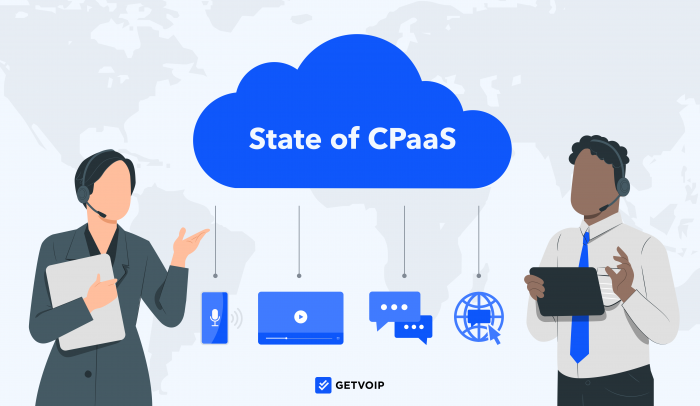
Voice calls, SMS messaging, video conferencing, APIs, analytics, management capabilities, customer management, etc., are the respective backbones of CPaaS. CPaaS also usually enables app functionalities like authentication/verification, call recording, transcription, caller identification tools, speech recognition, and more.
The global Communication Platform as a Service market, worth $32 billion in 2025 is expected to grow to as much as $100 billion by 2030.[*] That growth is on par with what we've seen in past years regarding the expansion of programmable communications growing in popularity.
Webex Connect, Amazon Chime, Twilio, and MessageBird all play a role in the market that continues to shape customer and user experience.
The biggest perk of CPaaS is that it makes the jobs of developers, employees, and even the customer experience better. Essentially, developers can beef up their stacks without reinventing the wheel with backend infrastructure or expensive hardware.
While the CPaaS industry looks to continue on some familiar paths in 2025, such as flexibility and customizability, the market also suggests several new trends: omnichannel communication, the use of AI, and an increase in rich messaging.
Omnichannel Communication to Differentiate Customer Experience
CPaaS software enables companies to select which communication channels to offer their customers. Organizations and call centers can integrate channels like voice, SMS, video, and live chat into their websites and apps, making it easy for customers to reach them in various ways.
Offering multiple communication channels is only half the battle, however, as many customers prefer to switch channels and expect context retention. At Twilio Signal 2025, Twilio addresses this with Conversational Intelligence, an AI-driven tool that lets users analyze customer interactions across channels, identifying sentiment, intent, and points of friction.
Sinch similarly announced richer WhatsApp/RCS support, unified conversation views, and SMS automation in 2025.
As companies seek to provide greater convenience for customers in 2026, they will continue to integrate the channels their customers use with a more seamless customer experience.
AI No Longer Optional, Essential For Customer Service
With AI-powered APIs like conversational chatbots and intelligent virtual agents, the CPaaS market will continue to participate in this machine-learning trend.
In January 2025, Twilio released a new feature of its AI-powered voice intelligence tool that enables it to analyze live voice call transcripts and extract actionable insights in real-time.
Machine learning can power customer self-service 24 hours a day, effectively cutting down on a team's employment needs and reducing staffing expenses. Using natural language understanding (NLU), IVA systems are becoming increasingly conversational, capable of offering more responses to a wider variety of customer inputs. Additionally, businesses may soon experience reductions in customer service inquiries due to the use of unofficial third-party GenAI tools such as ChatGPT, Google AI Overviews, and Apple Intelligence. Gartner predicts that by 2027, 40% of customer service issues will be solved by such tools.[*]
Vonage and Twilio both announced improved real-time AI integrations allowing developers to build AI workflows into other applications such as video meetings and voice interactions. Twilio's ConversationRelay enables developers to bring their own LLM or integrate with a third party app such as Google in order to implement speech-to-text or text-to-speech automation workflows with built-in conversation intelligence.[*]
A Thriving Low-and-No-Code Environment
In 2026 it is likely that the low-and-no-code development will continue to thrive.
While skilled developers are largely underpaid and overworked, the swift advancement of artificial intelligence has made them practically obsolete. These factors have contributed to near-perfect conditions for low code and no-code CPaaS solutions. It will also likely ensure the success and longevity of said CPaaS.
In order to cater to users without coding knowledge, many providers have begun offering lown-and-no-code solutions such as visual builders, reusable templates, and workflow automation layers. Cisco's Webex Connect, for example, includes a low-code builder and pre-packaged SaaS applications for marketing campaigns, conversation support, and automated notifications.
That's A Wrap
There will undoubtedly be some mergers/acquisitions: along with 'major' announcements from firms leading the way in the space. Vonage, Twilio, and others are the ones to be on the lookout for as they are not only leaders in the space - but what they tend to do - others tend to follow.