Conversational AI is a technology that lets humans have natural-sounding, back-and-forth conversations with intelligent virtual assistants like voice agents and chatbots. Conversational AI understands what someone is saying, the intent and context behind it, and their emotional state (sentiment) when saying it. It then generates an accurate, human-like response that resolves the issue, pulls in a human agent for further assistance, asks further relevant questions, or collects key data.
When executed well, conversational AI for customer service resolves routine high-volume tier-one support requests or connects the customer to the best available human agent that can. When poorly deployed, conversational AI is purely a deflection tool that gatekeeps access to human support, fails to resolve even basic issues, and damages the customer experience. In fact, 61% of consumers report feeling more frustrated when an AI bot fails to resolve their issue than when a human agent does in the same situation.
Orient the reader in one sentence on what conversational AI for customer service is, then give the bottom line: it resolves routine, high-volume requests across chat, messaging and voice and hands complex or emotional issues to humans with context, and it pays off only when deployed with guardrails rather than as a pure deflection tool.
This guide helps CX leaders navigate the tension between leveraging conversational AI to keep support costs down and preserving (even strengthening) relationships with customers that took years to build.
What is Conversational AI for Customer Service?
Conversational AI for customer service is a technology that lets customers describe a problem in plain language, understands the context and intent behind the issue, then responds to and resolves the problem without involving a human agent.
| Agent Type | How it understands requests | Actions it can take | Best For |
| Rules-based bot | Keyword matching, fixed decision trees | Provides pre-written answers to select questions, collects form data, routes customers to human support queues | Simple, predictable, and routine FAQs |
| Generative AI agent | NLP + LLMs interpret phrasing and intent | Composes answers grounded in knowledge base data, limited (if any) backend actions | Tier-1 support questions with answers in connected knowledge base |
| Agentic/Conversational AI agent | LLM reasoning + intent, context, and customer data | Executes tasks via APIs within permission limits, transfers to human agents with full context preservation | Complex, multi-step tasks that may or may not require human assistance |
Rules-Based Responses
The technology has evolved dramatically over the past few years. It started as rules-based bots that could only answer questions when customers used specific keywords or phrases.
These chatbots or voicebots use speech-to-text to transcribe the customer response and Natural Language Processing (NLP) to understand the customer request. Responses, however, were limited to pre-written options and bound by rigid decision trees.
Generative AI
Then came generative AI: bots that use massive data sets called Large Language Models (LLMs) and integrated knowledge base content to compose human-sounding responses to plain language questions in real time. Unlike rules-based bots that provide the same answers to the same questions, GenAI uses machine learning to improve its responses with every interaction. Machine learning recognizes patterns, improves accuracy over time, and even predicts customer needs based on previous conversations.
Unlike rules-based bots, GenAI understands slang, typos, unexpected phrasing, and colloquialisms: the way we as humans actually talk. It summarizes complex policies in language that’s easy for everyone to understand and quickly locates the exact information needed to solve a customer problem. As we’ve seen with tools like ChatGPT, GenAI can create text, audio, images, videos, and even code.
But while GenAI can talk about problems, it can’t take action to truly resolve them. For example, while it can explain a return policy to a customer, it can’t actually process the return.
Agentic AI
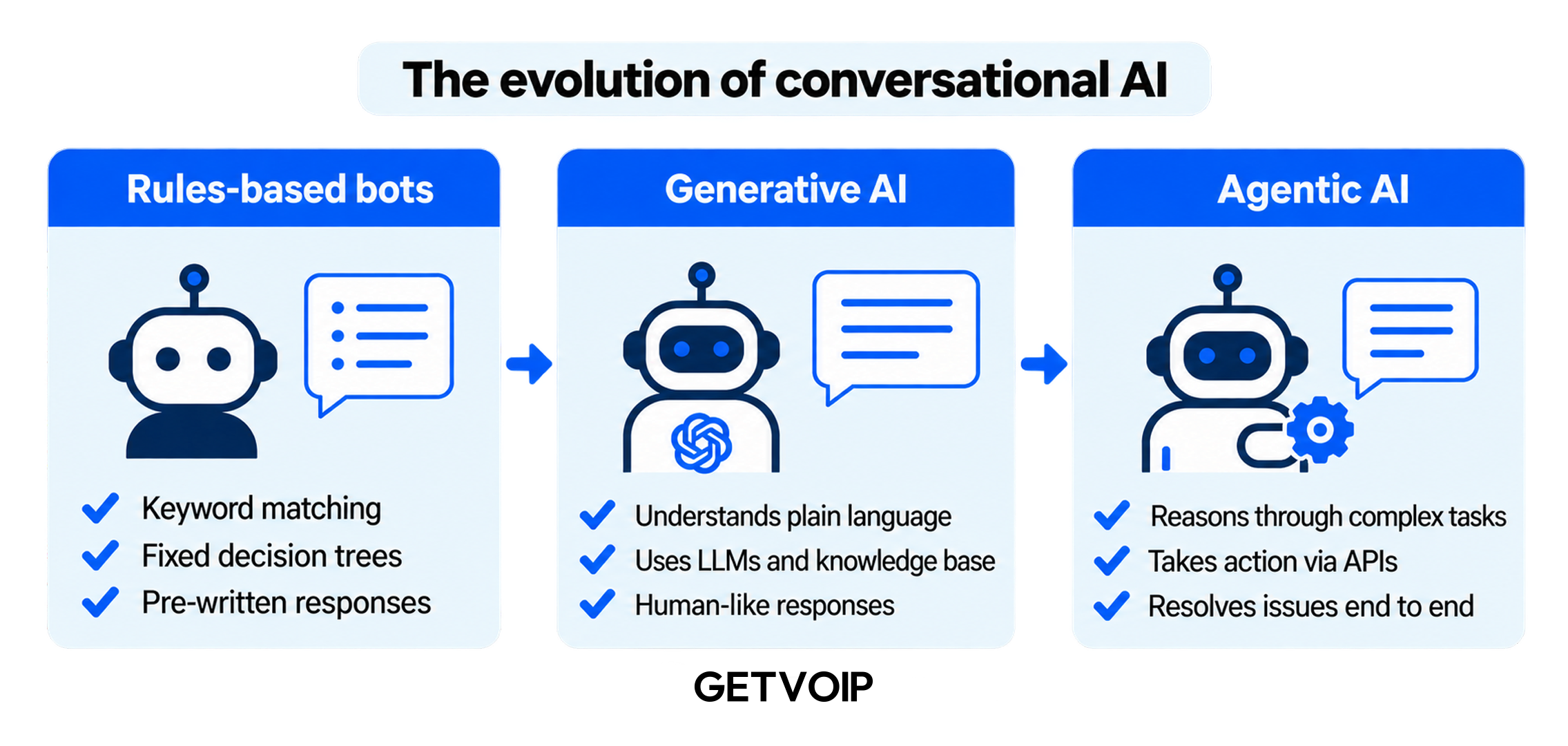
Enter agentic AI: a technology that understands the question being asked, finds the best solution, then executes that solution autonomously (on its own, without involving a human agent.) Agentic AI still uses LLMs to understand what a customer is asking, and still uses GenAI to create responses. But it goes much further.
Agentic AI can actually reason through complex, multi-step tasks, understand customer sentiment and intent, and take action inside backend systems. Using APIs to connect to CRM systems, contact centers, sales and analytics tools, knowledge bases, and more, agentic AI agents can verify customer identity, issue refunds, process orders, escalate the customer to a live agent, and much more: all within a single conversation.
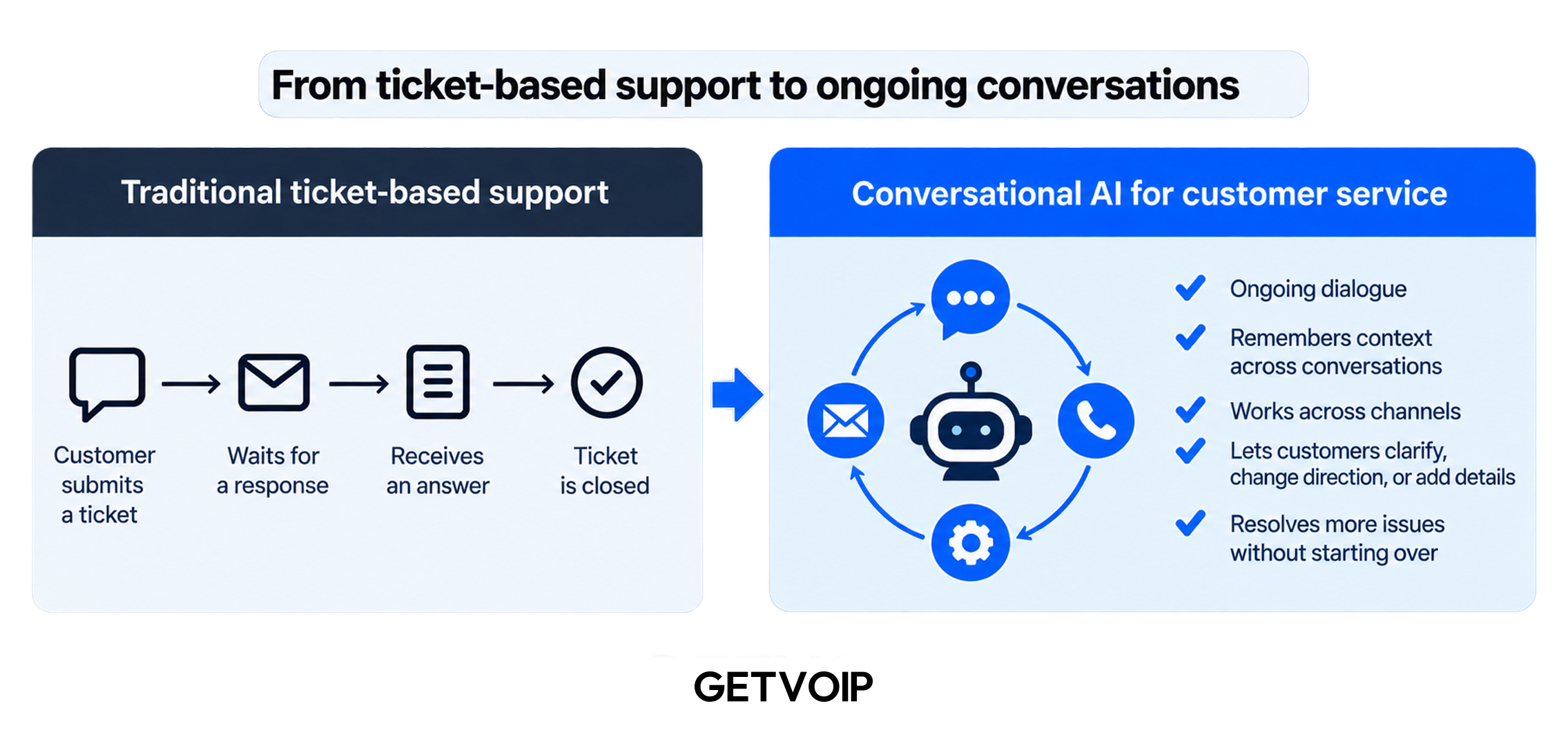
Conversational AI fundamentally changes the shape of customer support. Traditional ticket-based support is largely transactional: a customer submits a request, eventually gets a response, then the ticket is closed. Conversational AI, on the other hand, is an ongoing dialogue. It keeps track of context across follow-up conversations and questions, it picks up where the last conversation left off (even across channels), and lets the customer clarify, change their mind, or ask an entirely different question without starting the conversation over from scratch.
How conversational AI handles a customer request
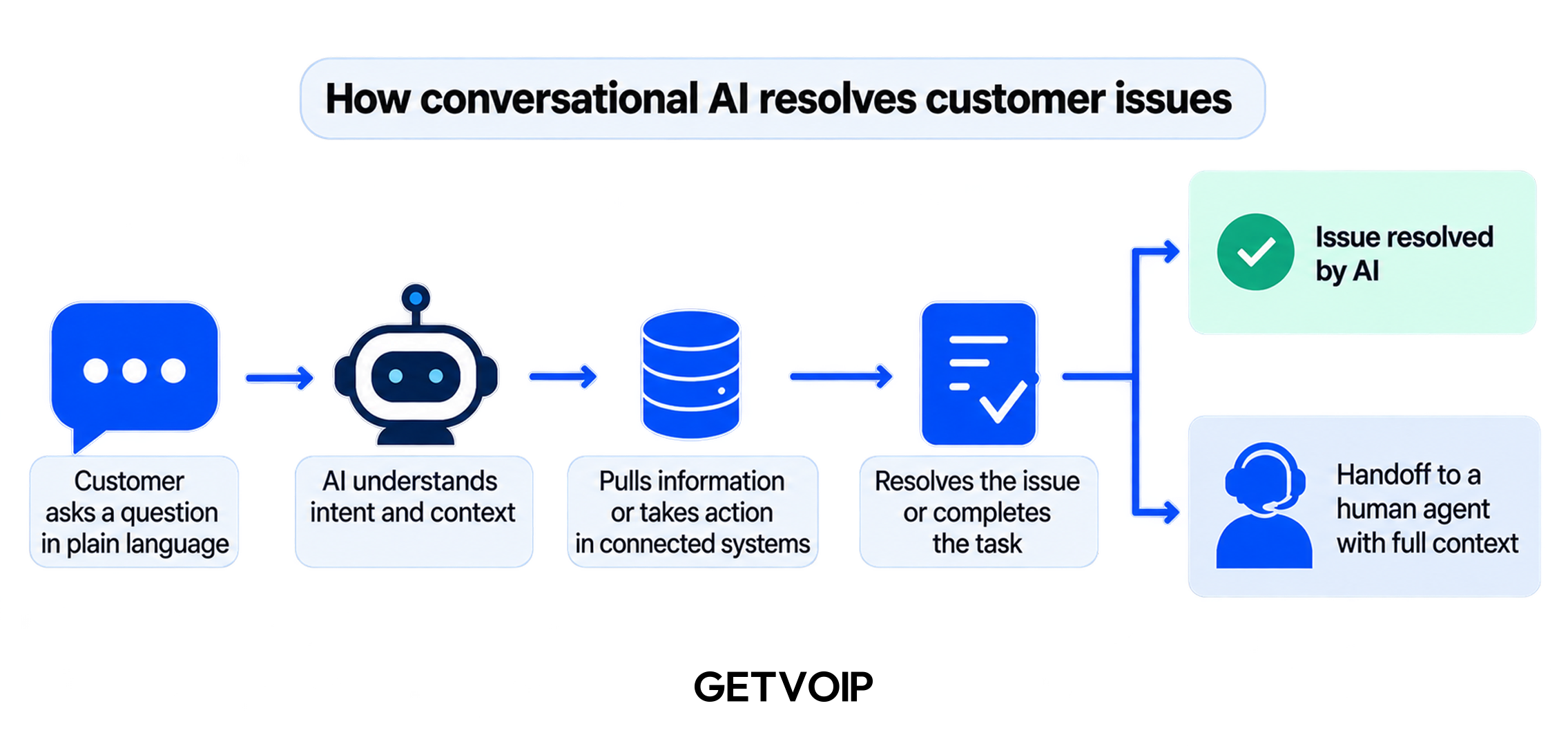
The simplest way to understand the mechanics of conversational AI is to follow a single request through the system. Let’s say a customer opens up the chat widget on a shoe retailer’s website and types, “Hi, I want to return the boots I ordered last week, they’re too small.”
Step 1: Intent Recognition and Multi-Turn Context
First, the system identifies the intent (a shoe return) and the key pieces of information the customer provided (customer ordered boots, last week, in the wrong size.) Next, it determines the information the customer didn’t provide, but that’s necessary to resolve the issue: the order number, whether the customer wants a refund/store credit or the shoes in another size, where the boots were shipped, etc.
Rather than sending the customer a form to fill out, the AI agent asks for the pieces of missing information one at a time, retaining and learning from each answer.
For example, if the customer says, “Can I just swap them for the next size up?” the AI agent understands that it’s processing an exchange, nor a refund, without having to ask the customer.
Step 2: Knowledge and Data Retrieval
With the key information obtained, the AI agent needs to now ground its response in actual data, not estimations.
It then pulls the customer’s order history and account details from the connected CRM system, verifies the company’s return/exchange policy in the knowledge base/helpdesk tool, and verifies that the correct size is currently in stock.
Step 3: Executes The Exchange
While a generative AI agent could tell the customer how to make the exchange themselves, an agentic AI agent can actually process it.
Before executing the return, the conversational AI agent first checks its permissions and approval limits to ensure its acting within the guardrails. Is the act of issuing the exchange actually within the AI agent’s authority? Is the refund above the threshold that requires a human sign-off? Is the customer properly verified?
If every check passes, the AI agent executes the exchange. If not, the customer is escalated to a human agent.
Where conversational AI helps: self-service, voice support and agent assist
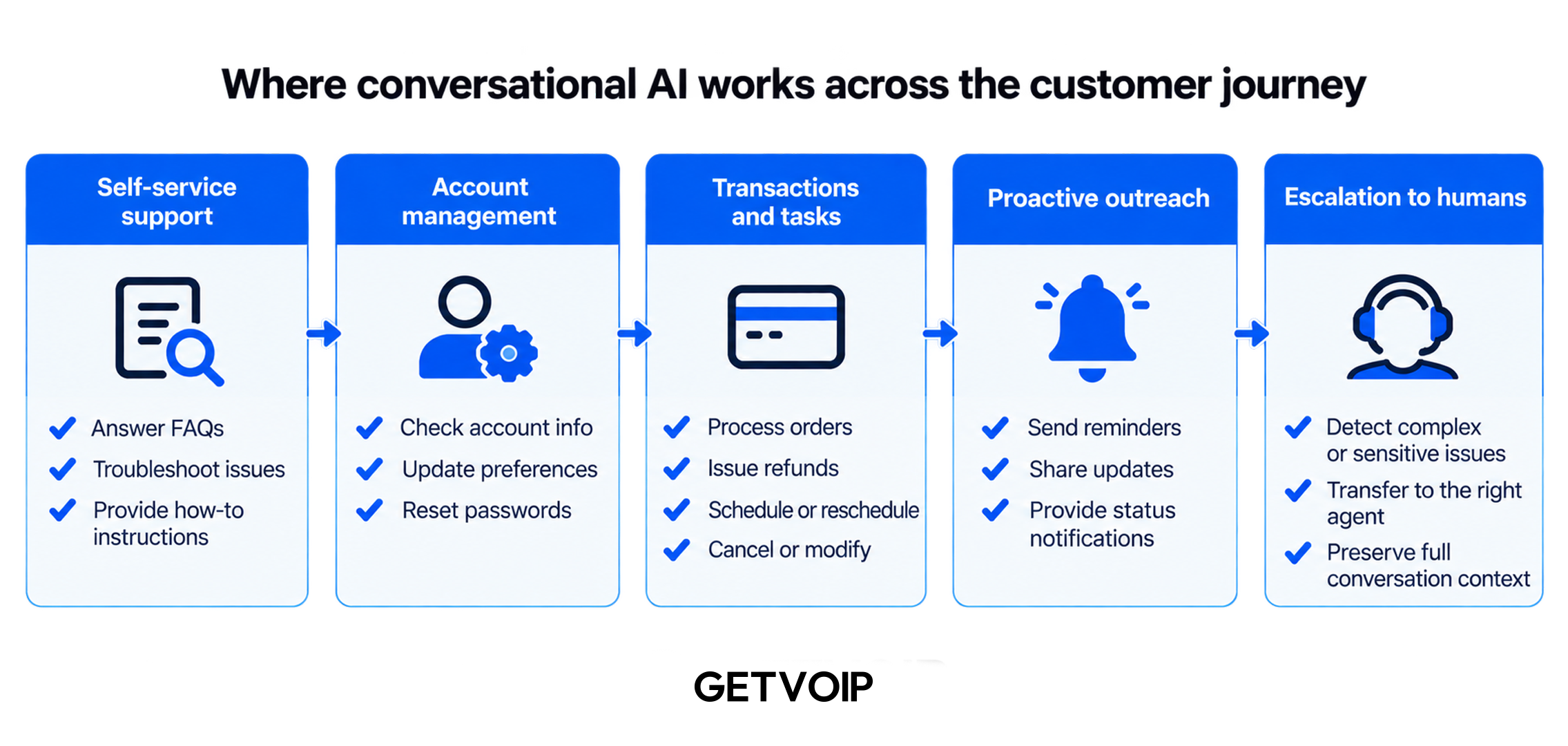
Conversational AI handles three primary jobs in a customer service context: customer-facing self-service, customer-facing phone support, and agent-facing agent assist.
| Conversational AI Type | Who It Helps | Typical Use Cases |
| Customer Self-Service | Customers across voice+digital channels | Account balance requests, order tracking,subscription renewals, contact information updates |
| Voice Support | Callers | Outage updates, identity verification, order management, appointment scheduling, prescription refills |
| Agent Assist | Human agents+supervisors | Reply drafts, next-best-action suggestions, knowledge base+CRM lookups, sentiment+intent alerts, post-call summaries |
Customer Self-Service
Customer self-service is the most well-known conversational AI for CX use case. Customers can resolve their own issues without a live agent, on their preferred channel: messaging, voice, SMS, etc.
This works best for high-volume, low-complexity tasks like account balance inquiries, order tracking, appointment bookings/confirmations, address or contact information updates, payment collection/reminders, subscription updates, etc.
These are the kind of interactions that just make sense to offload to an AI agent for both customers and enterprises: customers would much rather handle these basic tasks on their own in 90-seconds instead of after waiting in a queue for half an hour.
Voice Support
Phone support is a hugely popular use case for conversational AI, but context retention here is absolutely non-negotiable: customers do not want to repeat themselves to a human or an AI agent. Indeed, 77% of consumers say it matters that a company remembers their interaction history, underscoring just how much repeating themselves grates on customers.
If the call is transferred to a live agent, that agent should already know the caller’s name, account number, the reason for the call, and any other additional information they provided to the AI agent.
Within the voice support context, conversational AI is ideal for use cases like outage updates, identity verification, order management, account changes, prescription refills, travel bookings, and after-hours coverage.
Agent Assist
Conversational AI doesn’t just provide ROI within a customer-facing context, but also within agent-facing contexts via Agent Assist.
Agent Assist tools listen to or read live customer conversations, providing relevant support to the human agent in real time, during the active conversation, without the customer knowing it.
Agent assist can suggest next-best-actions, generate replies, pull up essential CRM and knowledge base data, flag live customer sentiment and intent shifts, and even automatically create post-call summaries.
Top Conversational AI Platforms for Customer Service
The providers below focus specifically on customer service, but you can explore our broader comparison of conversational AI platforms for additional options and use cases.
| Platform | What it is | Pricing | Best for |
| Zendesk AI | Powers a single system covering AI agents, AI Agent Assist, QA, WFM, knowledge, and analytics across voice, email, and messaging | Included in:
- Customer Service Suite plans from $55-$115/agent/month with annual billing - Employee Service Suite plans from $29-$99/agent/month with annual billing - Contact Center plans from Suite plan+$83/agent/month with annual billing |
- High-volume, omnichannel support teams needing pre-built and custom AI agents to work with existing tech stacks
- Teams that want a single unified platform for customer and employee experience with AI built-in, not bolted-on |
| Fin From Salesforce | An omnichannel AI agent that works within your existing helpdesk system in a sales and support context | - Outcomes-based pricing at 0.99/outcome
- 50 outcomes/month minimum |
- Teams looking for an AI agent for both sales and service that integrates with existing helpdesk tools
- Lean startups and businesses prioritizing per-outcome, pay-as-you-go pricing |
| Ada | An enterprise customer service AI agent builder for automating complex, multi-step customer interactions across voice, messaging, and chat | - Quote-based
- Conversation-based/resolution-based pricing |
- Global enterprises in the ecommerce, financial, health, or insurance sectors needing AI agents to complete more complex, multi-step tasks
- CX teams that want humans to create, manage, coach, and monitor AI agents, but that need pre-built playbooks they can customize |
| Genesys Cloud CX | An enterprise agentic orchestration solution combining AI agents, omnichannel contact center operations, WFM, analytics, and QM | - 4 seat-based plans from $75-$240/user/month with annual billing
- Usage-based AI Experience tokens for specific AI features |
- Enterprise omnichannel contact centers that want to manage human and AI agents under one platform
- Teams with a hefty tech stack needing an all-in-one AI solution that eliminates unnecessary, repetitive tools and integrates with the ones they want to keep |
Zendesk AI
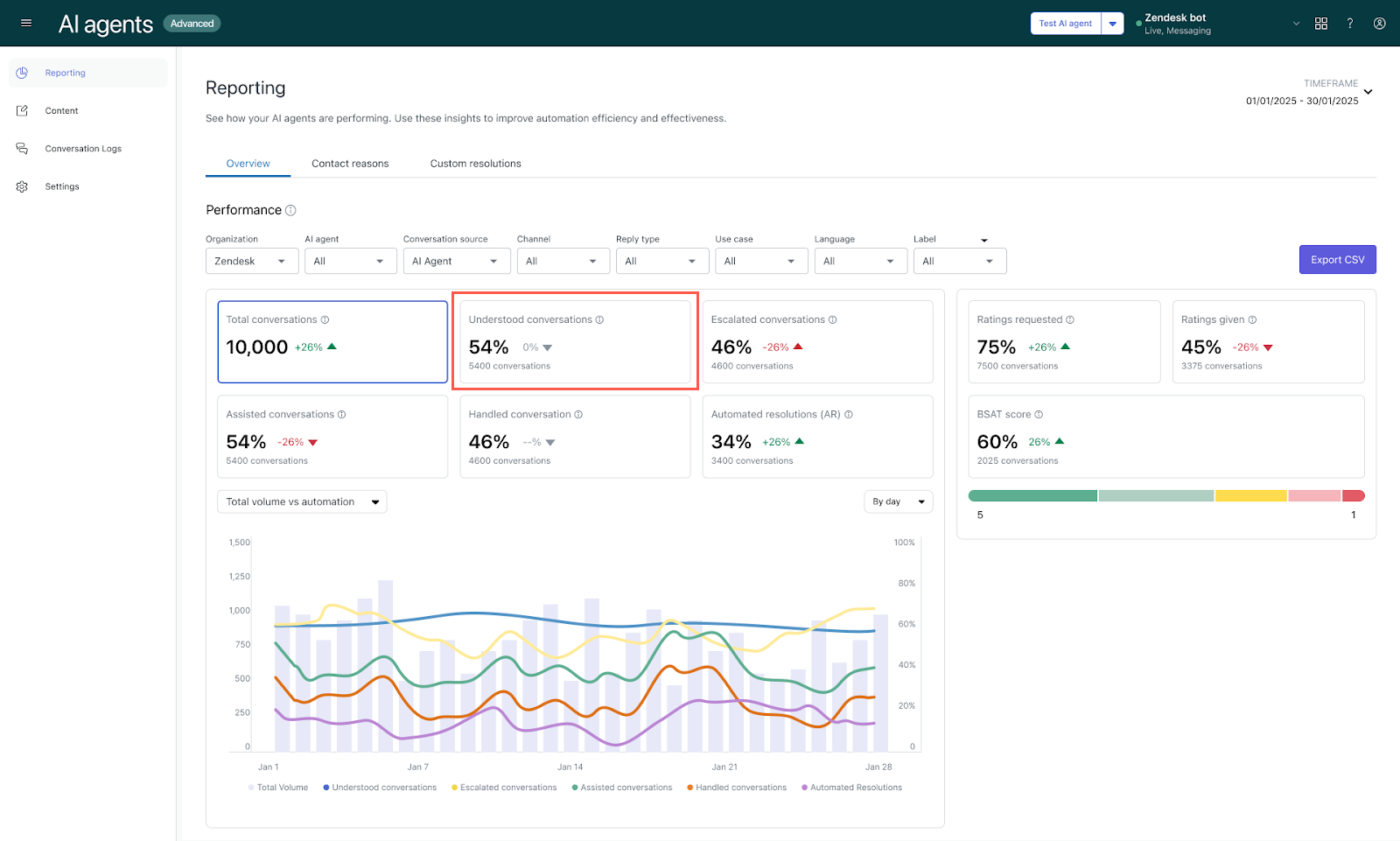
Zendesk AI is Zendesk’s intelligence layer, included with Zendesk Suite Team plans and above. Trained on roughly 20 billion ticket interactions, Zendesk AI powers the Resolution Platform, which unifies customer and knowledge base data, workflows, and governance in one interface.
Custom, self-improving AI agents resolve complex, mulit-step support requests across channels and take action directly within integrated systems. Agent Assist tool Copilot offers real-time live agent guidance. Zendesk AI is open and modular, meaning users aren’t locked into a single LLM or tool.
Standout Capabilities
- Specialized Agents: Use case-specific AI agents. Industry Agents are prebuilt for specific industries (commerce now, financial/media/tech to follow) and connect to existing tech stacks out of the box (Shopify, Stripe, etc.) Custom Agents, built in the Zendesk Agent Builder interface, allows teams to build, test, and deploy their customized AI agents.
- Zendesk Copilot: Add-on AI Agent Assist tool with real-time live agent guidance, intelligent triage, pre-built reporting, knowledge base integration, automated ticket classification, automated return processing, etc.
- Voice AI: 24/7 conversational AI phone support with intent detection, caller verification, context preservation, escalation to a human agent, and custom guardrails.
Pricing
Zendesk AI is included in Zendesk Customer Service Suite plans from $55-$115/agent/month, and in Employee Service Suite plans from $29-$99/agent/month, both billed annually. Contact center plans cost the price of a Suite plan plus an additional $83/agent/month with annual billing.
Best For
- High-volume support teams: Zendesk says AI agents can resolve up to 80% of interactions on their own, in over 80 languages
- Teams that need results quickly: Zendesk says 90% of customers see value in under 8 weeks
Ada
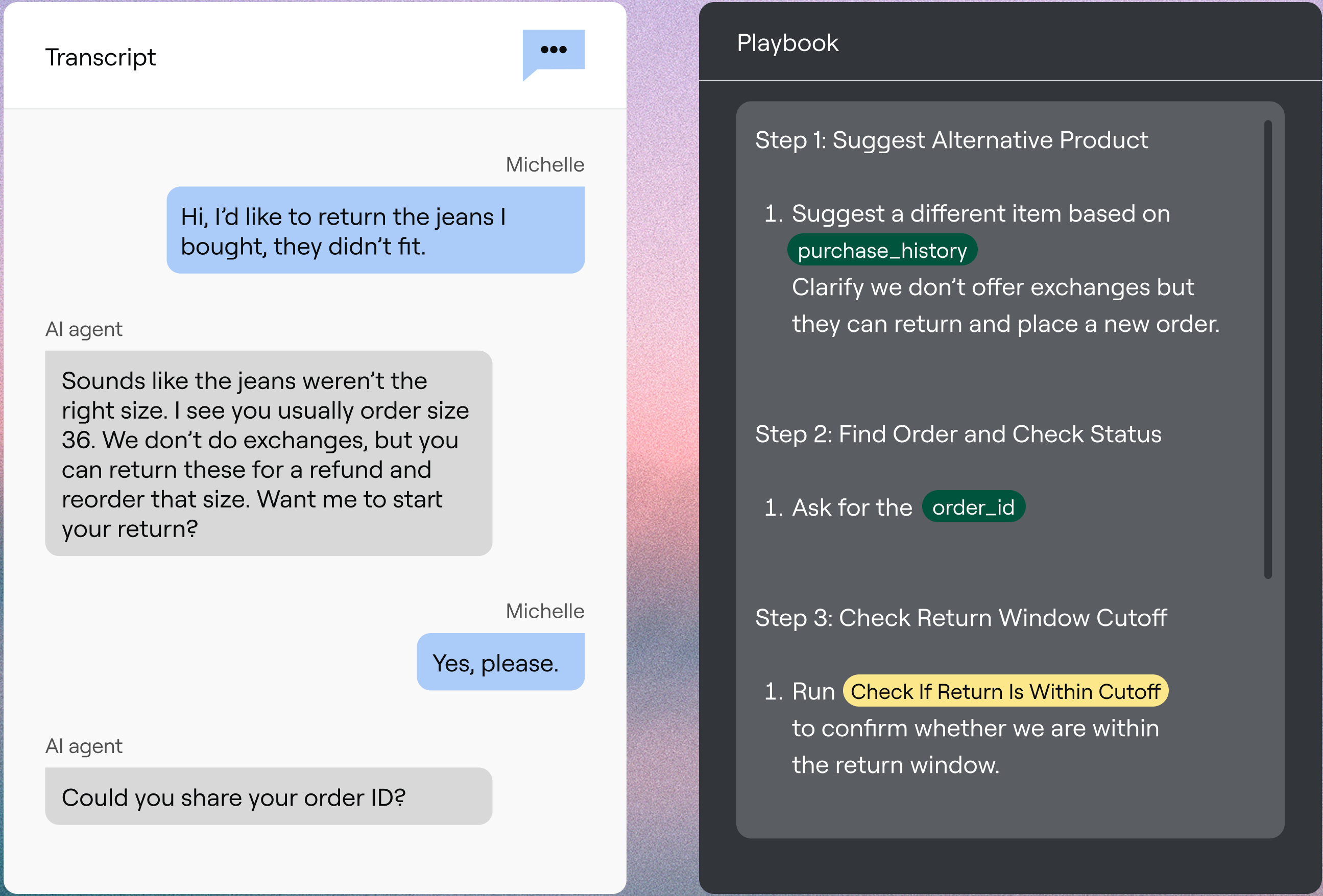
Ada is an enterprise, AI-native customer service platform for building and deploying AI agents that can handle more complex, multi-step customer interactions across voice, messaging, and email. Its ACX (Agentic Customer Experience) platform comes with how-to playbooks of best practices for AI agents, while human ACX experts also work alongside your team.
The platform also gives teams centralized control over AI behavior, with customizable workflows, built-in guardrails, and coaching tools to improve performance over time.
Standout Capabilities
- Unified Reasoning: A single shared “brain” powering Ada AI agents across voice, digital, and languages. If you write an instruction once, it applies everywhere.
- Ada Computer: Connects to your existing systems, runs your rules as code, and logs every AI interaction with custom built-in guardrails. AI agents can complete tasks like flight rebookings, refund issuance, etc.
- Voice AI with Playbooks+Coaching: Voice AI that follows your custom operating workflows step-by-step, available in 42+ languages. Plugs into existing phone systems like Genesys, NiCE, Twilio, and Avaya.
Pricing
Ada pricing is not publicly available and uses a quote-based enterprise pricing model. Conversation-based and resolution-based pricing available.
Best For
- Increased customer satisfaction: Ada claims a 162% increase in CSAT)
- AI ROI: Ada claims an up up 357% ROI on AI investment)
Genesys Cloud CX
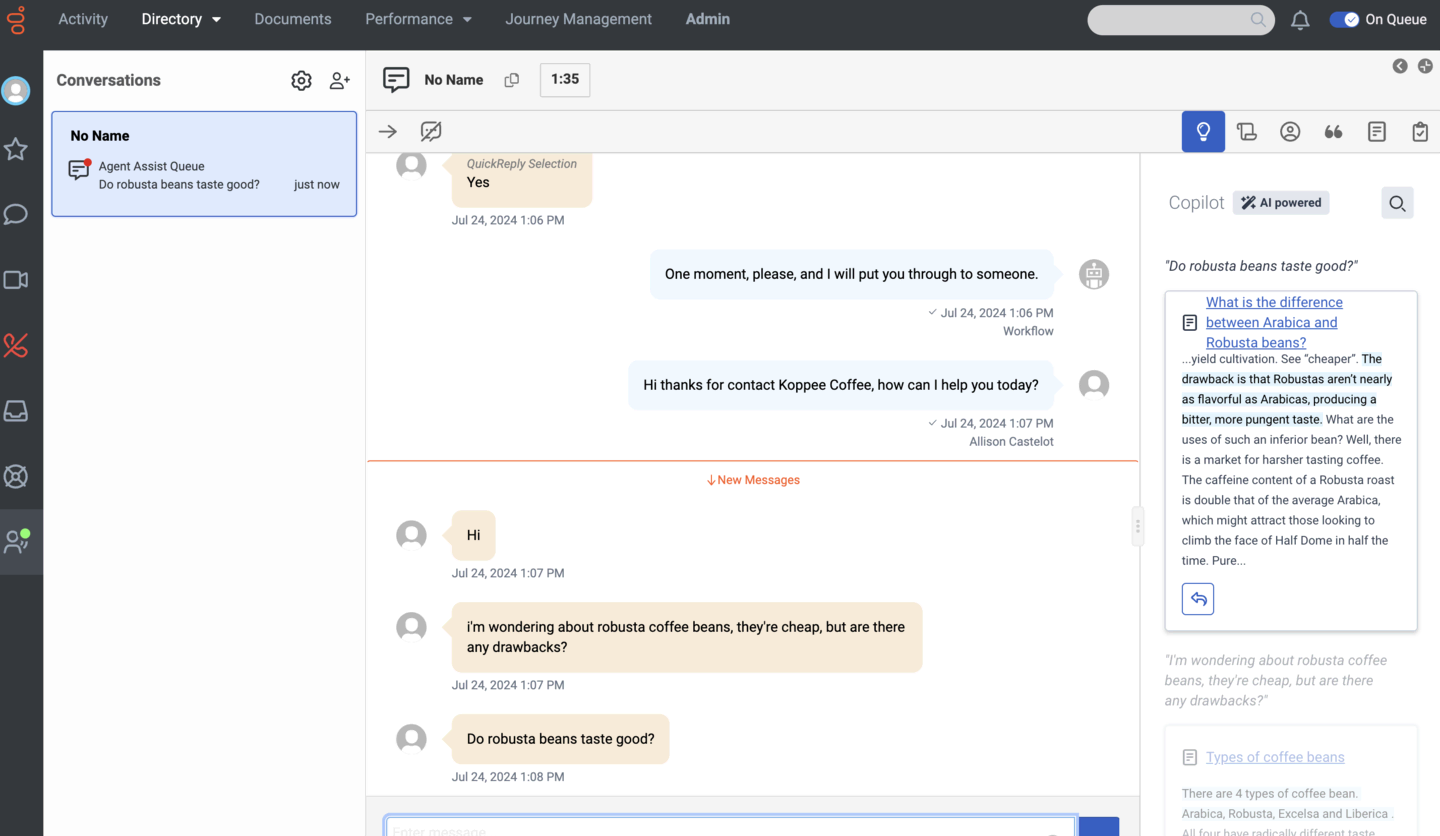
Genesys Cloud CX is an all-in-one enterprise agentic orchestration platform for building and scaling AI agents, contact center operations, workforce management, quality management, and intelligent analytics in a single unified platform.
It coordinates back-office systems, human employees, and AI agents across voice, email, chat, SMS, social media, WhatsApp, and social media. It plugs in with popular existing tools, including Salesforce and ServiceNow.
Standout Capabilities
- Agent Orchestration Suite: 4 interconnected pieces to manage the whole customer journey, not individual conversations. Navigator is the conversational voice AI agent, Orchestrator coordinates workflows and agents, Contextual Intelligence provides experience memory, and AI Control Plane is the governance layer.
- Copilots: Gives human agents live, in-conversation guidance and coaching. Connects directly to CRM systems and knowledge bases.
- Agentic Virtual Agent: AI agent that reasons, acts, and adapts dynamically, in real time across multi-step customer interactions. Provides defined controls, decision reasoning, and auditable outcomes.
Pricing
Genesys Cloud CX offers four seat-based plans, from $75/user/month for CX 1 up to $240/user/month for CX4, billed annually. On top of seat licenses, Genesys uses usage-based AI Experience tokens for specific AI features, like virtual agents, Agent Copilot, and predictive routing. Every plan includes a monthly token allowance, and teams can buy more tokens as needed (or up-front for a discount.)
Best For
- Increased productivity: Customer outcomes include a 173% productivity increase, 90% faster agent onboarding, and repeat calls cut by 50%
- Tech stack consolidation: A customer cut its technology TCO by 65% after migrating to Genesys Cloud
Fin From Salesforce
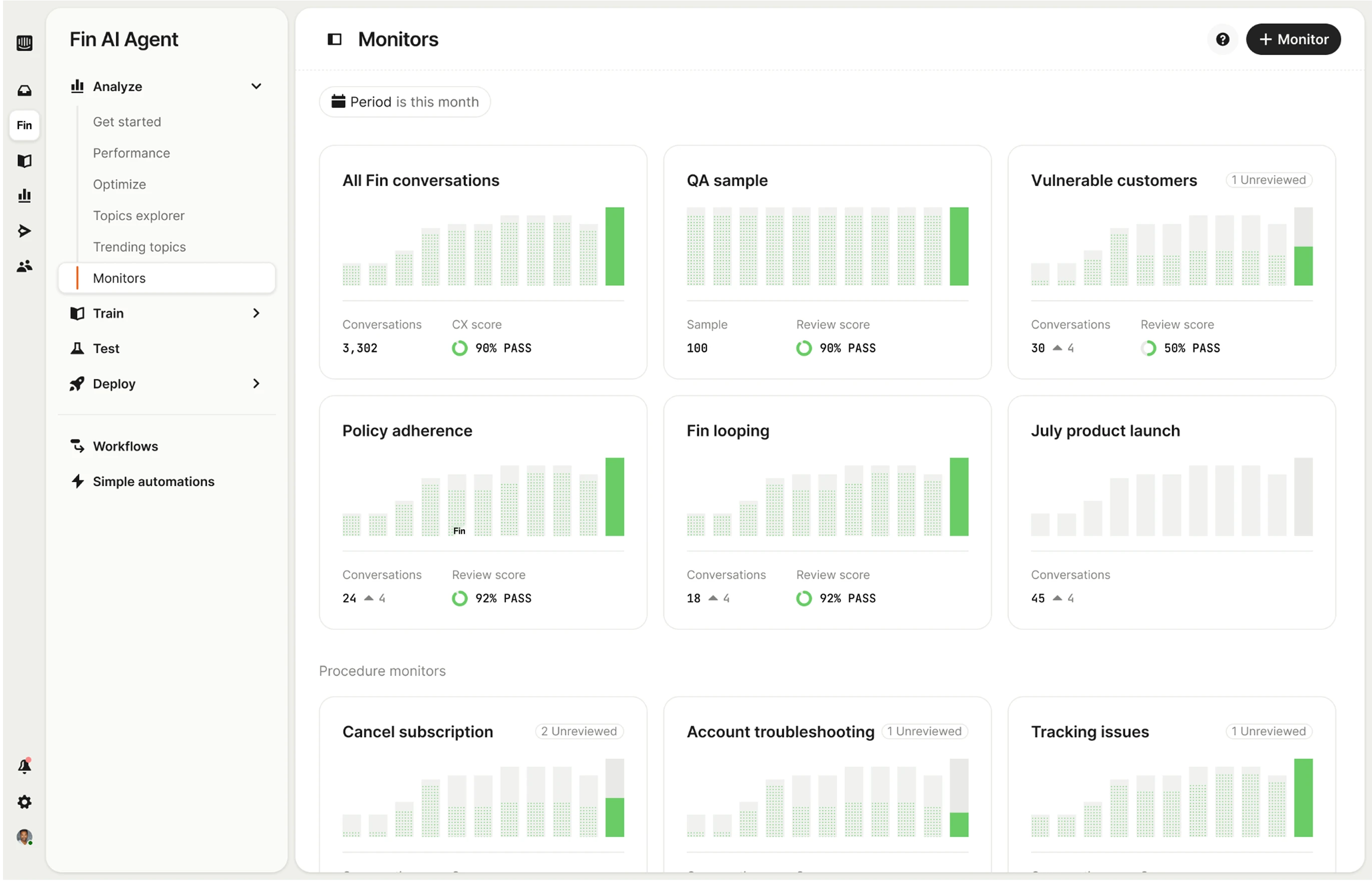
Fin from Salesforce (formerly Fin by Intercom) is an AI Agent for omnichannel customer service. It runs on the proprietary Apex model, trained on millions of customer interactions. It works across key Salesforce channels, Slack, and existing helpdesk tools like Freshdesk and HubSpot. Setup can take under an hour, and Fin says it averages a 76% resolution rate across over 12,000 customers.
Beyond answering customer questions, Fin can execute multi-step workflows, perform actions in connected systems, and follow predefined company policies to resolve issues without human intervention.
Standout Features
- Operator: An AI agent for managing support operations in the backend. Operator proactively finds and resolves problems, tunes Fin’s answers, and updates content.
- Procedures: Fin executes multi-step workflows against existing policies and guardrails and sharing data between systems. Fin says the Apex model, built for Procedures, delivers 15% more confirmed resolutions than Claude Sonnet 5.
- Simulations: Pre-launching testing allows users to run simulated customer conversations with their AI agent, view decision trees/reasoning, and more. Users can create a reusable simulation library of custom tests, and preview changes to the AI agent in real time.
Pricing
Fin operates on a per-outcome basis, meaning customers only pay when Fin gets something done. Pay-as-you-go pricing is available from $0.99/outcome, with a 50 outcome/month minimum charge, unlimited teammates, and no seat fees.
Fin is also available with Intercom for 0.99/outcome plus $29/seat/month and up. Note that Salesforce recently completed its acquisition of Fin, so this package is likely to evolve shortly.
Best For
- Lean startups: Per-outcomes pricing and a year of Fin for free for qualifying startups allows for competitive cost savings
- Agentic Customer Journey management: Fin’s AI agents aren’t limited to support alone. The same agent can handle service, sales (qualifying leads, booking demos), ecommerce, and customer success
When Conversational AI Pays Off And Where It Breaks Down
In the past, conversational AI was measured by deflection rate alone: how many customers an AI agent kept away from a human agent. Today, successful deployments measure resolution quality and customer sentiment.
If done right, conversational AI offers a variety of benefits like:
- 24/7 multilingual coverage across voice and digital channels in a variety of languages/dialects
- Consistent answers, ensuring every customer is given the same policy, pricing, and suggested resolution
- Increased productivity and decreased customer repetition, as AI autonomously resolves routine customer service requests
If done wrong, conversational AI can cause serious failures like:
- Hallucinations, or when the AI gives customers invented answers, prices, or policies that don’t actually exist
- The AI overstepping policies, incorrectly granting access permissions, disclosing sensitive internal or customer data
- Lost context, meaning every interaction starts over completely from scratch, leading to increased customer repetition, lost time, and contradictions
Getting and scaling those benefits doesn’t happen overnight, and hinges heavily on two key components: AI guardrails and human handoff design.
AI guardrails keep AI agents in check, ensuring they don’t provide inaccurate information or take unauthorized action. Refund thresholds, eligibility rules, compliance requirements, and more should live in deterministic business logic outside the model. These are rules that the AI must follow, and can’t creatively interpret.
The handoff from an AI agent to a human agent is the most pivotal point in AI-assisted customer interactions today. That's because 83% of consumers say they at least sometimes have to repeat themselves after being transferred from an AI agent to a human one. To get it right, always make it easy for customers to actually reach a live person. Pass full context from the AI-led conversation to the live agent that’s taking it over: the transcript, the intent, the customer’s key account data, etc. Set clear escalation triggers like repeated failed attempts, detected frustration, or sensitive topics.
FAQs
While technically, you can use ChatGPT for customer service, standalone general-purpose chatbots are not complete CCaaS and CX platforms. The right way is to choose a trusted CX solution or contact center that runs LLMs under the hood, or by building a custom application via an LLM API.
Conversational AI uses retrieval-augmented generation (RAG) to to search approved sources like help center articles, policy documents, resolved tickets, CRM records, product catalogues, and more to ground answers to customer questions.
Integrations and APIs give conversational AI agents access to live customer and order data, while configured workflows define the steps it can take. Some vendors may fine-tune models on historical conversations to better match a company’s tone and terminology.
Of course not. Conversational AI technology also powers internal IT and HR help desks, sales, marketing, and employee onboarding. Customer service just tends to be where the volume (and the case for ROI) is the strongest.
Using sentiment analysis. In text-based channels, that includes things like word choice, negative phrases, profanity, all capital letters, repeated questions, and requests to speak to a human. In voice, conversational AI can also analyze tone, speaking pace, pitch, volume, and interruptions.
When frustration crosses a preset threshold, a well-designed system should instantly escalate the conversation to a human agent or alert a supervisor in real time, preserving all conversational context to prevent customer repetition.