

Retell AI is a unique AI voice agent platform that’s truly developer-first and friendly, plus it has a modular and transparent pay-as-you-go model for building phone agents. Still, other AI voice agent platforms do specific elements much better in ways Retell cannot quite match, whether its all-in-one pricing, quicker setup times, or no-code visual builders.
We went out of our way to showcase our best Retell alternatives, evaluating these various AI voice agent solutions across different categories. We looked into conversation quality, deployment complexities, integration opportunities, and pricing transparency to figure out what works best for whom. Based on these findings, we’ve assembled a team of Retell alternatives worth looking at.
Key Takeaways
- One decision splits the whole field: either you assemble your own voice stack and keep control of every component (Vapi, LiveKit, and Retell itself), or you deploy a bundled platform that ships voice, LLM, transcription, and telephony under one bill (Synthflow, Bland.ai, Sierra, ElevenLabs).
- Best for non-technical teams: Synthflow, thanks to its drag-and-drop builder, bundled single rate, and sub-400ms latency without engineering involvement.
- Best for QA and call auditing: XBert, when the constraint is reviewing and scoring conversations after the fact rather than increasing call volume.
- Best for enterprise customer experience: Sierra, which charges on resolved outcomes and executes multi-step backend workflows instead of just handling call flows.
- Best for outbound sales: Regal, with intent-based prioritization, CRM-native data, and coordinated voice, SMS, and email cadences.
- Best for extreme call volume: Bland.ai, rated for up to 20,000 calls per hour at a flat per-minute rate.
- Best for self-hosting: LiveKit, the open-source route for teams that would rather own the infrastructure than pay a platform fee.
- When staying on Retell still makes sense: if you have engineers, want to swap models and voices freely, and prefer transparent usage-based costs over a single predictable invoice, Retell remains competitive and there is little reason to migrate.
At-a-Glance Overview of Best Retell Alternatives
The table below lines up each Retell alternative on the attributes buyers check before shortlisting the provider.
| Platform | Deployment Model | Stated Latency | Compliance | Pricing Model | Best For |
| Sierra | Hybrid (enterprise platform with professional services) | Not published | SOC 2, HIPAA | Bundled, outcome-based custom contract | Large enterprises with complex backend integrations |
| Cresta | Hybrid (enterprise contact center overlay) | Not published | Not published | Bundled per agent seat, per month, annual commitment | Contact centers requiring both AI automation and human agent performance improvement at enterprise scale |
| XBert | No-code setup with fast onboarding | Sub-400ms for routing, Sub-600ms for conversational voice | SOC2 Type II, PCI DSS, HIPAA | Bundled per agent seat, per month, no contracts | Companies already using Nextiva for VoIP and/or call center software |
| Regal | Hybrid (no-code campaign builder with CRM sync) | Not published | Not published | Bundled platform access plus outreach volume, no per-minute charge | Sales-focused teams wanting outbound voice agents with CRM integration for lead qualification and conversion |
| Bland.ai | API-first with visual conversational pathways | Not published | SOC 2 Type II, HIPAA | Bundled single rate: $0.09/min active call time, plus $299-$499/month base plans | Developer-led teams building high-volume outbound campaigns requiring extreme scalability |
| Synthflow | No-code visual builder | Sub-400ms | SOC 2, HIPAA | Bundled single rate (~$0.13/min) on $29-$1,250/month plans | Businesses wanting customizable voice agents without engineering resources or vendor management complexity |
| Vapi | API-first with Flow Studio builder | Sub-600ms | SOC 2, HIPAA as a $1,000/month add-on | Modular pass-through: $0.05/min platform fee plus external services ($0.13-$0.31/min) | Technical teams wanting granular control over their voice stack with provider flexibility |
| ElevenLabs Conversational AI | Hybrid (managed platform with SDKs) | Not published | Not published | Bundled: $11/month Creator tier plus $0.12/min beyond 250 included minutes | Businesses prioritizing ultra-realistic voice quality and multi-language support with simplified platform setup |
| LiveKit | Free self-hosted open-source framework, paid plans available for $50-$500/month | Depends on your infrastructure and model choices | Inherited from your own hosting environment | No platform fee: you pay only for models, telephony, and hosting | Engineering teams with infrastructure capacity and call volume high enough that per-minute platform fees dominate cost |
What Retell AI Is (and Why Teams Start Looking Elsewhere)
Retell AI is an API-first platform for building, testing, and deploying phone agents. Developers define the prompt and call logic, wire in their own model and voice providers, run test calls, then push agents to production numbers. The common deployments are AI receptionists, appointment scheduling and reminders, lead qualification, and after-hours call coverage.
Leaving Retell rarely means replacing one product. It means replacing an assembled stack: the LLM vendor, the text-to-speech vendor, the speech-to-text vendor, and the telephony carrier, each with its own contract, its own dashboard, and its own invoice. That is the tradeoff buyers weigh when they shop alternatives.
The switching triggers we hear most often:
- No engineers to spare: the team needs agents live this month and wants a no-code builder rather than an API integration project.
- One bill instead of four: finance wants a predictable monthly number, not four usage lines that move independently.
- Latency-sensitive conversations: inbound support or qualification calls where Retell’s ~800ms response window feels like a pause to the caller.
- Compliance and audit demands: documented SOC 2, HIPAA, or GDPR coverage plus call-level auditability, without stitching certifications together across vendors.
- Crossing a volume threshold: campaigns that need thousands of concurrent calls, or enough minutes that per-minute platform fees start dominating total cost.
How We Evaluated These Alternatives
To determine the best Retell alternatives, we focused on features that matter most when deploying AI voice agents for real business scenarios rather than technical experimentation. We wanted platforms that matched or exceeded Retell's capabilities while addressing its complexity drawbacks around multi-vendor management and unpredictable costs.
Here are the categories that really mattered when evaluating these alternatives:
- Pricing Structure and Transparency: We examined how clearly each platform communicates total costs compared to Retell's modular approach requiring separate payments for voice, LLM, transcription, and telephony providers
- Deployment Time and Ease: We analyzed how quickly businesses maneuver from concept to production versus say Retell's developer-first approach requiring API integration expertise. Special care was given to platforms offering visual builders, pre-built templates, and speedier time-to-value for teams without dedicated engineering resources
- Conversation Quality and Latency: We evaluated natural language understanding, response speed, interruption handling, and voice realism compared to Retell's ~800ms latency. We looked for platforms delivering human-like conversations with sub-second response times and emotional tonality rather than robotic interactions
- Integration and Customization Options: We investigated how well each platform connects with CRMs, knowledge bases, and business systems compared to Retell's webhook flexibility. We sought platforms balancing ease of integration with customization depth for complex workflows
- Enterprise Preparedness: We examined compliance certifications (SOC 2, HIPAA, GDPR), concurrent call capacity, and scalability compared to Retell's infrastructure. We prioritized platforms supporting high-volume deployments with reliability guarantees and data security controls
- Support and Onboarding: We looked into how platforms assist with implementation compared to Retell's minimal hands-on support. We valued platforms offering white-glove services, dedicated account teams, or comprehensive documentation for smoother deployment
Best Retell Alternatives
We’ve done the research for you and identified the top Retell alternatives, and discussed exactly what makes them tick and worthy of your consideration.
Sierra

Sierra is an enterprise-grade solution to AI customer service that shares DNA with Salesforce (they came from a shared co-founder). It is a solution more concerned with conversational experiences that feel human as it’s built with world-class natural language processing techniques. The use of NLP allows it to have nuance, emotion, and a rich multi-turn conversational flow that integrates deeply with customer data systems. Personalization is its key distinguishing feature where customer history, preferences, and past issues form a tapestry of information to build interactions from.
What distinguishes Sierra from Retell is its outcome-based pricing model and focus on business results rather than technical infrastructure. While Retell charges per minute with separate vendor costs, Sierra charges only when AI agents successfully resolve customer issues, aligning vendor incentives with business outcomes. The platform emphasizes building agents that represent your entire brand experience rather than just handling individual call flows.
Top Features
- Third-Party Integrations: Native connections with CRM systems, order management platforms, and backend databases for executing actions like updating cases or managing deliveries
- Outcome-Based Pricing: Pay only for successfully resolved conversations rather than all interactions, with custom routing/greeter interactions using consumption-based models
- Multi-LLM Integration: Leverages multiple language models simultaneously with advanced security controls ensuring deterministic, policy-compliant system interactions
- Agent Performance Tracking: Built-in quality assurance workflows, real-time monitoring, and AI-generated insights that automatically identify improvement opportunities
- Action Execution: Agents don't just answer questions but take actions like processing returns, managing subscriptions, updating CRM entries, and triggering backend workflows
Pricing
Sierra operates on outcome-based pricing rather than just charging per conversation or minute. When you get a successful business objective done (like a closed sale or a processed return), then and only then will Sierra charge you.
Exact pricing is not publically available per successful interaction, but one should note it is a premium option for the mid-market and enterprise-sized businesses out there looking for the fanciest solution. Expect an annual contract with scalable pricing based on complexity and conversational volume. There is no free trial available at this time.
Why Sierra is a Good Alternative to Retell
Sierra provides a one-stop-shop where business teams deploy sophisticated agents without assembling voice stacks via multiple providers like Retell demands them to. The outcome-based pricing eliminates Retell's cost unpredictability from fluctuating per-minute charges across multiple vendors, while Sierra agents execute multi-step workflows and backend integrations that would need extensive custom development in Retell's framework.
Best For
- Large enterprises with complex customer experience requirements requiring next-level automation
- Companies willing to invest in professional services for deep customization and integration
- Businesses prioritizing outcome alignment over cost predictability
- Organizations shifting towards agents that execute actions across multiple backend systems
Cresta
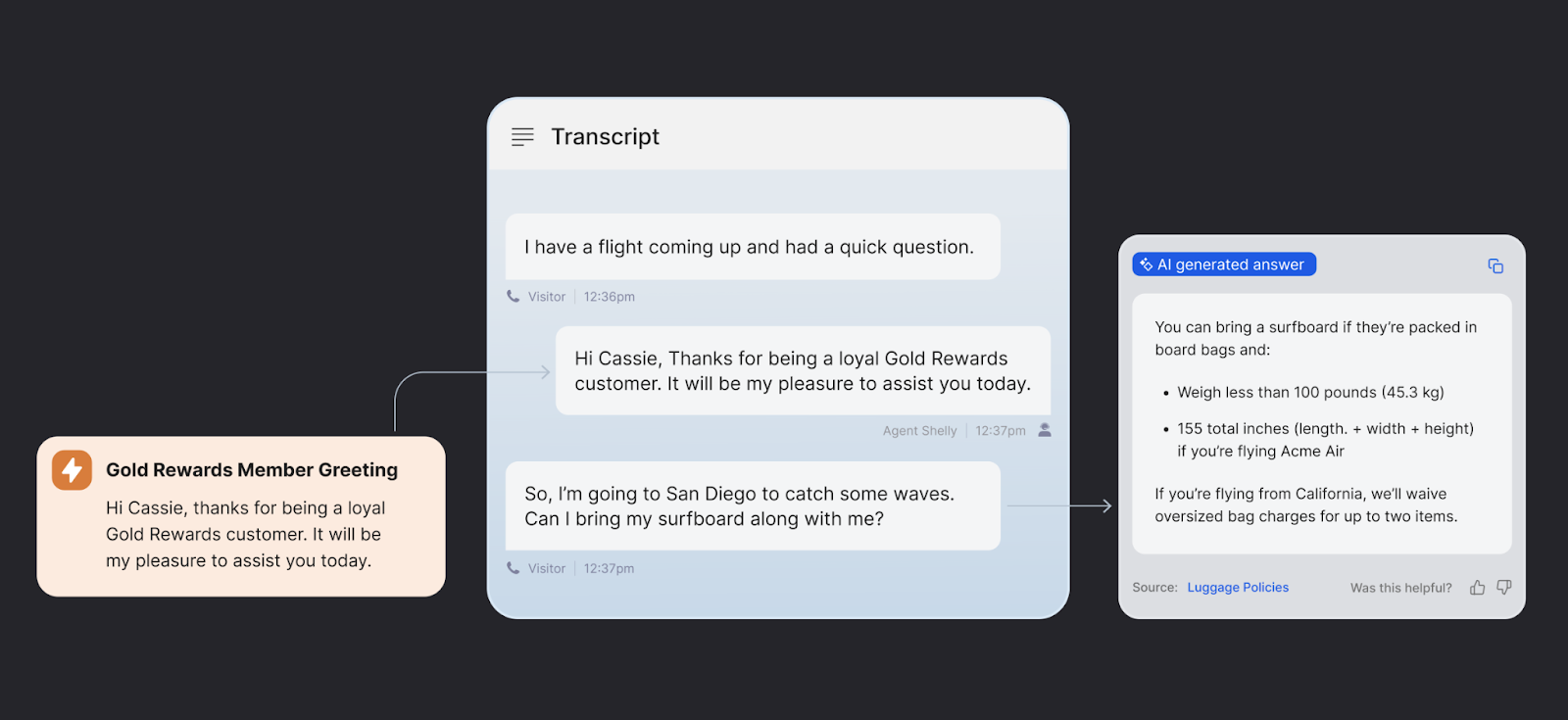
Cresta takes AI voice agents in another direction where the focus and onus is more on real-time agent assistance than outright full-on automation techniques, though it has its own AI agent as well to handle the smaller tasks. Cresta will listen in on live conversations between your customers and your human staff to surface relevant information, flag big issues, and suggest solutions all in the moment. It is an expert supervisor who’s there to coach and mentor your agents at a moment’s notice across thousands of simultaneous interactions.
Contrasting Retell's focus on voice infrastructure for developers, Cresta targets enterprise contact centers seeking comprehensive transformation of both AI and human agent performance. Cresta’s proprietary domain-adaptive language models are trained specifically on contact center conversations rather than general-purpose LLMs, delivering contextual understanding that Retell's bring-your-own-LLM approach requires custom tuning to achieve.
Top Features
- Third-Party Integrations: Native connections with Salesforce, Microsoft Dynamics, ServiceNow, Adobe Experience Cloud, and major contact center platforms
- Real-Time Agent Coaching: Provides live guidance, best practice prompts, and behavioral suggestions to human agents during customer conversations
- AI Agent Automation: Fully autonomous AI agents handle routine inquiries with natural conversations, escalating complex issues to human agents seamlessly
- Conversation Intelligence: Analyzes 100% of interactions with custom transcription models trained on your data for unmatched accuracy and actionable insights
- Custom Domain-Adaptive LLM: Proprietary language model specifically built for contact centers, continuously learning from your conversations through human-in-the-loop fine-tuning
Pricing
Cresta uses an enterprise pricing model that’s based on your agent seat number and what features you’ll anticipate using. You will pay per agent per month, with additional costs for advanced functionality like their voice biometrics or any custom integrations. No exact numbers were listed on their site, but based on publicized quotes from clients, it may start at the tens of thousands.
You’ll need to request your own custom quote. The platform also requires annual commitment and implementation tends to be billed separately. They offer a free demo, but no free trial.
Why Cresta is a Good Alternative to Retell
Cresta delivers complete contact center transformation combining AI automation with human agent augmentation, addressing broader needs than Retell's voice infrastructure. The custom domain-adaptive LLM understands contact center terminology and workflows without the custom prompt engineering Retell deployments required for comparable accuracy.
Best For
- Enterprise contact centers who want AI automation and human agent performance improvement in tandem
- Organizations with large teams seeking to replicate top performer behaviors across all agents
- Companies requiring sophisticated conversation intelligence and quality management tools
- Businesses with existing contact center software wanting AI overlay capabilities
Nextiva XBert
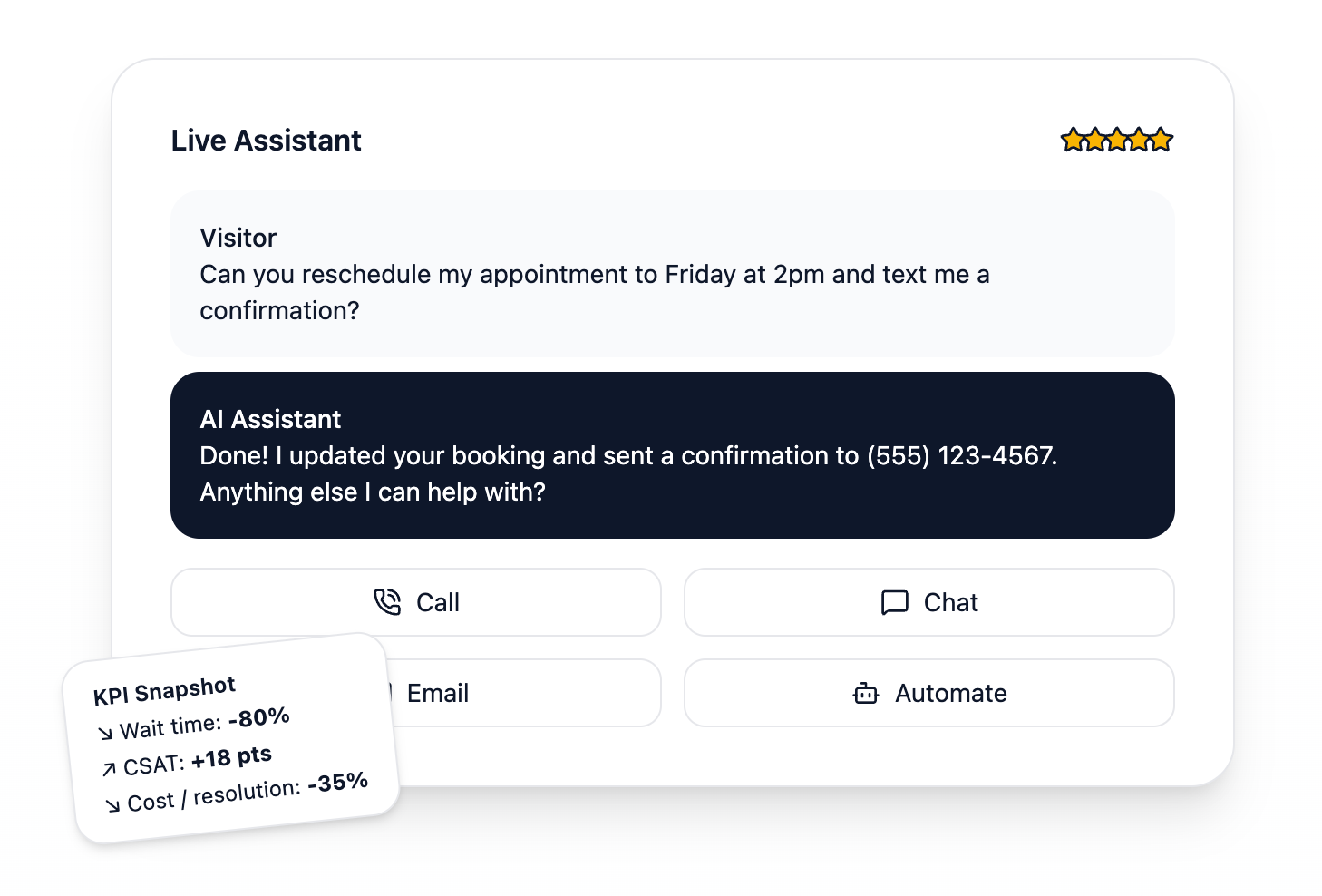
Nextiva XBert approaches voice AI from the opposite direction of Retell -- instead of a developer toolkit for assembling agents, it starts as a full business communications platform and layers automation on top. Voice, business texting, team chat, video, and call routing all live in one portal, so an AI agent isn't a standalone service bolted onto a phone system, it's another participant in the same call flow the human team already uses.
What separates XBert from Retell is who can operate it. Retell expects engineering resources to wire together models, telephony, and transcription. XBert's admin portal is built for office managers and operations leads, with IVR menus, ring groups, and voicemail settings configurable through the same interface that handles day-to-day phone administration.
Top Features
- 24/7 call answering: Handles unlimited inbound calls around the clock, so after-hours and overflow calls never go to voicemail
- AI text messaging and live chat: Covers SMS and website chat alongside voice, keeping conversations in one system
- Calendar and CRM integration: Syncs with your existing stack so bookings and contact records update automatically
- Automatic appointment booking: Confirms slots during the call rather than promising a callback
- Full call transcripts and analytics: Every interaction is transcribed and logged for review and coaching
- Smart handoff: Passes calls to the right team member when the conversation needs a human
Pricing
XBert's AI Employee runs $99 per month for 100 interactions, then $0.99 per interaction beyond that. There are no contracts, and a 30-day money-back guarantee covers the first month.
The plan includes unlimited 24/7 call answering, AI text messaging and live chat, calendar and CRM integration, automatic appointment booking, full call transcripts and analytics, and smart handoff to your team members. Because billing tracks interactions rather than seats, costs scale with call volume instead of headcount.
Why XBert is a Good Alternative to Retell
XBert suits businesses that want a working AI receptionist today, not a voice application to build. Retell's per-minute, per-component billing rewards teams with engineering capacity, while XBert runs $99/month for 100 interactions and $0.99 per interaction after that, with no contracts and a 30-day money-back guarantee. Setup is guided self-service: XBert learns from your website, FAQs, and business details, then you pick a pre-built role (Receptionist, Sales, or Support), a voice, hours, and routing rules.
Best For
- Service businesses like HVAC, plumbing, dental, law firms, salons, and restaurants that lose jobs to unanswered calls
- Owners who want calls, texts, and live chat handled from one place, 24/7, including nights, weekends, and holidays
- Operations leads without developer support who need to update responses and routing themselves at no extra cost
Regal
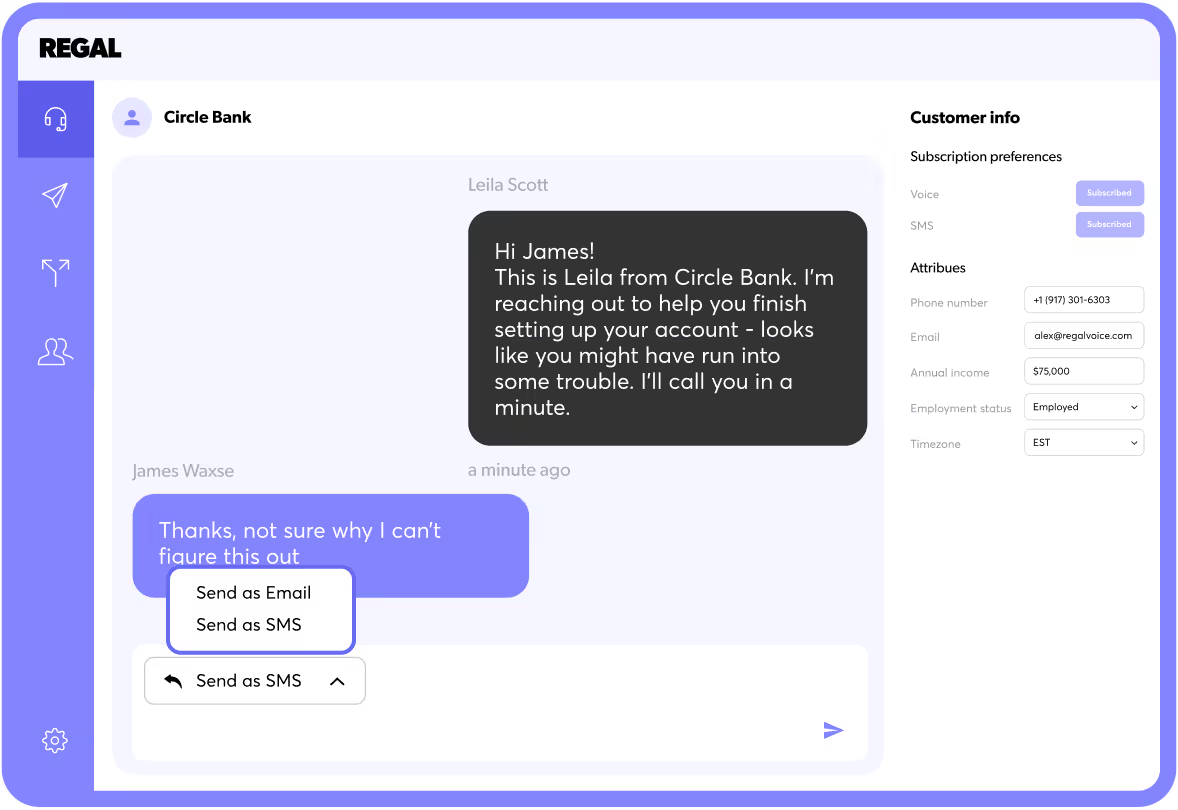
Regal is primarily built to handle sales and your outbound calling tasks using AI agents that amplify and qualify leads, move prospects through your sales funnel, and even book meetings. It is not primarily built to handle support tasks, instead it optimizes for conversion metrics such as: conversion rates, contact rates, and meeting set rates. It’s meant to connect deeply with your sales engagement tools and CRMs to help you orchestrate omnichannel campaigns that weave in and out of calls, emails, and texts for all-around coverage.
Top Features
- Third-Party Integrations: Seamless connections with Salesforce, HubSpot, and major CRMs plus over 40 integrations for unified customer data access
- Multi-Channel Orchestration: Coordinates when to call versus text versus email based on prospect behavior, automatically adjusting cadence based on engagement signals
- Intent-Based Prioritization: Uses behavioral signals (website visits, email opens, previous conversations) to determine who to contact and when for maximum conversion
- AI Voice Agents: Handles structured interactions like appointment scheduling, lead qualification, and reminder calls with 50 concurrent call capacity and seamless human handoffs
- Progressive Dialer for AI Agents: Automates outbound campaigns at scale with intelligent pacing and connect rate optimization
Pricing
Regal pricing is based on specific factors pertaining to your business, it has a custom pricing model that accounts for the number of contacts in your database and your volume (calls, texts, emails) on a monthly basis. It could run several hundreds monthly for small teams but quickly runs thousands in the enterprise space.
While it has no per-minute charges, it does require paying for platform access and per-volume of outreach. Implementation and onboarding costs are typically included, but any customized integration may incur charges. Regal notes “as you commit to higher spend and longer contracts, pricing is discounted” on their page. You can request a personalized demo.
Why Regal is a Good Alternative to Retell
Regal targets sales teams wanting AI voice agents with built-in CRM intelligence and multi-channel orchestration rather than Retell's developer infrastructure. While Retell requires custom integration work to connect voice agents with customer data, Regal provides sales-specific capabilities natively including intent-based prioritization that determines optimal contact timing and channel based on prospect behavior.
Best For
- Sales-driven organizations prioritizing lead qualification and conversion over support automation
- Companies with existing CRM systems wanting AI agents that leverage customer intelligence
- Teams running outbound campaigns requiring high-volume concurrent calling capacity
- Businesses who desire unified orchestration across voice, SMS, and email channels
Bland.ai
Bland.ai offers a simple value: high-quality AI calls at a fixed rate of just $0.09 per minute with little to no setup complexity gumming up your chances to hit the ground running. The platform is just focused on one task it does very well: making and receiving phone calls using AI. There are no crazy or extensive feature sets or any customized pricing models that you’ll need to account for or bother a sales team about, it’s a no-frills solution that might work best for people who just need AI voice agents now.
Unlike Retell's modular approach requiring multiple vendor contracts, Bland provides more bundled infrastructure while maintaining developer-friendly APIs. However, like Retell, Bland targets technical teams comfortable with API integration rather than business users seeking no-code solutions. The platform charges base subscription fees plus per-minute usage, creating cost structures similar to Retell's but with different vendor consolidation.
Top Features
- Third-Party Integrations: API-first architecture enabling custom connections to any system via webhooks and programmable workflows
- Extreme Scalability: Handles up to 20,000 calls/hour capacity, making it ideal for massive outbound campaigns exceeding most platforms' concurrent limits
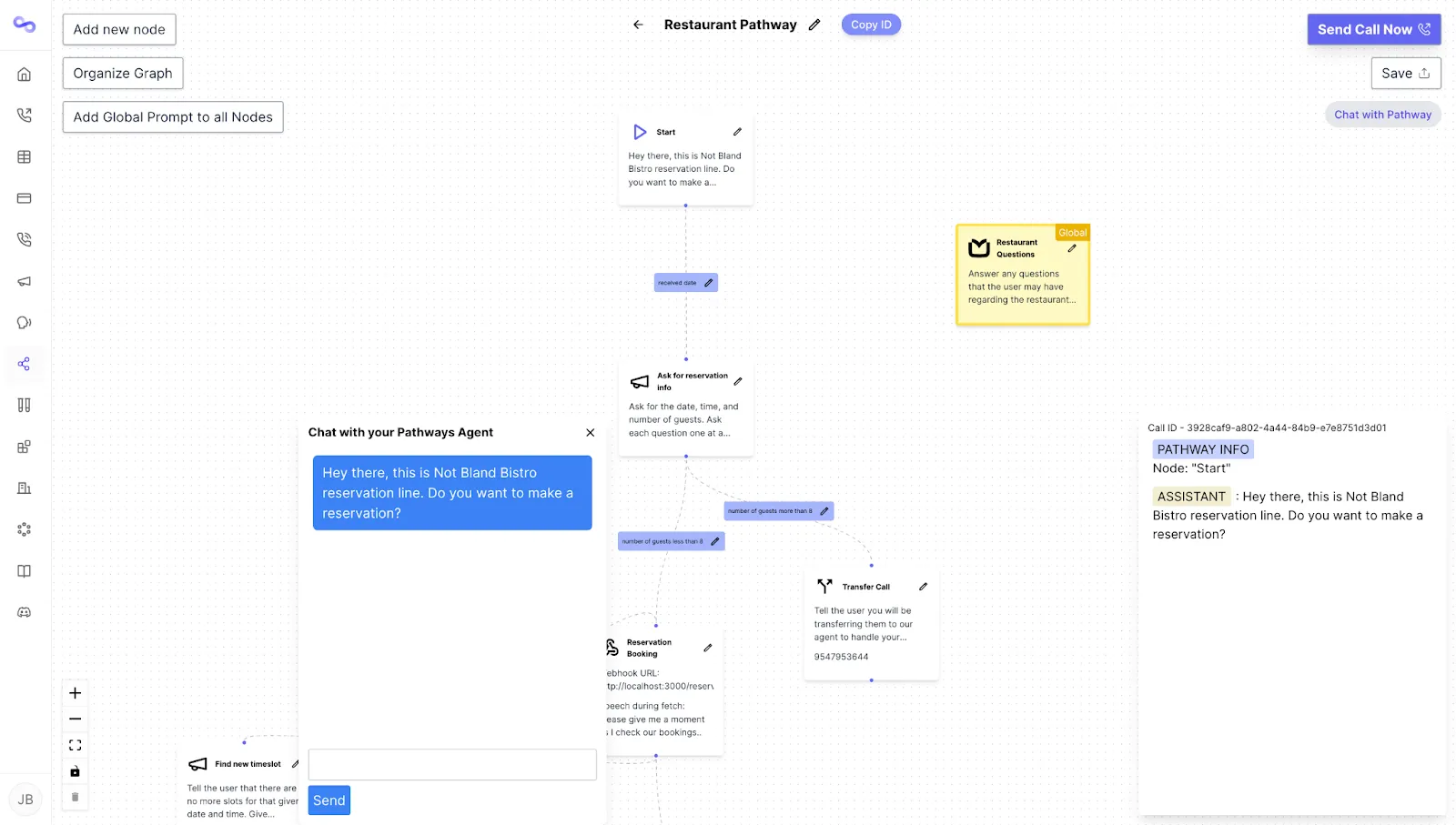
- Conversational Pathways: Visual node-based system for building call logic with triggers, conditional branching, and dynamic response paths
- Voice Cloning: Beta-stage custom voice replication for brand consistency, though not yet production-ready according to reviews
- Enterprise Compliance: SOC 2 Type II and HIPAA certified with encryption in transit and at rest for regulated industries
Pricing
Bland.ai charges $0.09 flat per minute in both outbound and inbound calls for active call time only. There are no minimums or platform fees for your basic everyday usage. It is a pay-as-you-go model that’s truly cost effective for any business that has variable call volume. Enterprise customers can save even more if they negotiate volume discounts with the sales team.
What’s included at all levels are: speech-to-text (and vice versa), telephony, and barebones analytics. However, expect to pay for custom voice cloning and dedicated phone numbers. Free trial credits are available.
Why Bland.ai is a Good Alternative to Retell
Bland competes directly with Retell's developer infrastructure but optimizes for extreme-scale outbound campaigns with more than 20,000 calls/hour capacity exceeding Retell's standard concurrent limits. For massive cold calling or notification campaigns, Bland's scale-focused architecture provides capacity advantages, though users report Retell has better latency and more mature feature stability.
Best For
- Developer-led teams building massive-scale outbound calling campaigns
- Companies requiring over 20,000 concurrent calls/hour capacity
- Technical organizations comfortable managing API integrations and conversational logic
- Businesses requiring programmable voice workflows for complex call trees
Synthflow
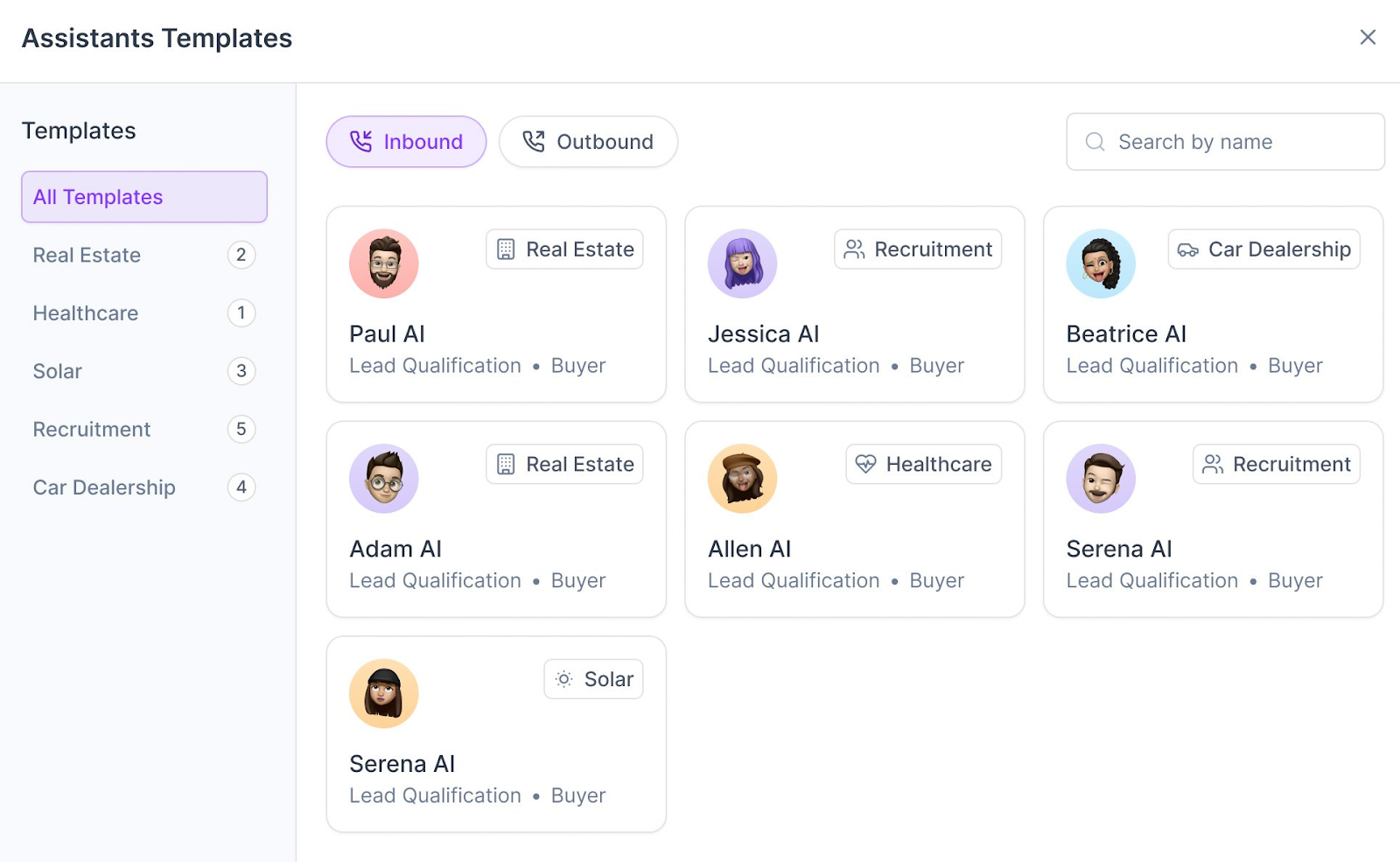
Synthflow specializes in conversational AI for customer service, offering advanced natural language capabilities and extensive customization options. Their unique selling point is voice cloning technology that can replicate your actual voice or create custom brand voices, ensuring complete brand consistency across all customer interactions while having the most natural-sounding conversations in the market.
What distinguishes Synthflow from Retell is accessibility for non-technical teams through drag-and-drop builders and pre-configured workflows. While Retell requires engineering resources to assemble voice stacks, Synthflow enables business users to design, test, and deploy voice agents independently with visual tools and bundled infrastructure.
Top Features
- Third-Party Integrations: HubSpot, Salesforce, Google Calendar, Stripe, monday.com, Zapier, and custom API connections through visual workflow builder
- No-Code Visual Builder: Drag-and-drop conversational flow design with conditional logic, variable collection, and fallback triggers without programming knowledge
- Sub-400ms Latency: Ultra-fast response times creating smoother conversations than slower platforms, critical for natural-feeling interactions
- All-in-One Bundled Pricing: Single rate includes TTS, LLM, telephony, transcription, and analytics without managing multiple vendor bills like Retell requires
- Over 50 Languages with Voice Cloning: Extensive multilingual support with custom voice replication for brand consistency
Pricing
Synthflow bases pricing on anticipated monthly usage minutes. Plans start at $29 per month for small-scale use with limited minutes and concurrent calls. Mid-tier plans range from $375 to $750 monthly with thousands of minutes included and lower per-minute rates. High-volume plans provide 6,000 minutes for $1,250 per month.
Enterprise customers can negotiate custom pricing that includes compliance features, SLAs, SIP trunking, and volume discounts. The platform charges approximately $0.13 per minute, with additional fees for workflow usage and concurrent call capacity. They offer a free trial for up to 14 days.
Why Synthflow is a Good Alternative to Retell
Synthflow targets businesses wanting customizable voice agents without Retell's engineering requirements or vendor management complexity. The transparent all-in-one pricing ($0.08/min enterprise) provides cost predictability Retell's modular structure lacks, since Retell's $0.07/min base requires separate LLM, TTS, transcription, and telephony payments totaling $0.13-$0.31/min for equivalent functionality.
For more details and a better head-to-head discussion, check out our Retell vs. Synthflow breakdown.
Best For
- Businesses who want customizable voice agents without technical teams or engineering resources
- Companies wanting cost transparency and predictable monthly billing without vendor juggling
- Teams prioritizing fast deployment through no-code tools over maximum technical flexibility
- Organizations requiring HIPAA/SOC 2 compliance with simplified vendor management
Vapi
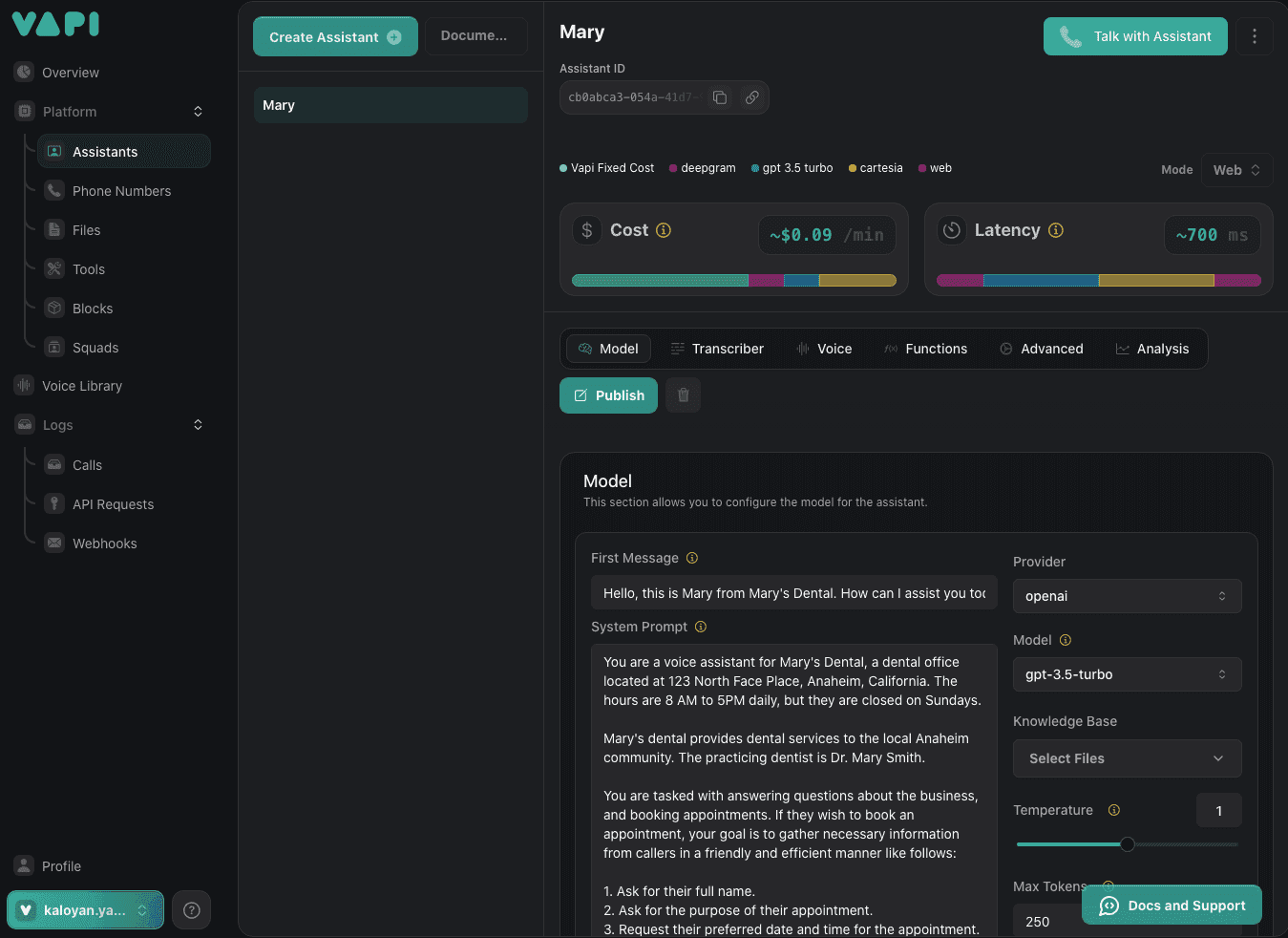
Vapi is a developer-first AI voice agent platform emphasizing modularity and technical control similar to Retell's approach. What they offer is simple: infrastructure for technical teams to build custom voice agents. All the while, organizations get their choice of speech-to-text, LLM, and text-to-speech providers with real-time WebRTC audio streaming.
What positions Vapi as a direct Retell competitor is the similar architectural philosophy: both platforms charge base fees while passing through external service costs, require technical expertise, and prioritize developer flexibility over ease-of-use. Vapi offers sub-600ms latency compared to Retell's ~800ms but with comparable complexity requiring management of 4-6 different vendor relationships.
Top Features
- Third-Party Integrations: Compatible with OpenAI, Claude, Deepgram, Whisper, ElevenLabs, PlayHT, Twilio, Telnyx, and custom API connections
- Flow Studio Visual Builder: Drag-and-drop conversational logic design with branching prompts, error fallbacks, conditional paths, and webhook triggers
- Bring-Your-Own Architecture: Complete freedom to select and swap STT, LLM, TTS, and telephony providers based on cost or performance optimization needs
- Multi-Agent Orchestration: Connect specialized agents within single flows for complex workflows like tiered support or appointment routing
- Sub-600ms Latency: Real-time WebRTC audio with GPU inference delivering faster response times than most competitors
Pricing
Vapi charges $0.05/min platform fee plus external service costs totaling $0.13-$0.31/min for complete deployments. Enterprise plans offer custom pricing with volume discounts.
HIPAA/SOC 2 compliance costs $1,000/month additional on pay-as-you-go plans. Priority support via dedicated Slack channels typically requires Enterprise contracts. Vapi provides $10 free credits (30-75 minutes) for testing but you will have to pay to play with it.
Why Vapi is a Good Alternative to Retell
Vapi competes directly with Retell's modular approach, offering marginally faster latency (sub-600ms vs ~800ms) with comparable architectural flexibility. For teams comparing developer infrastructure platforms, Vapi's Flow Studio visual builder provides slight usability advantages over Retell's more code-centric interface, though both require managing multiple vendor invoices with similar complexity and final costs.
Vapi and Retell both face similar challenges around expensive compliance add-ons and limited visual design tools frustrating non-technical stakeholders.
Best For
- Technical teams wanting marginally faster latency than Retell while maintaining architectural flexibility
- Developers prioritizing provider choice and experimentation over cost predictability
- Organizations with dedicated engineering resources for ongoing voice agent maintenance
- Companies requiring multi-agent orchestration with specialized agents handling workflow segments
ElevenLabs Conversational AI
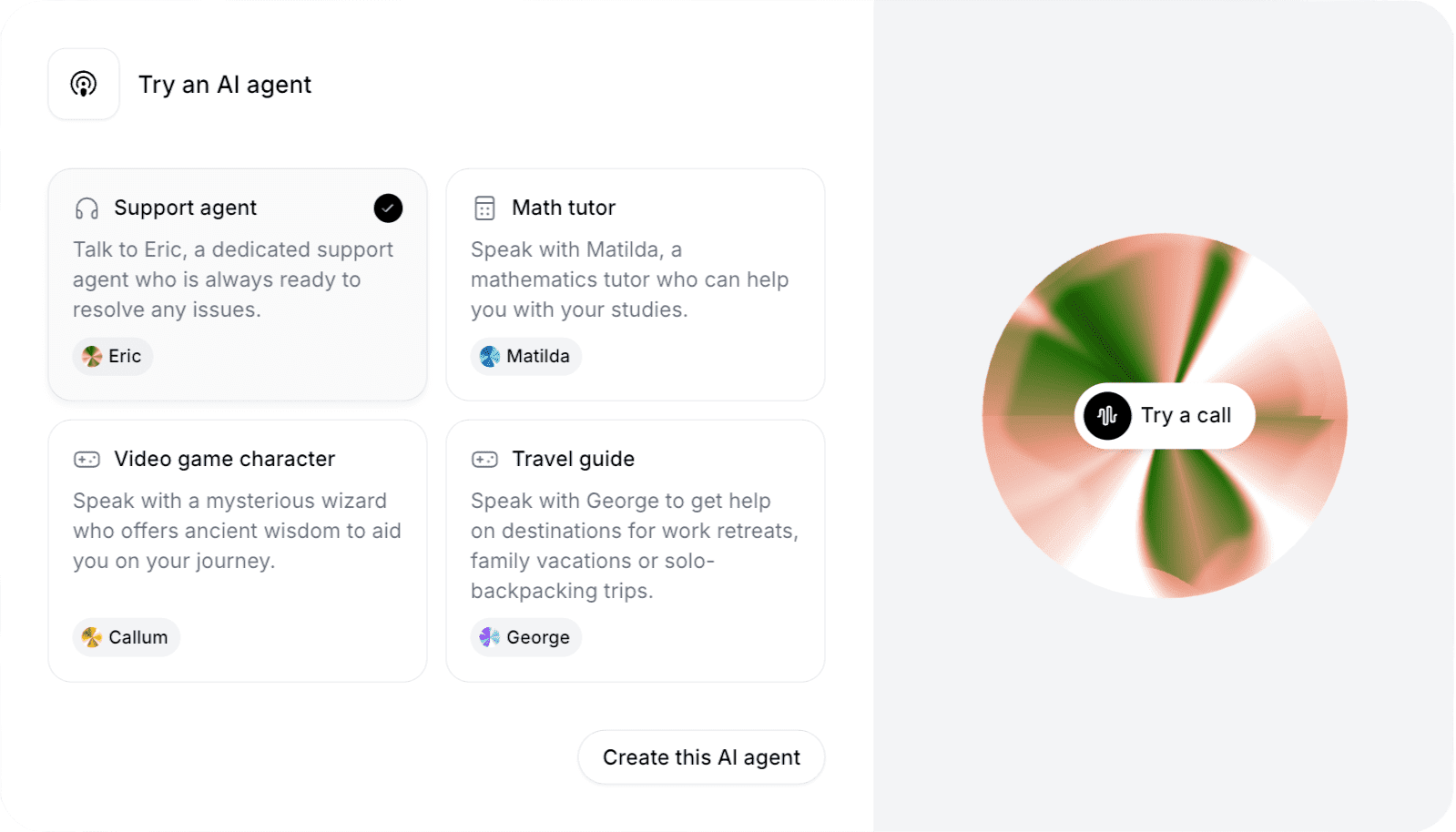
ElevenLabs Conversational AI is a voice agent platform from the AI audio company considered by some to be the industry's leader in creating the most realistic voices. Launched very recently, the platform leverages ElevenLabs' premium voice technology while adding conversation orchestration, interruption handling, and integration capabilities that position it as a complete voice agent solution rather than just a TTS provider.
Unlike Retell's developer-focused infrastructure requiring assembly of voice stacks, ElevenLabs provides a more unified platform where premium voice quality is the central feature rather than a swappable component. The platform supports 31 languages natively, handles real-time interruptions naturally, and offers SDKs for Python, JavaScript, React, and Swift that simplify integration compared to Retell's API-first complexity.
Top Features
- Third-Party Integrations: Native Twilio telephony integration, webhook connections to Salesforce, Zendesk, Stripe, and custom APIs for mid-call actions
- Industry-Leading Voice Quality: Access to ElevenLabs' premium ultra-realistic voices with emotional tonality and expression exceeding generic TTS providers
- 31 Different Languages Supported: Built-in multilingual capabilities covering major global languages without requiring separate configurations per market
- Interruption Handling and Turn-Taking: Advanced conversation dynamics allowing natural mid-sentence responses and human-like speech cadence patterns
- Multiple LLM Support: Integrates with GPT-4, Claude, Gemini, or custom models through simple configuration rather than complex API management
Pricing
ElevenLabs charges $0.12/min for Creator plans (starting at $11/month) with Enterprise rates dropping further based on volume. Costs include voice synthesis and platform features, though LLM fees are currently absorbed by ElevenLabs during the growth phase and will eventually pass through to customers.
The credit-based system can confuse budgeting, with 10,000 credits providing approximately 15 minutes of conversational AI time versus 10 minutes of standard TTS. Setup and testing calls are billed at 50% discount. Concurrency limits range from 4-30 concurrent sessions depending on plan tier.
Why ElevenLabs is a Good Alternative to Retell
ElevenLabs appeals to businesses prioritizing voice realism over technical infrastructure flexibility. While Retell allows swapping TTS providers, ElevenLabs' premium voice quality surpasses generic alternatives, creating more natural-feeling conversations that reduce customer friction. For use cases where voice quality directly impacts user experience (customer service, healthcare, education), ElevenLabs provides meaningful advantages.
Best For
- Businesses where ultra-realistic voice quality is paramount for user experience and brand perception
- Companies serving global markets requiring extensive native multilingual capabilities
- Teams wanting simplified voice agent deployment without managing multiple vendor relationships
- Organizations prioritizing rapid prototyping with SDKs and pre-built integrations over maximum customization
LiveKit
LiveKit is the open-source route on this list. Rather than a hosted product with a per-minute platform fee, it is a real-time agent framework that engineering teams run on their own infrastructure, using WebRTC transport to move audio between callers, models, and telephony. Teams pick their own speech-to-text, LLM, and text-to-speech providers, wire them into the pipeline, and keep full control over how audio is buffered, interrupted, and handed off.
The tradeoff is ownership. There is no vendor absorbing hosting, autoscaling, monitoring, or upgrades, so the savings on platform fees are paid back in engineering time. Teams that already run production infrastructure tend to find that trade favorable; teams without a platform function usually do not.
Top Features
- Self-Hosted Deployment: Run the full agent stack on your own cloud accounts or hardware, keeping audio and transcripts inside infrastructure you control
- Open-Source Agent Framework: Inspect, fork, and extend the codebase instead of filing feature requests with a vendor
- Full Media Pipeline Control: Tune turn detection, buffering, interruption handling, and audio routing directly rather than through platform settings
- Bring-Your-Own Providers: Swap STT, LLM, TTS, and telephony vendors freely with no platform markup on any of them
- WebRTC Real-Time Transport: Low-latency streaming built for live audio and video sessions rather than adapted from batch processing
Pricing
LiveKit’s agent framework is open source, so there is no per-minute platform fee layered on top of your model and telephony spend. Your costs are the underlying services you already pay for plus the compute, bandwidth, and monitoring needed to host the stack.
A managed cloud option exists for teams that want the framework without operating it, priced on usage. The Ship plan includes 5,000 minutes and 20 custom voices and costs $50/month. The Scale plan costs $500/month and includes 50,000 minutes and 50 custom voices. Either way, budgeting looks different from Retell: you are estimating infrastructure and headcount, not a blended per-minute rate.
Why LiveKit is a Good Alternative to Retell
LiveKit removes the platform fee and the vendor lock-in that Retell’s modular pay-as-you-go model imposes. Retell still charges its own per-minute rate on top of the LLM, voice, transcription, and telephony costs you pay separately, and the orchestration layer itself stays a black box. With LiveKit, that layer is yours: at high minute counts the platform fee disappears entirely, and nothing about your call logic is tied to a vendor’s roadmap or pricing changes.
Best For
- Engineering teams with existing infrastructure capacity and a platform function to maintain it
- Organizations at call volumes high enough that per-minute platform fees dominate total cost
- Companies with data residency or audit requirements that favor self-hosting over a vendor’s environment
- Developers who want to modify the orchestration layer itself rather than configure someone else’s
Which Retell Alternative Should You Choose?
Choosing the Retell alternative that offers the features and deployment model to meet your needs requires balancing technical control desires with resource realities and budget predictability.
Here's a breakdown to simplify your decision:
- Best for Non-Technical Teams: Synthflow and XBert both offer customizable platforms with transparent pricing, and no-code automation building for businesses without engineering resources
- Best for Enterprise Customer Experience: Sierra provides the most sophisticated platform for large organizations who seek AI agents that handle complex, high-stakes interactions with outcome-based pricing aligned to business results.
- Best for Contact Centers: Cresta uniquely combines AI agent automation with human agent coaching, delivering complete contact center transformation rather than just voice infrastructure. The platform suits enterprises with existing agent teams wanting to augment performance while automating suitable interactions
- Best for Sales Teams: Regal's intent-based prioritization, multi-channel orchestration, and CRM intelligence make it purpose-built for revenue-driving use cases that Retell's general infrastructure approach doesn't optimize for. The platform excels at lead qualification and conversion tracking with sales-specific workflows
- Best for Massive Scale: Bland.ai handles 20,000+ calls/hour capacity exceeding Retell and most alternatives, making it ideal for extreme-volume outbound campaigns. However, the developer complexity and cost structure mirror Retell's challenges while optimizing for specific high-volume scenarios
- Best for Maximum Technical Control: Vapi competes directly with Retell's modular approach, offering marginally faster latency with comparable architectural flexibility. For teams already committed to vendor management complexity, Vapi's Flow Studio provides slightly better visual tools than Retell's code-centric interface
- Best for Voice Quality: ElevenLabs Conversational AI delivers unmatched vocal realism for use cases where voice quality directly impacts user experience.
- Best Developer Infrastructure: Retell remains competitive for technical teams wanting granular control with transparent usage-based pricing.
The right choice ultimately depends on whether you prioritize cost predictability (Synthflow/XBert), business outcomes (Sierra), agent augmentation (Cresta), sales optimization (Regal), extreme scale (Bland), technical control (Vapi/Retell), or voice quality (ElevenLabs).
For most mid-market businesses seeking balance between customization and simplicity, Synthflow and ElevenLabs offer the best alternatives to Retell's developer-focused complexity.
FAQs
Retell AI is an API-first platform for building and deploying phone agents, so it suits teams with engineering resources that want granular control over the voice stack. The most common deployments are AI receptionists, appointment scheduling and reminders, and outbound lead qualification.
Retell charges a $0.07 per minute base rate, but that is only the platform layer. LLM, text-to-speech, transcription, and telephony are billed separately by their own vendors, which puts a working deployment in the $0.13-$0.31 per minute range.
Synthflow, whose drag-and-drop builder, conditional logic, and pre-configured workflows let business users design and launch agents on their own. Regal is the better pick if the workflow is outbound sales, since campaign setup and CRM sync are handled in the interface rather than in code.
Sierra, Synthflow, XBert, and Bland.ai all state SOC 2 and HIPAA coverage as part of the platform. Vapi supports both, but as a $1,000 per month add-on on pay-as-you-go plans, so factor that into any regulated-industry comparison.
There is no one-click import between these platforms. Prompts, system instructions, and knowledge base content usually transfer with light editing, while call logic has to be rebuilt in the destination tool, whether that is Synthflow’s visual builder, Vapi’s Flow Studio, or Bland.ai’s conversational pathways.
Bland.ai, which is rated for up to 20,000 calls per hour at a flat $0.09 per minute on active call time. Regal is the alternative worth pricing if the volume is sales outreach that needs intent-based prioritization and multi-channel cadences rather than raw dialing capacity.